住所
304ノース・カーディナル
セント・ドーチェスター・センター(マサチューセッツ州02124
勤務時間
月曜日~金曜日:午前7時~午後7時
週末午前10時~午後5時
住所
304ノース・カーディナル
セント・ドーチェスター・センター(マサチューセッツ州02124
勤務時間
月曜日~金曜日:午前7時~午後7時
週末午前10時~午後5時

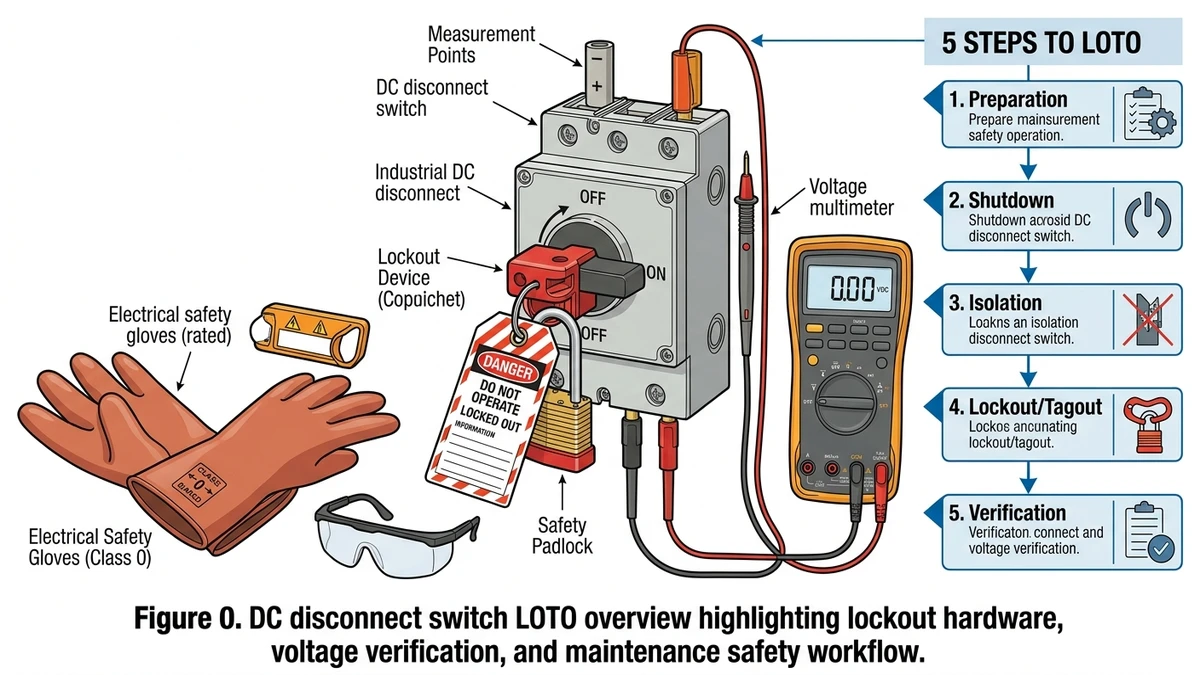
Before you can troubleshoot a failed disconnect or plan routine maintenance, you need to understand why DC isolation behaves differently from the AC lockout routines many technicians learned first.
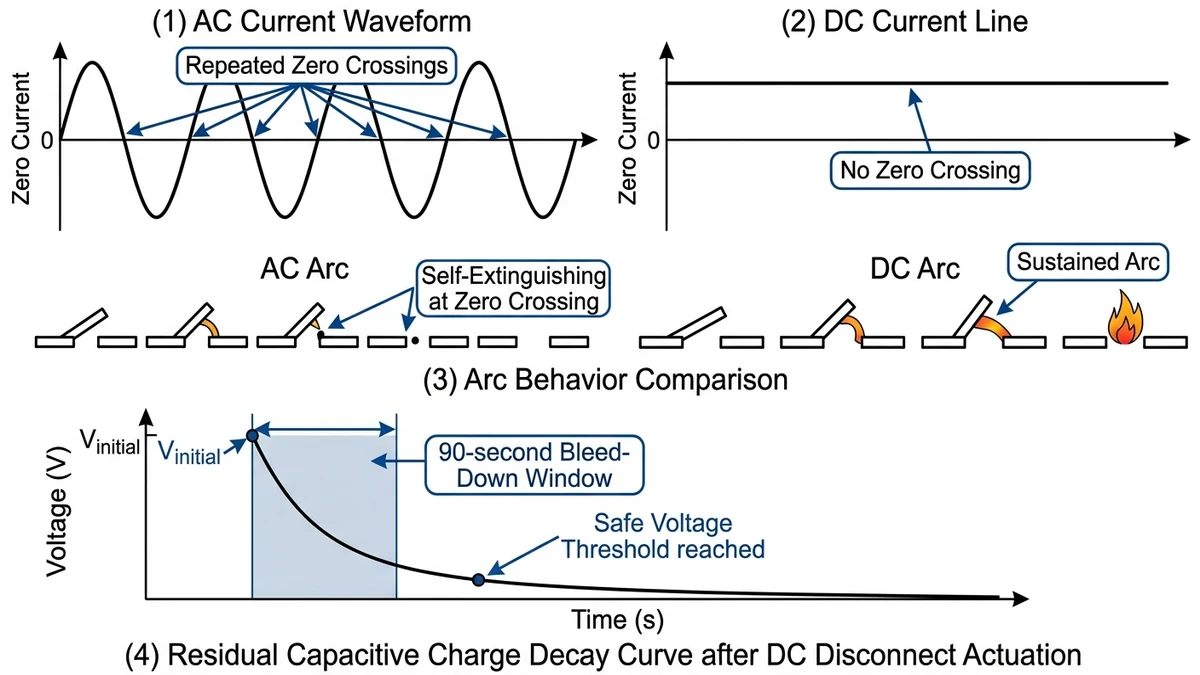
AC circuit protection benefits from current naturally passing through zero 100–120 times per second at 50–60 Hz, which helps arcs extinguish. DC has no such reset point. Once a DC arc is struck, it can continue until the circuit is mechanically interrupted or the stored energy is exhausted.
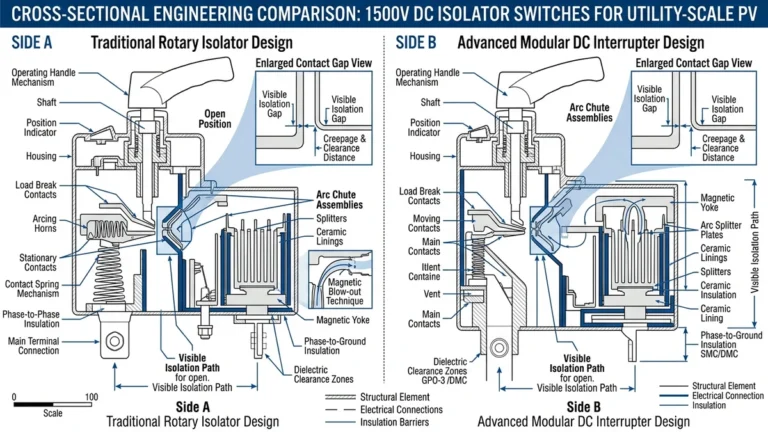
In practical terms, a sustained DC arc in a 1000 VDC PV string can exceed 5000°C. That is why a 直流開閉器 used in LOTO must be rated for true DC load breaking, not treated as interchangeable with an AC device of similar voltage.
DC systems also retain energy after the handle is turned off. Solar arrays, inverter input stages, and battery systems can leave hazardous residual voltage on conductors and busbars even after the disconnect opens.
In a 30 MW ground-mount installation in Gansu Province in 2023, maintenance crews recorded residual bus voltage above 200 VDC for up to 90 seconds after disconnect actuation. Opening the switch is only the start, and direct voltage measurement is what confirms the circuit is actually safe to touch.
NFPA 70E and IEC 60364-7-712 both recognize this distinction by requiring verification of de-energization through direct testing before contact with DC conductors. For a full hardware breakdown, the DC disconnect switch selection guide explains rating requirements across 600 V and 1000 VDC architectures.
Once the DC hazard profile is clear, the next step is making sure the technician and the lockout hardware are both matched to the voltage and fault energy on site.
| 電圧範囲 | Minimum Arc Flash PPE Category | Face Protection | Glove Rating | Clothing |
|---|---|---|---|---|
| ≤ 50 VDC | PPE Category 0 | Safety glasses | Class 00 (500V) | Non-melting long sleeves |
| 51–600 VDC | PPE Category 2 | Arc-rated face shield (8 cal/cm²) | Class 0 (1000V) | Arc-rated shirt + pants (8 cal/cm²) |
| 601–1000 VDC | PPE Category 3 | Arc-rated hood (25 cal/cm²) | Class 1 (7500V) | Arc-rated jacket + bib overalls |
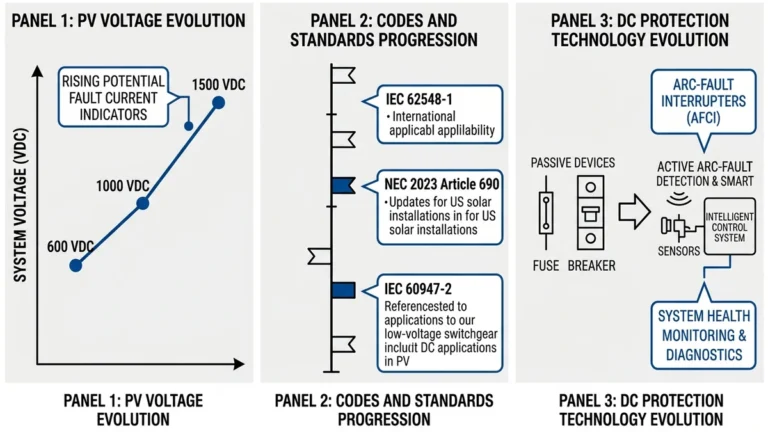
| 1001–1500 VDC | PPE Category 4 | Arc-rated hood (40 cal/cm²) | Class 2 (17,000V) | Full arc flash suit (40 cal/cm²) |
Most utility-scale PV systems at 1000–1500 VDC fall into Category 3 or 4. In a 60 MW ground-mount installation in Hebei Province in 2023, crews servicing 1500 VDC string combiner circuits were required to wear full 40 cal/cm² arc flash suits after an earlier incident involving an improperly labeled disconnect.
Not all lockout hardware is suitable for DC service. Verify each item before use:
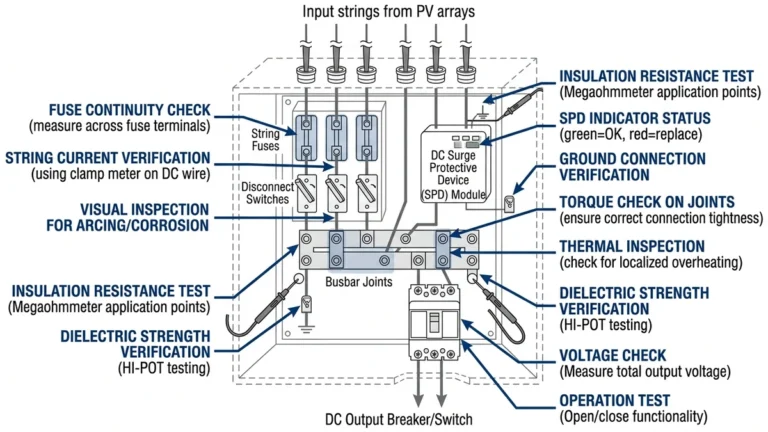
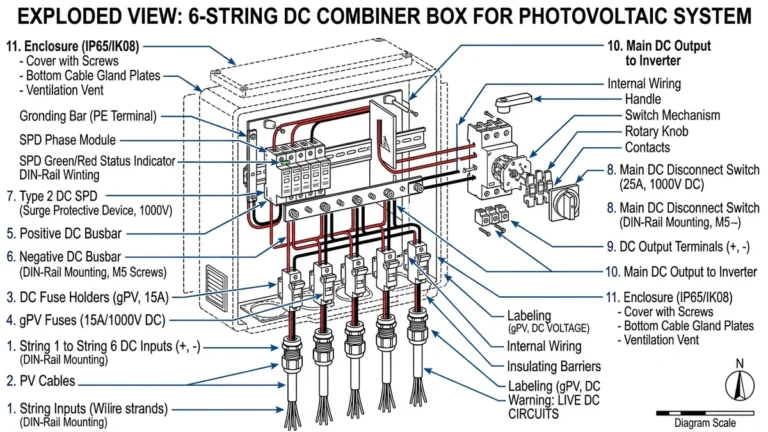
If the system uses gPVヒューズ for string-level overcurrent protection, make sure fuse holders are de-energized and isolated before any lockout device is applied. Pulling a fuse on a live 1000 VDC circuit is a severe arc flash exposure.
[Expert Insight]
– Keep one dedicated DC-only meter in the LOTO kit and verify its leads are rated for the site’s maximum open-circuit voltage.
– Replace faded outdoor tags before each maintenance season; UV-damaged tags are a common audit failure.
– On rooftop PV work, carry a spare lockout hasp because cramped enclosures often force a different locking orientation than planned.
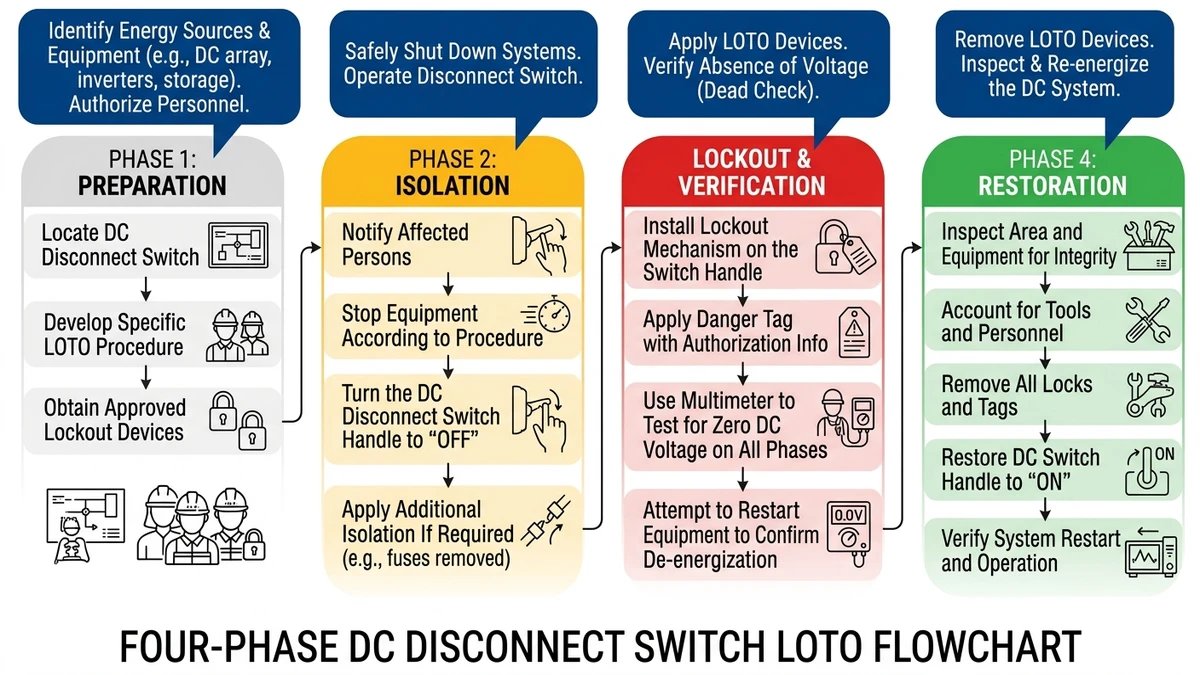
A DC disconnect switch LOTO procedure requires isolating all energy sources, verifying zero voltage, and applying physical lockout devices before maintenance starts. The following 15-step process aligns with OSHA 29 CFR 1910.147 for control of hazardous energy and is suitable for PV systems up to 1500 VDC.
In a 22 MW ground-mount installation in Hebei Province in 2024, crews using a structured LOTO workflow cut average isolation time from 18 minutes to under 6 minutes per string combiner while eliminating arc flash incidents over a 14-month cycle.
For site-specific code issues, the NEC 690.13 compliance checklist covers disconnect placement and marking rules that affect field execution.
Single disconnects are rarely the whole story in modern installations, so troubleshooting and maintenance planning must account for every path that can backfeed the work area.
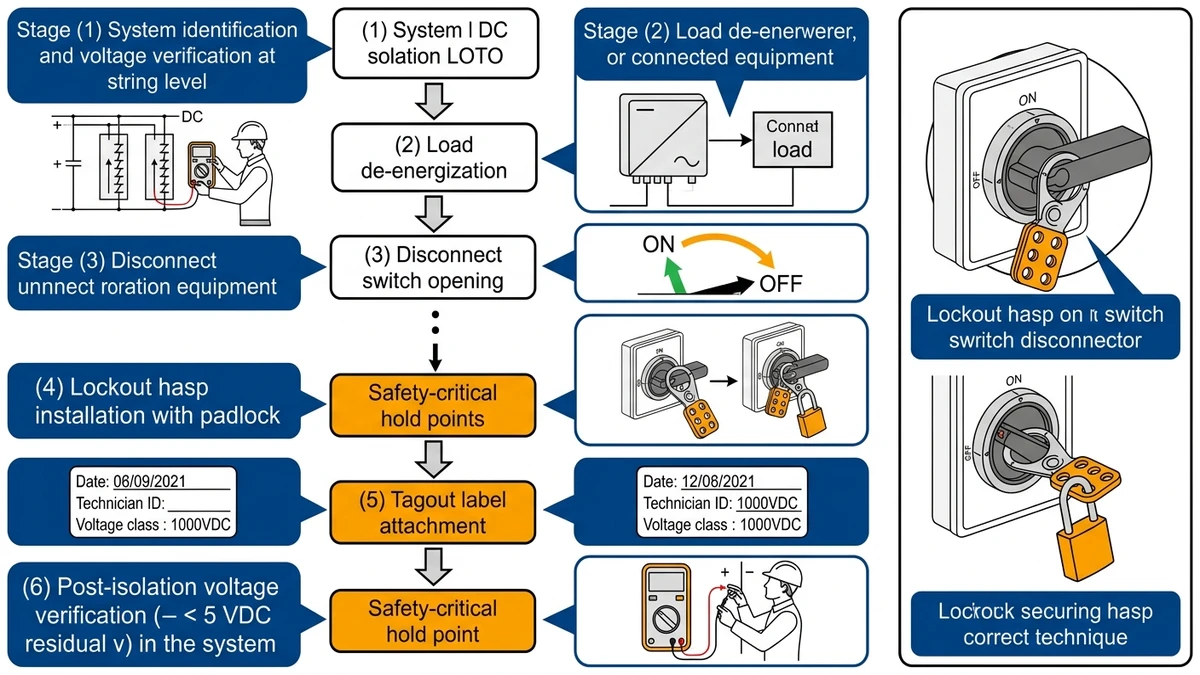
In large PV fields, opening only the inverter disconnect may leave dangerous voltage present at combiner or string terminals. At a 120 MW site in Inner Mongolia in 2023, crews found that skipping combiner-box isolation left 600–900 VDC at the work point even after the inverter DC disconnect was opened.
The safe sequence is to open the inverter DC disconnect, then isolate each string at the combiner box, then verify voltage at the string terminals drops to a safe level before applying locks and tags. Each lock point needs its own device and identification tag.
Battery ESS enclosures can both deliver and absorb current, which makes them more complex than a one-direction PV string. IEC 62619 governs safety requirements for stationary secondary lithium cells and supports isolation practices that address both charge and discharge paths.
For a 2 MWh ESS rack at 1000 VDC bus voltage, technicians must isolate the AC/DC converter, the battery management system contactor, and any parallel rack interconnects independently. Residual DC bus capacitor charge can keep voltage above 120 VDC for 30–90 seconds after contactor opening, so waiting and re-verifying is essential.
High-power DC fast chargers in the 150–350 kW range often share a common DC bus supplied by multiple rectifier modules. Isolating one charger cabinet does not necessarily de-energize the bus. Each rectifier feed must be individually locked out, and the DC switch disconnector at each rectifier input has to be confirmed open before downstream service begins.
[Expert Insight]
– On multi-inverter PV sites, mark temporary isolation boundaries on the one-line print before any handle is operated; this prevents missing a parallel feed.
– In ESS work, recheck the DC bus after any BMS reset or controller reboot, because contactors can re-close under remote logic.
– For DC fast chargers, verify whether the cabinet shares pre-charge circuitry with adjacent units; it can keep the bus energized after a local shutdown.
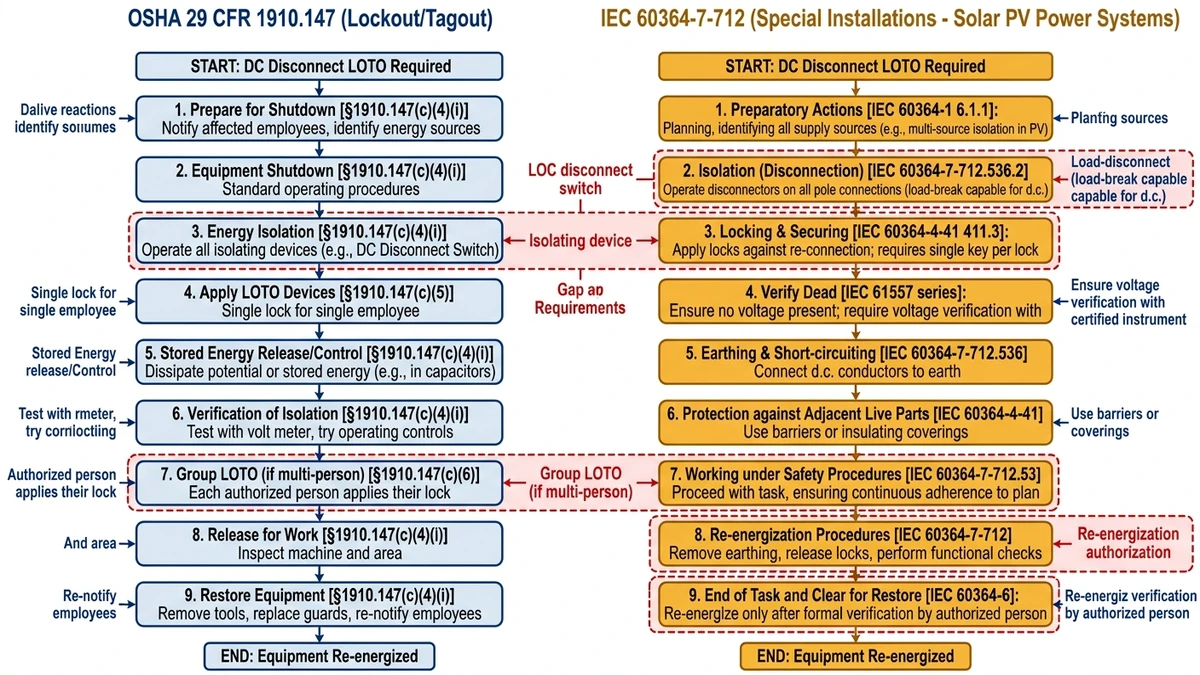
After the field sequence is defined, the procedure must also hold up under both U.S. and international safety frameworks.
A 2023 compliance review across 15 utility-scale PV sites in Zhejiang Province found that more than 60% of DC LOTO violations came from using AC-style checklists that ignored residual voltage hold-up after isolation.
| Requirement Area | OSHA 29 CFR 1910.147 | IEC 60364-7-712 | DC-Specific Gap |
|---|---|---|---|
| Voltage verification | Requires zero-energy state confirmation | Specifies ≤ 25 V safe threshold post-isolation | OSHA lacks a numeric voltage floor; IEC’s 25 V limit is actionable for DC systems |
| Capacitive discharge | Not explicitly addressed | Mandates discharge verification before contact | PV string capacitance can sustain hazardous voltage for 30–120 seconds |
| Lockout device rating | Requires “substantial” physical restraint | Specifies lockout hardware rated for DC arc interruption environments | OSHA is qualitative; IEC ties hardware to system voltage class |
| Multi-energy source control | Covers multiple energy sources generically | Requires isolation of each DC string circuit individually | Combiner box configurations with 16–24 strings need string-level documentation |
| Re-energization authorization | Single authorized employee sign-off | Requires documented verification at each isolation point | IEC demands point-by-point confirmation, not blanket sign-off |
| Periodic revalidation | Annual program review | Revalidation triggered by system modification | IEC’s event-driven model better suits expanding PV arrays |
The most common gap is residual voltage control. OSHA requires control of hazardous energy but does not state a numeric DC threshold after shutdown, while IEC 60364-7-712 requires verification that residual voltage has dropped below 25 VDC before contact.
Another frequent failure is device selection. A 直流開閉器 used as a LOTO point must be rated for the full DC system voltage under load, commonly 1000 VDC or 1500 VDC in modern PV systems. An AC-rated switch with a padlock hole does not satisfy the intent of DC isolation.
For teams working across jurisdictions, the practical approach is to use IEC’s numeric thresholds as the minimum technical benchmark and layer OSHA’s documentation and authorized-worker controls on top. The NEC 690.13 compliance checklist is a useful reference for applying those requirements in permitted PV installations.
Safe lockout depends heavily on the disconnect itself, so maintenance reliability starts with specifying equipment that can be safely isolated under real operating conditions.
Use this checklist when evaluating DC disconnects for maintenance environments:
At a 60 MW ground-mount site in Hebei Province in 2024, maintenance teams found several installed disconnects were isolator-grade only and lacked load-break ratings. Opening them under residual string current caused contact welding in three units and delayed LOTO work by more than four hours.
That problem can be avoided when procurement checks load-break performance to IEC 60947-3 rather than relying on enclosure appearance or handle style. For solar work, cross-check disconnect selection against the NEC 690.13 compliance checklist before installation. If you are sourcing for PV or ESS projects, Sinobreaker’s DC switch disconnector series includes 1000 V and 1500 V options with integrated padlock provisions and load-break ratings.
DC arcs do not naturally extinguish at a zero crossing, so they can persist longer and release more heat once initiated. Residual stored energy in PV and battery systems also increases post-shutdown risk.
There is no universal wait time because discharge depends on system capacitance and equipment design. Wait according to site procedure, then verify with a properly rated meter before touching conductors.
No. A padlockable handle does not mean the device can safely interrupt or isolate DC current at the system voltage.
Your site procedure and governing standard should define the acceptable threshold, but many teams use direct measurement to confirm the circuit is at or near zero and below the applicable safe-contact limit before work proceeds.
Yes. Any source that can backfeed the work zone must be individually isolated, verified, and locked out.
A frequent issue is skipping or rushing the voltage verification step after opening the disconnect. Another is treating one visible switch position as proof that all connected energy sources are isolated.
Use a calibrated CAT III or CAT IV meter with a DC voltage range that exceeds the site’s maximum open-circuit voltage. The leads and probes should be rated to the same level as the meter.