住所
304ノース・カーディナル
セント・ドーチェスター・センター(マサチューセッツ州02124
勤務時間
月曜日~金曜日:午前7時~午後7時
週末午前10時~午後5時
住所
304ノース・カーディナル
セント・ドーチェスター・センター(マサチューセッツ州02124
勤務時間
月曜日~金曜日:午前7時~午後7時
週末午前10時~午後5時


Understanding optimal DC SPD Connection Diagrams topologies enables effective surge protection system design for photovoltaic installations. This technical guide examines string-level versus combiner-level SPD placement strategies, multi-stage protection coordination principles, and system integration considerations that determine protection effectiveness. Engineers and system designers will find detailed connection diagrams, coordination analysis, and decision criteria for selecting appropriate SPD topologies.
The placement of surge protective devices within PV system architecture fundamentally affects both protection effectiveness and economic efficiency. Single SPD installations at inverter inputs provide minimal acceptable protection but leave upstream components vulnerable. Multi-stage SPD coordination with devices at string origins, combiner outputs, and inverter inputs delivers comprehensive protection through defense-in-depth approach.
IEC 62305 establishes lightning protection zone (LPZ) concept dividing installations into regions based on electromagnetic threat severity. Zone 0 represents unprotected external environment exposed to direct lightning strikes and full electromagnetic field intensity. Zone 1 encompasses protected building interior where direct strikes are prevented but induced surges penetrate through conductors entering from Zone 0. Subsequent inner zones (2, 3, etc.) provide progressively better protection through additional SPD stages.
Solar photovoltaic arrays typically install in LPZ 0A (unprotected exterior) making them highly vulnerable to both direct lightning strikes and induced electromagnetic transients. Conductors bringing DC power from arrays to inverters cross zone boundaries requiring SPD installation at each transition point. The zone boundary crossing from LPZ 0A (array) to LPZ 1 (building interior) represents critical protection point requiring robust Type 1 SPD capability.
Effective PV surge protection establishes multiple LPZ boundaries using coordinated SPD installations. First boundary occurs at array origin where conductors transition from exposed mounting structures to protected conduit systems. Second boundary appears at building penetration where external conductors enter interior electrical spaces. Final boundary installs immediately before sensitive inverter electronics creating last line of defense against transients bypassing upstream protection.
Multi-stage SPD systems divide surge energy handling across multiple devices rather than forcing single SPD to absorb entire threat. Upstream SPDs (typically Type 1 devices at array origins) intercept high-energy direct-strike components reducing surge amplitude before energy propagates to downstream equipment. Conductor impedance between SPD stages provides natural decoupling allowing each stage to operate independently without interference.
The conductor impedance between SPD stages—typically 10-50μH for 5-20 meter DC runs—creates voltage drop during surge events that prevents downstream SPDs from seeing full surge amplitude. This impedance allows upstream SPD to clamp surge voltage to protective level (e.g., 2000V) while downstream SPD sees only residual voltage after impedance drop (perhaps 1500V). Each stage contributes to overall voltage reduction creating cumulative protection greater than sum of individual SPD capabilities.
Proper coordination requires minimum 10 meter conductor separation between SPD stages or installation of decoupling inductors when physical separation is insufficient. Inadequate separation causes both SPDs to conduct simultaneously fighting each other for surge current control. This uncoordinated operation increases voltage stress on both devices potentially causing premature failure or allowing higher voltages at protected equipment than properly coordinated single-stage protection.
重要な洞察: SPD placement represents system engineering challenge requiring threat assessment, conductor routing analysis, and protection coordination—not simply installing maximum number of SPDs. Poorly coordinated SPD installations can actually worsen protection by creating voltage reflections, ground loops, or protective device coordination failures.
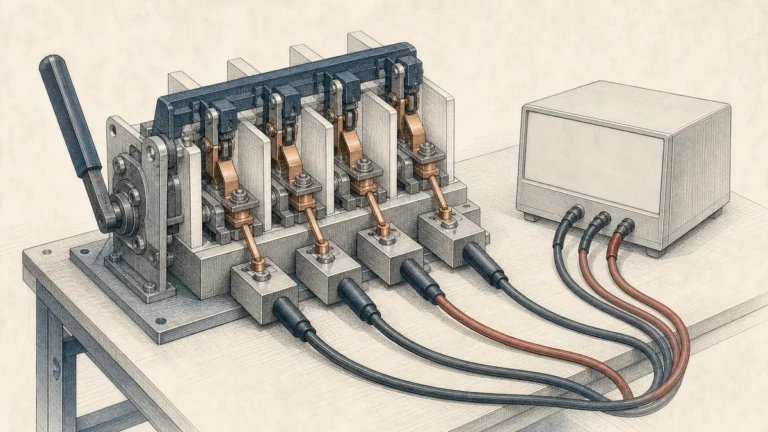
String-level SPD configuration installs dedicated surge protective device for each PV string at point where string conductors enter combiner box or protection enclosure. This topology provides independent protection for every string preventing surge energy coupling between strings through common busbars. Each string SPD connects between its string’s positive conductor, negative conductor, and equipment ground using three-terminal device or two separate single-phase SPDs.
The primary advantage of string-level protection stems from intercepting surges immediately at array origin before energy distributes onto parallel strings. Lightning strikes or induced transients affecting single string divert to ground through that string’s SPD without coupling onto other strings’ conductors. This isolation prevents single-string lightning event from damaging multiple strings or overwhelming downstream protection with combined energy from multiple paths.
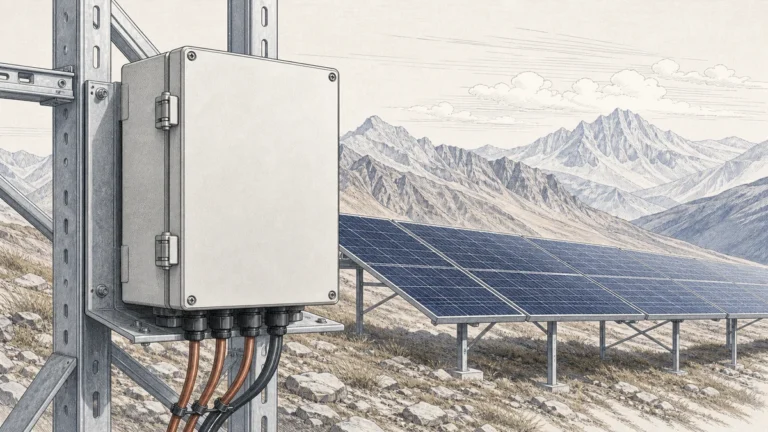
String-level SPDs typically mount on DIN rail inside combiner boxes positioned between string input terminals and string overcurrent protection (fuses or circuit breakers). This location provides ideal access to individual string conductors before they combine onto common busbars. Ground terminals connect to combiner box grounding busbar using shortest possible leads (≤300mm) minimizing ground path inductance critical for SPD effectiveness.
| String-Level SPD Characteristic | メリット | Design Consideration |
|---|---|---|
| Independent Protection | No surge coupling between strings | Requires SPD for each string (higher cost) |
| Early Interception | Diverts surges at point of entry | Combiner box must accommodate multiple SPDs |
| Failure Isolation | Single SPD failure affects only one string | Status monitoring requires checking multiple devices |
| 負荷分散 | Surge energy divides across devices | Lower per-device current rating acceptable |
String-level SPDs typically use Type 2 classification (8/20μs test waveform) with surge current ratings 10kA to 40kA per pole. Higher Type 1 ratings (10/350μs, 25kA+) provide enhanced protection for exposed installations but cost significantly more and may not be necessary when combined with downstream combiner SPD creating two-stage protection. Lightning current divides between multiple parallel strings reducing per-string energy to levels manageable by Type 2 devices.
Voltage rating selection for string SPDs must account for system maximum DC operating voltage plus appropriate safety margin. For 600V nominal systems, specify SPDs rated 1000V MCOV (maximum continuous operating voltage) minimum. For 1000V systems, use 1500V rated devices. Adequate voltage margin prevents SPD degradation from continuous voltage stress near rating limits that shortens service life.
Some installations use varistor-based string SPDs rated for expected maximum surge current rather than code-required minimums. Metal oxide varistors (MOVs) degrade gradually with each surge exposure—cumulative energy absorption eventually exhausts varistor capacity requiring replacement. Specifying surge current ratings 2-3× expected maximum provides service life margin allowing SPD to withstand multiple surge events before reaching end of life.
⚠️ 重要: String-level SPD installations require careful coordination with string overcurrent protection. SPD short-circuit failures must clear through string fuses or circuit breakers preventing cascading failures. Select string overcurrent devices rated to interrupt SPD short-circuit current (typically 10kA minimum) and install upstream of SPDs allowing protective isolation of failed devices.

Combiner-level SPD topology installs single higher-capacity surge protective device protecting combined output of all strings after they connect to common busbars. This configuration requires only one SPD regardless of string count reducing equipment cost and simplifying installation. The combiner SPD connects between positive busbar, negative busbar, and equipment ground at point just before combined DC output leaves enclosure toward inverter.
Combiner-level protection works most effectively in smaller residential systems (2-4 strings) where limited string count reduces surge energy coupling concerns between parallel strings. Single SPD at combiner output intercepts surges entering from utility grid, inverter backfeed, or induced transients in combiner-to-inverter wiring. For array-originated surges, busbar impedance provides limited isolation between strings—lightning affecting one string can couple onto others through common busbar connections.
The principal advantage of combiner-level SPD stems from protecting combined output circuit and all downstream equipment with single robust device. This topology works well for systems where array-originated direct strikes represent low probability threat (sheltered locations, urban areas with taller nearby structures providing shielding). Combiner SPDs typically specify higher surge current ratings than individual string SPDs since single device handles combined energy that would distribute across multiple string-level devices.
Combiner-level SPDs serving as sole protection point require Type 1 classification (10/350μs test waveform) with surge current ratings 25kA to 100kA per pole depending on lightning exposure assessment. Type 1 rating provides capability to withstand partial lightning current that may appear at combiner location through direct array strikes or conductor coupling. The higher energy capacity of Type 1 devices costs more than Type 2 but eliminates need for multiple string-level devices.
Maximum continuous operating voltage (MCOV) rating for combiner SPDs must exceed system maximum DC voltage under all conditions including temperature-compensated open-circuit voltage on coldest expected day. For systems with 600V nominal maximum power point voltage, string open-circuit voltage might reach 750V at -10°C requiring SPD MCOV rating ≥850V minimum. Inadequate voltage rating causes SPD degradation or premature failure from overvoltage stress.
Current rating selection considers worst-case scenario where all string currents combine during surge event. For 4-string combiner with 12A per string short-circuit current, combined array could deliver 48A continuous plus surge current contributions. While SPD steady-state current is minimal (leakage only), specified ratings should account for potential fault conditions where SPD might conduct for extended periods before upstream protection clears fault.
Combiner-level SPD installations require careful integration with system grounding architecture avoiding multiple parallel ground paths that create circulating currents. The combiner SPD ground terminal connects to enclosure grounding busbar which bonds to building grounding electrode system through single grounding electrode conductor (GEC). All string equipment grounding conductors also terminate on this same busbar creating single-point ground reference for entire DC system.
Avoid creating supplemental ground connections at array mounting structures or conduit runs that create parallel paths between array and building ground systems. Multiple ground connections allow lightning current to divide between paths creating circulating currents that induce voltages in conductors routing near ground paths. These induced voltages can exceed protected equipment ratings despite SPD presence because they result from magnetic coupling rather than conductive surge propagation.
When arrays span multiple roof sections or buildings, establish deliberate grounding architecture defining primary ground reference point. Array sections may require local supplemental grounding for mechanical bonding and personnel safety but these should integrate through controlled impedance paths preventing circulating currents during surge events. Consult lightning protection system designers for installations with complex grounding topologies.

Energy distribution between coordinated SPD stages depends on conductor impedance separating devices and surge current rise time characteristics. Fast-rising surge currents (sub-microsecond rise times from nearby lightning) encounter higher conductor impedance than slow-rising surges (tens of microseconds from distant induced transients). This frequency-dependent impedance affects how surge energy divides between upstream and downstream SPD stages.
Calculate approximate voltage division during surge events using conductor impedance and surge current di/dt. For 15-meter cable run between combiner and inverter (inductance ~25μH), 10kA surge with 1μs rise time creates voltage drop V = L(di/dt) = 25μH × (10,000A/1μs) = 250V across cable. This 250V drop reduces voltage appearing at downstream SPD by corresponding amount allowing use of lower-rated device.
The energy coordination concept: upstream SPD clamps surge to its protection level (e.g., 2000V for Type 1 device). Conductor impedance between stages subtracts from this voltage so downstream SPD sees clamping voltage minus impedance drop (2000V − 250V = 1750V in example). Downstream Type 2 SPD rated 1600V clamping activates handling residual energy while upstream device handles bulk energy. Both devices contribute to total protection without competing for surge current.
IEC 61643-12 specifies minimum separation distances between coordinated SPD stages ensuring adequate decoupling for independent operation. For systems with conductor separation, minimum distance depends on conductor inductance per meter (typically 1μH/m for typical DC cables) and required impedance for coordination. Standard recommendation specifies 10 meters minimum separation providing approximately 10μH decoupling inductance.
When physical separation of 10 meters is impractical, install discrete decoupling inductor between SPD stages artificially creating required impedance. Decoupling inductors rated 10-50μH with current capacity matching circuit ratings provide equivalent coordination to 10-50 meters conductor separation. These inductors must handle continuous system current plus short-duration surge currents without saturation degrading performance.
Installations violating minimum separation requirements risk coordination failure where both SPDs conduct simultaneously competing for surge current control. This uncoordinated operation creates voltage oscillations and current reflections potentially damaging both SPDs and allowing higher voltages at protected equipment than properly coordinated protection. When coordination requirements cannot be met, use single robust SPD at most critical location rather than poorly coordinated multi-stage installation.
| Separation Method | Typical Impedance | Coordination Effectiveness | 申し込み |
|---|---|---|---|
| 10m cable run | 10-15μH | Good for most surges | Standard coordination minimum |
| 20m cable run | 20-30μH | Excellent coordination | Preferred for high-exposure sites |
| 5m + 15μH inductor | 20μH total | Equivalent to 20m cable | Compact installations, rooftop systems |
| <5m no inductor | <5μH | Poor—coordination failure risk | Not recommended—use single SPD |
Coordinated SPD stages require appropriate voltage protection level (VPL) relationships ensuring upstream device activates before downstream device protecting it from excessive energy. Upstream SPD should specify lower VPL than downstream device creating voltage threshold hierarchy. When surge voltage exceeds upstream VPL, that device conducts limiting voltage that appears at downstream device input to value below downstream VPL.
For two-stage system using Type 1 upstream and Type 2 downstream SPDs, typical VPL relationship: upstream VPL 2000-2500V, downstream VPL 1500-1800V. While downstream device has lower VPL (activates at lower voltage), conductor impedance between stages ensures upstream device sees surge first and begins conducting before voltage rises to downstream activation threshold. The impedance voltage drop prevents both devices from conducting simultaneously.
Improper VPL selection—particularly specifying downstream VPL higher than upstream—risks coordination failure and potential downstream SPD overload. If downstream device activates before upstream, it handles surge energy that should be diverted by upstream protection. This inappropriate energy distribution may exceed downstream SPD rating causing premature failure while leaving upstream device unused.
🎯 プロのアドバイス: Test SPD coordination using portable surge generators simulating lightning waveforms at coordinated voltage levels. These tests verify proper upstream device activation before downstream device conducts and measure actual voltage appearing at protected equipment terminals. Testing proves coordination effectiveness before actual surge events occur identifying coordination deficiencies requiring correction.
Hybrid SPD topology combines string-level and combiner-level protection providing comprehensive defense-in-depth surge mitigation. This approach installs Type 2 SPDs at individual string inputs plus additional Type 1 SPD at combiner output creating two-stage coordinated protection. String SPDs intercept array-originated surges while combiner SPD protects against grid-side and induced transients affecting combined DC circuit.
The dual-layer protection justifies additional cost in high-exposure installations, critical facilities, or systems protecting expensive inverter equipment where surge damage would cause extended downtime. Commercial and utility-scale systems frequently specify hybrid protection given the substantial replacement costs for large inverters and revenue losses during equipment failure downtime exceeding equipment cost.
Coordination between string and combiner SPDs occurs naturally through busbar impedance separating devices. String SPDs connect at individual string conductor terminals while combiner SPD connects at busbar after all strings combine. Busbar impedance (typically 0.1-1μH depending on busbar length and construction) provides sufficient decoupling for independent SPD operation preventing surge current oscillation between protection stages.
Not all installations require full hybrid protection—selective application based on threat assessment optimizes protection investment. High-priority strings (those most exposed to lightning strike probability) receive string-level SPDs while less-exposed strings rely on combiner protection alone. This selective protection balances enhanced safety for vulnerable circuits with cost control for lower-risk portions.
Consider string-level SPDs for:
– Strings on highest roof sections or tallest structures receiving preferential lightning attachment
– Strings with longest conductor runs from array to combiner acting as larger surge collection antennas
– Strings in exposed areas without nearby taller structures providing lightning shielding
– Strings serving critical loads where downtime is unacceptable
Use combiner-level protection only for:
– Strings on lower roof levels or building sides with overhead lightning protection
– Strings with minimal conductor exposure routing through protected conduit immediately after leaving array
– Strings in urban areas with numerous taller nearby buildings providing statistical shielding
This risk-based approach concentrates protection investment where threat levels justify additional expense while maintaining baseline protection for entire system.
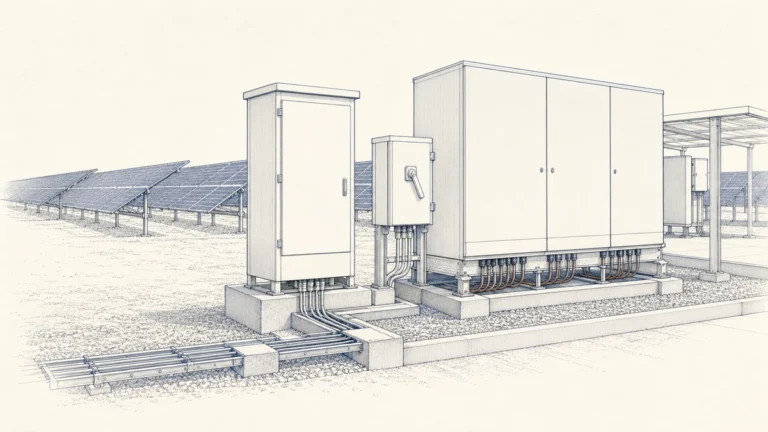
SPD installation requires adequate enclosure space accommodating devices, wiring, and maintaining required clearances. Each string-level SPD occupies approximately 20mm width on DIN rail—8-string combiner with string SPDs requires 160mm rail space minimum plus additional space for wiring channels and terminal blocks. Combiner-level SPD installations require less space (single device 40-60mm width) but typically use larger-capacity devices with correspondingly larger housing.
Plan enclosure selection during system design phase ensuring adequate space for intended SPD topology. Undersized enclosures force either eliminating planned SPD protection or installing SPDs in supplemental external enclosures adding cost and creating scattered equipment difficult to maintain. Include SPD space requirements in combiner box specifications avoiding field modifications to accommodate protection equipment.
Allow minimum 50mm clearance around SPD housing for heat dissipation and access to terminals. SPDs generate modest heat during normal operation (typically 2-5W per device) but substantially more during surge events requiring adequate ventilation. Maintain front-panel access to status indicators for visual inspection without opening enclosures reducing maintenance time and improving safety.
Strategic cable entry gland and grounding busbar positioning minimizes SPD ground lead length critical for effectiveness. Position grounding busbar on enclosure wall nearest cable entry point allowing short direct ground conductor routing. Avoid placing ground busbar on opposite wall from SPD mounting area requiring long ground leads crossing enclosure interior.
Use multiple grounding bushars in large enclosures when single busbar location cannot serve all SPDs with acceptable lead lengths. Secondary ground busbars bond to primary busbar and grounding electrode conductor using short heavy conductors (minimum 6 AWG) creating equipotential grounding plane throughout enclosure. This distributed ground system allows optimal SPD positioning without compromising ground lead length requirements.
Consider cable entry gland placement relative to expected conductor routing inside enclosure. Cables entering near bottom reduce electromagnetic coupling with horizontal conductors routing to upper-mounted SPDs. This vertical separation provides natural decoupling between incoming surge energy on cables and internal wiring to protected equipment.
SPD installation environments affect component reliability and service life requiring appropriate environmental ratings. Outdoor combiner boxes experience wide temperature ranges (−40°C to +70°C in many climates) demanding SPDs rated for extended temperature operation. Standard commercial SPDs typically rate for −25°C to +40°C inadequate for outdoor applications—specify industrial-grade devices rated for extended ranges.
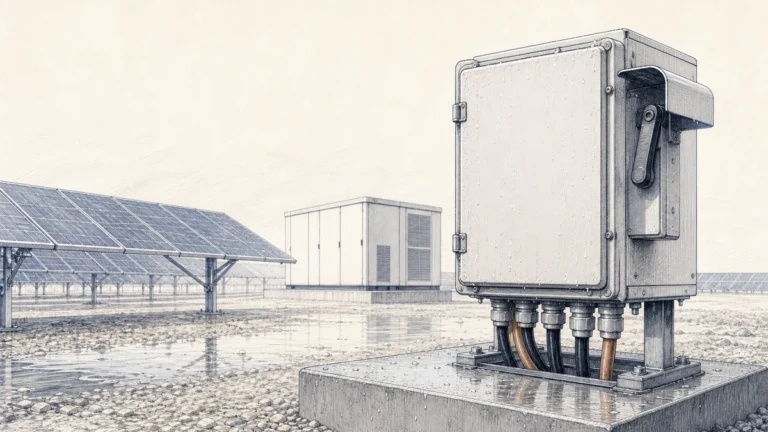
Humidity affects SPD reliability particularly in coastal environments where salt air accelerates corrosion of terminals and housing hardware. Specify SPDs with conformal-coated circuit boards and sealed terminal blocks preventing moisture ingress. NEMA 4X or IP66 rated enclosures provide adequate environmental protection for most outdoor applications but SPD internal construction also requires moisture resistance surviving condensation inevitable in sealed enclosures experiencing temperature cycling.
Altitude affects SPD voltage ratings through reduced dielectric strength of thin air at high elevations. SPDs installed above 2000 meters (6600 feet) elevation require derating or higher voltage ratings compensating for reduced flashover voltages. Consult manufacturer altitude derating curves when specifying SPDs for mountain installations or high-plateau locations.
SPD protection investment should scale with protected equipment value and lightning exposure probability. Residential 5kW systems with $6,000 inverter replacement cost may justify $300-500 SPD protection investment (5-8% of equipment value). Commercial 100kW systems protecting $50,000 inverters warrant $2,000-3,000 comprehensive protection investment (4-6% of equipment value) including string-level and combiner coordination.
Calculate total SPD system cost including devices, installation labor, enclosure modifications, and periodic testing/replacement:
Single Combiner SPD Strategy:
– Device cost: $200-800 (Type 1, 50kA rating)
– Installation labor: 2 hours @ $75/hour = $150
– Enclosure modification: Minimal, existing space adequate
- Total initial cost: $350-950
String-Level SPD Strategy (6 strings):
– Device cost: 6 × $120 = $720 (Type 2, 20kA each)
– Installation labor: 4 hours @ $75/hour = $300
– Enclosure upgrade: Larger combiner box +$400
- Total initial cost: $1,420
Hybrid Strategy (string + combiner):
– String devices: 6 × $120 = $720
– Combiner device: $500 (Type 1, 100kA)
– Installation labor: 5 hours @ $75/hour = $375
– Enclosure upgrade: +$400
- Total initial cost: $1,995
Many insurance policies reduce premiums 5-15% for commercial PV systems documenting comprehensive surge protection meeting or exceeding code minimums. Annual premium savings $500-2,000 on large systems can offset SPD investment within 2-4 years. Request insurer review of protection plans before finalizing SPD topology ensuring compliance with their specific surge protection requirements.
Equipment warranties often require “adequate lightning protection” without defining specific requirements. Manufacturer warranty claims for lightning damage may be denied if investigation reveals protection inadequacies. Document SPD specifications, installation details, and maintenance records proving reasonable protection measures preserving warranty coverage for actual equipment defects vs. inadequate protection.
Consider extended warranties and protection guarantees offered by some SPD manufacturers covering protected equipment replacement costs when damage occurs despite properly installed SPD protection. These warranties typically cost 10-30% of SPD price but provide financial protection against protection system failures or extreme events exceeding SPD ratings.
Total cost of ownership includes initial purchase, installation, ongoing inspection, and periodic replacement over 25-year system lifetime. String-level SPDs require more frequent inspection (7× more devices to check) and higher probability of failures requiring replacement during system lifetime. Combiner SPDs offer lower maintenance burden but single-device failure eliminates all protection until replacement.
25-Year Lifecycle Cost Example (6-string commercial system):
Combiner-only strategy:
– Initial: $950
– Inspections: 100 visits × $50 = $5,000
– Replacements: 2 devices @ $800 = $1,600
- Total lifecycle: $7,550
String-level strategy:
– Initial: $1,420
– Inspections: 100 visits × $75 = $7,500 (checking 6 devices)
– Replacements: 8 devices @ $120 = $960
- Total lifecycle: $9,880
Hybrid strategy:
– Initial: $1,995
– Inspections: 100 visits × $85 = $8,500
– Replacements: 8 string + 2 combiner = $1,960
– Lightning damage avoided: −$8,000 (1 prevented inverter replacement)
- Total lifecycle: $4,455 (with avoided damage)
Optimal SPD placement depends on system size, lightning exposure, and equipment value. Small residential systems (2-4 strings) in moderate-exposure areas typically need only combiner-level Type 1 SPD providing adequate protection at reasonable cost. Larger commercial systems (6+ strings) benefit from string-level Type 2 SPDs plus combiner Type 1 device creating two-stage coordinated protection.
High-exposure installations (mountaintop arrays, coastal locations, areas with frequent thunderstorms) justify investment in comprehensive string-plus-combiner protection regardless of system size. The enhanced protection prevents costly inverter damage and extended downtime offsetting higher initial SPD investment. Lightning damage to unprotected or inadequately protected systems often costs 10-20× more than comprehensive protection investment.
Conduct formal lightning risk assessment per IEC 62305-2 calculating expected annual frequency of dangerous events and potential loss values. When calculated risk exceeds acceptable threshold (typically >10% probability of damaging event over 25-year system life), specify enhanced protection moving from combiner-only to string-level or hybrid topology.
IEC 61643-12 recommends minimum 10-meter conductor separation between coordinated SPD stages providing approximately 10μH decoupling inductance. This separation ensures upstream SPD activates before downstream device preventing coordination failures where both devices conduct simultaneously. Longer separation (15-20 meters) improves coordination reliability particularly for fast-rising surges with sub-microsecond rise times.
When physical separation of 10 meters is impractical—common in compact rooftop installations where combiner box mounts immediately adjacent to inverter—install discrete decoupling inductor artificially creating required impedance. Inductors rated 10-20μH with current capacity matching circuit ratings (typically 60-100A for commercial systems) provide equivalent coordination to 10-20 meter cable runs.
Installations with less than 5 meters separation and no decoupling inductor risk coordination failure requiring use of single robust SPD at most critical location rather than poorly coordinated multi-stage system. Poor coordination can actually worsen protection compared to properly selected single-stage SPD by creating voltage oscillations and reflection phenomena.
Adding string-level SPDs to existing combiner-SPD-only system creates two-stage coordinated protection enhancing overall system protection. This upgrade makes sense for installations experiencing frequent surge events, systems protecting high-value inverters, or installations where lightning exposure was underestimated during initial design. Verify adequate combiner box space for additional string SPDs before beginning upgrade project.
Consider coordination requirements when adding upstream string SPDs to existing downstream combiner SPD. The existing combiner SPD becomes second protection stage requiring coordination with new string devices. Verify existing combiner SPD voltage protection level (VPL) exceeds string SPD VPL by appropriate margin (typically 300-500V) ensuring proper coordination hierarchy.
Upgrading protection requires system shutdown for safe installation. Schedule upgrade during planned maintenance outage minimizing lost production time. Test all SPDs after installation verifying status indicators, connections, and coordination using portable surge generator if available proving protection effectiveness before returning system to service.
Coordinated SPD stages require appropriate capability hierarchy: upstream devices specify higher surge current ratings than downstream devices reflecting their role handling bulk surge energy. For two-stage system, typical coordination: upstream Type 1 SPD rated 50-100kA (10/350μs), downstream Type 2 SPD rated 20-40kA (8/20μs). The different test waveforms (10/350 vs 8/20) reflect different expected threat characteristics.
Voltage protection levels (VPL) should create threshold relationship where upstream device activates before downstream device sees excessive voltage. However, conductor impedance between stages naturally separates activation thresholds—upstream device sees surge first and begins conducting before voltage rises sufficiently at downstream location. Typical VPL relationship: upstream 2000-2500V, downstream 1500-1800V.
Maximum continuous operating voltage (MCOV) ratings for all SPD stages must exceed system maximum DC voltage with adequate margin. Both upstream and downstream devices see full system operating voltage during normal conditions requiring identical MCOV specifications. For 600V systems, specify ≥850V MCOV; for 1000V systems, specify ≥1300V MCOV accounting for temperature-compensated open-circuit voltage extremes.
Bipolar PV systems using center-tapped ground reference require specialized SPD topology protecting both positive-to-ground and negative-to-ground separately. Standard three-terminal SPDs work for bipolar systems installing SPD at center point with line terminals connecting to positive and negative conductors. Alternatively, use two separate single-phase SPDs—one protecting positive-to-ground, second protecting negative-to-ground.
The two-SPD approach offers redundancy advantage where single SPD failure leaves one polarity protected while other requires replacement. Three-terminal SPDs provide more compact installation and simplified wiring but single device failure removes all protection until replacement. Consider redundancy requirements and maintenance access when selecting bipolar protection topology.
Some bipolar systems specify Type 1 SPD from positive to ground plus Type 2 SPD from negative to ground (or vice versa) when threat assessment indicates asymmetric exposure. Positive conductor routing near metallic structures might collect more induced surge energy than negative conductor justifying higher positive-side protection rating. Analyze specific installation geometry determining whether symmetric or asymmetric protection is appropriate.
NEC 690.35 requires surge protective devices without specifying particular connection topology—string-level, combiner-level, or hybrid all satisfy code requirements if SPDs meet rating requirements and install at code-specified locations. The code requires SPDs “at the DC source or DC output circuits” allowing flexibility in placement strategy. Engineer selects topology based on threat assessment and protection objectives rather than code mandate.
Regardless of topology selected, installation must comply with conductor sizing (690.35(A)), disconnect means (690.35(C)), and overcurrent protection (690.35(D)) requirements. All SPD conductors require proper sizing per Article 250, appropriate disconnecting means for maintenance access, and overcurrent protection preventing uncontrolled failures. These requirements apply equally to single combiner SPD or multiple string-level SPDs.
Local authorities having jurisdiction (AHJ) may impose requirements beyond NEC minimums mandating specific SPD placement locations or minimum ratings. Review local amendments to NEC and utility interconnection standards before finalizing protection design ensuring compliance with all applicable requirements. Document protection design rationale and calculations proving adequate protection for insurance and warranty purposes.
Multi-stage SPD systems require quarterly visual inspection of status indicators at all protection stages checking for failure indications (red or dark status lights). This inspection frequency catches failures before they compromise protection while avoiding excessive maintenance burden. Document all inspections in maintenance log recording device status, inspection date, and any anomalies noted.
More comprehensive electrical testing should occur annually measuring SPD voltage protection level (VPL), leakage current, and coordination timing between stages. These tests verify protection degradation from cumulative surge exposure hasn’t diminished effectiveness below acceptable thresholds. Replace any SPDs showing VPL degradation >10% from initial rating or increased leakage current suggesting component degradation.
After major thunderstorm events passing within 5km of installation, perform special inspection checking all SPD status indicators and looking for signs of surge activation (indicators may show temporary activation then reset). Storms causing widespread electrical disturbances in area likely delivered surges to SPD system requiring verification all devices survived without damage. Proactive post-storm inspection catches surge-weakened SPDs before subsequent events cause complete failures.
Optimal DC SPD connection topology selection requires balancing protection effectiveness, cost, and system-specific threat assessment. String-level protection provides maximum surge isolation and early interception justifying investment in high-exposure installations. Combiner-level topology delivers adequate protection for moderate-threat scenarios at lower cost with simpler installation. Hybrid string-plus-combiner approaches create defense-in-depth protection for critical high-value systems where surge damage consequences justify comprehensive protection investment.
重要なポイント
1. Multi-stage SPD coordination requires minimum 10-meter conductor separation or equivalent decoupling inductance for independent operation
2. String-level SPDs provide superior isolation preventing surge coupling between parallel strings through common busbars
3. Combiner-level SPDs offer economical protection for smaller systems with moderate lightning exposure
4. Voltage protection level (VPL) hierarchy ensures upstream SPDs activate before downstream devices in coordinated systems
5. Hybrid topology combining string and combiner protection delivers optimal defense-in-depth for high-exposure and high-value installations
Understanding these connection strategies and coordination principles enables engineers to design surge protection systems optimized for specific installation requirements rather than applying generic one-size-fits-all approaches. Proper SPD topology selection combined with correct installation practices delivers reliable protection throughout 25-year system operational lifetime.
関連リソース
- How to Wire DC SPD: Installation Procedures and Grounding
- ソーラーシステム用DC SPD:タイプ1とタイプ2のアプリケーション
- PV Combiner Box Components and Protection Integration
Ready to design optimized SPD connection topology for your solar installations? Contact our protection engineering team for lightning risk assessment, multi-stage coordination analysis, and custom SPD topology recommendations based on your specific site conditions and equipment protection requirements.
最終更新日 NOVEMBER 2025
著者 SYNODEテクニカルチーム
レビュー 雷保護エンジニアリング部