Adresse
304 Nord Kardinal
St. Dorchester Center, MA 02124
Arbeitszeiten
Montag bis Freitag: 7AM - 7PM
Am Wochenende: 10AM - 5PM
Adresse
304 Nord Kardinal
St. Dorchester Center, MA 02124
Arbeitszeiten
Montag bis Freitag: 7AM - 7PM
Am Wochenende: 10AM - 5PM

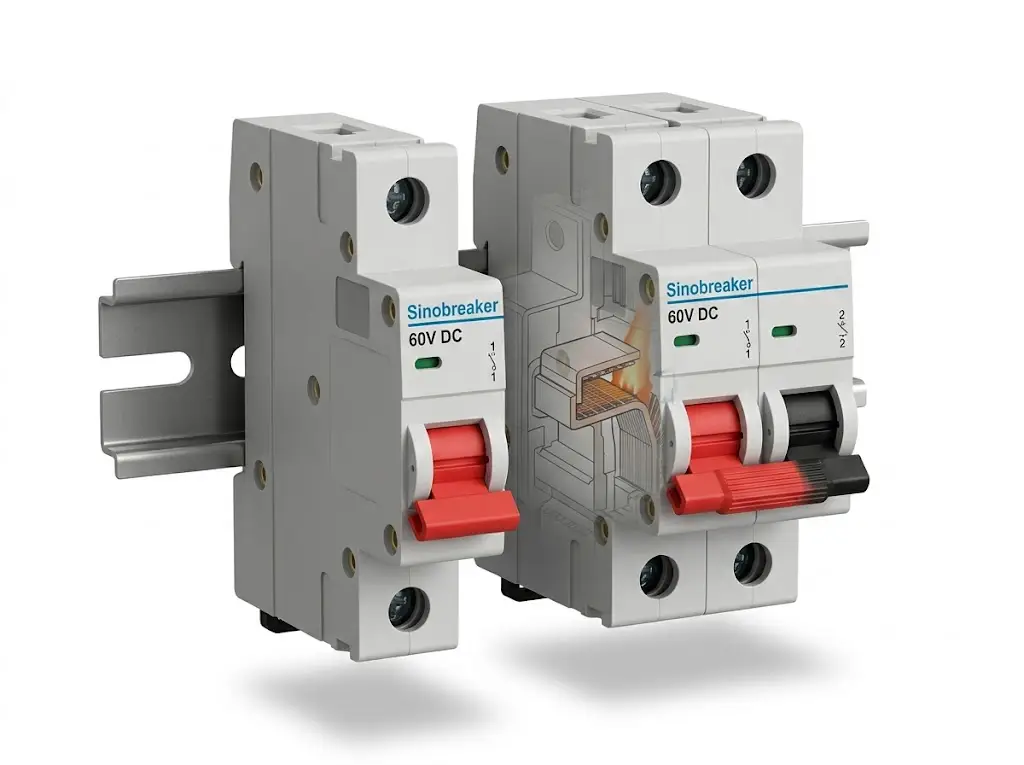
A 48V DC circuit breaker serves as the primary overcurrent protection device in telecom power systems and data center distribution networks, interrupting fault currents without the natural zero-crossing advantage that AC systems provide. Unlike AC circuits where current crosses zero 100–120 times per second, DC fault currents maintain continuous flow, generating sustained arcs that standard AC breakers cannot reliably extinguish.
In a 2023 retrofit project across 12 telecom base stations in Guangdong Province, upgrading from 32A fuses to properly rated 48V DC MCBs reduced mean time to restore service from 3.2 hours to 18 minutes per fault event. That performance gap illustrates why breaker selection matters in mission-critical environments.
Per IEC 60947-2 Annex H, a DC-rated breaker must demonstrate breaking capacity at its rated DC voltage with arc energy fully contained within the enclosure. For 48V nominal systems—which can reach 57.6V float voltage in telecom rectifier configurations—breakers must handle this elevated voltage while maintaining rated interrupting capacity, typically 6 kA to 10 kA for distribution-level devices.
The physics are straightforward. When contacts separate under fault conditions, an arc forms across the gap. At 48V nominal (typically 42–60V operating range), arc voltage must exceed system voltage to force current extinction. The arc generates temperatures reaching 3000–5000°C at the contact surface. Lower voltage means the arc sustains more easily, demanding aggressive interruption mechanisms that AC breakers simply lack.
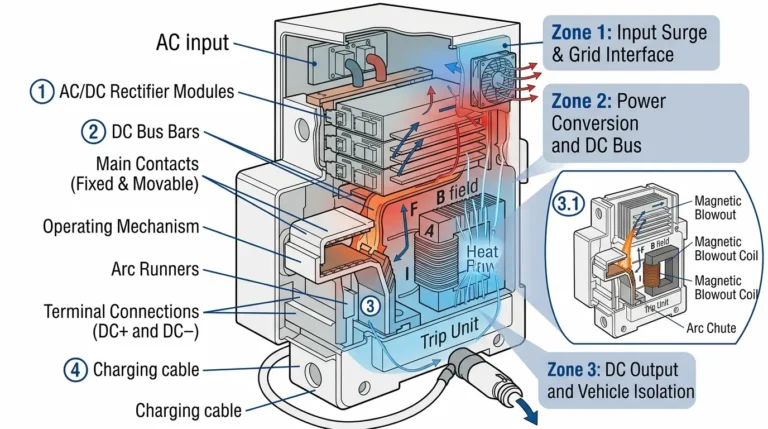
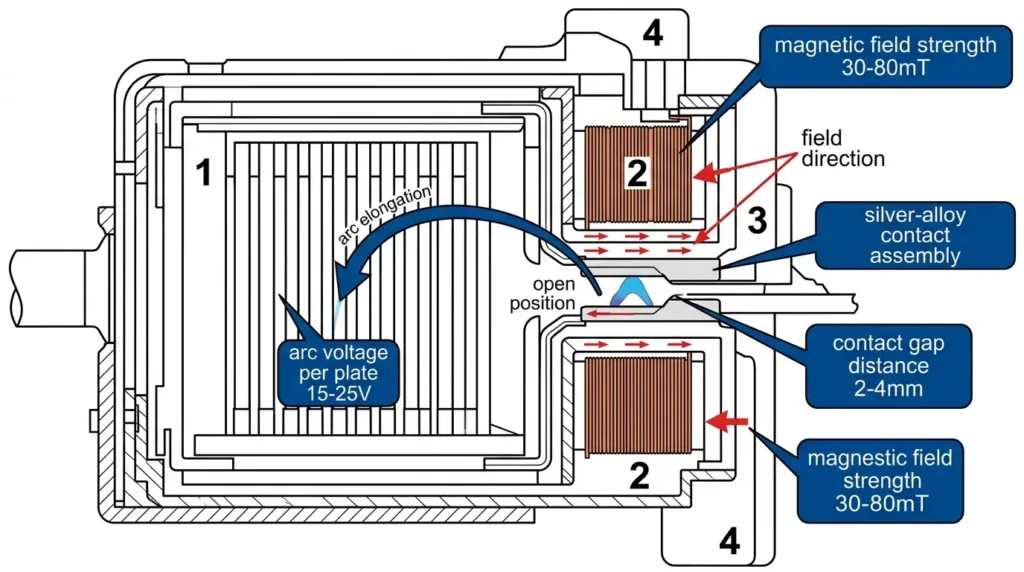
Modern 48V DC breakers employ magnetic blowout coils generating 30–80 mT field strength to deflect the arc into segmented arc chutes. Each steel or ceramic plate in the chute stack forces the arc to re-strike across multiple gaps, multiplying arc voltage drops. A typical design uses 8–12 arc chute plates, collectively raising arc voltage to 80–120V—well above the 48V system voltage—ensuring reliable extinction within 5–15 milliseconds for faults up to 10 kA.
[Experteneinblick: DC-Bogenunterbrechung]
- Contact separation speed in quality breakers: 1.5–3.0 m/s
- Each splitter plate adds approximately 15–25V of arc voltage
- Ceramic-filled arc chutes reduce arc duration from 15–20 ms to 8–12 ms versus polymer alternatives
- Silver-tungsten (AgW) contacts withstand 4000+ operations at rated current before replacement
Selecting the correct 48V DC circuit breaker requires matching three interdependent parameters: rated voltage (Ue), rated current (In), and rated short-circuit breaking capacity (Icu).
Telecom applications following ETSI EN 300 132-2 standards operate at -48V DC (positive ground), requiring breakers with polarity-sensitive arc chute designs. Data center 48V bus architectures demand breakers rated for bidirectional current flow to accommodate battery charge/discharge cycles reaching 200A continuous per string.
Telecom branch circuits typically range from 10A to 100A per circuit. Data center rack feeds often require 63A to 125A ratings. Always account for continuous duty—breakers should operate at no more than 80% of rated current for sustained loads in enclosed panels where heat dissipation is limited.
The breaking capacity must exceed the prospective fault current at the installation point. A typical telecom power distribution unit fed by 100 Ah battery banks can deliver 8–12 kA prospective fault current within the first 5 milliseconds. Data center bus bar distribution systems can exceed 15 kA. Select breakers with Icu ratings of at least 10 kA at 60V DC for telecom applications; 20 kA or higher for data center busway installations per IEC 60947-2 industrial standards.
Trip characteristics determine response to different fault types:
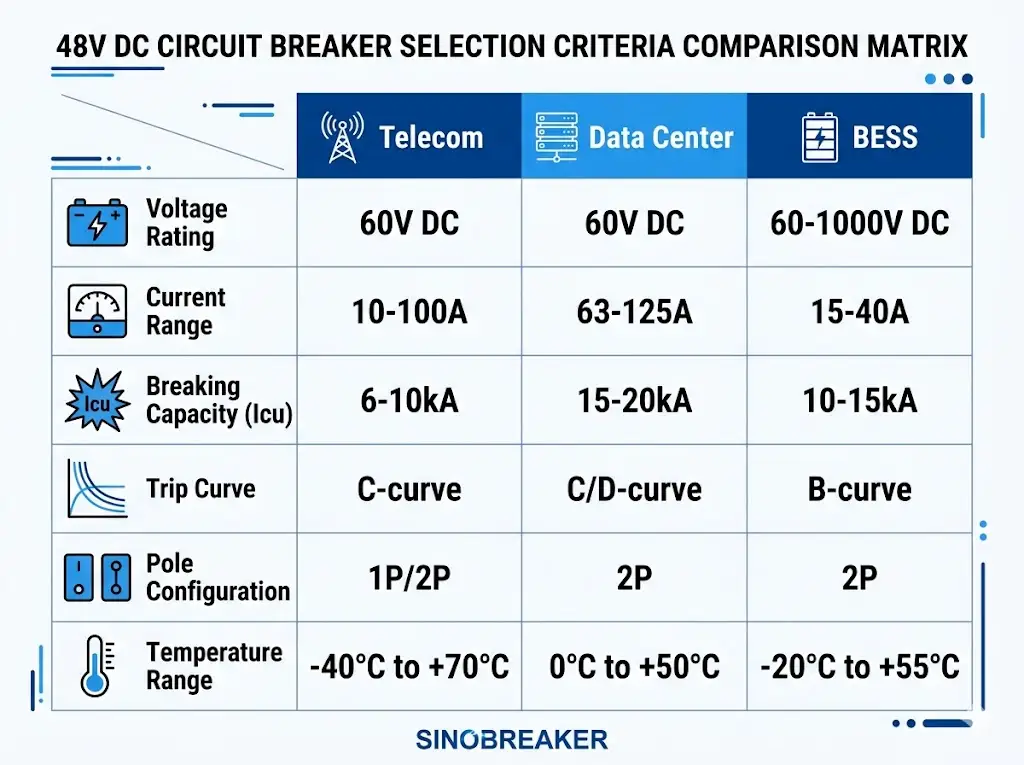
Outdoor telecom cabinets require breakers rated for -40°C to +70°C ambient conditions. The critical selection parameter is DC-rated breaking capacity—typically 6 kA to 10 kA per IEC 60898-2 requirements for equipment protection. Negative ground polarity (-48V DC) is standard; verify breaker arc chute orientation matches installation polarity.
Hyperscale facilities adopting Open Compute Project architectures increasingly deploy 48V DC distribution to eliminate AC-DC conversion losses. The selection priority shifts toward current-limiting capability: breakers that limit let-through energy (I²t) protect downstream busbars and battery connections from thermal damage during bolted faults.
During a 2023 retrofit of a Tier III data center in Frankfurt (480 server racks), upgrading from 32A to 63A DC-MCBs with 10 kA breaking capacity reduced nuisance trips by 78% during peak load transients while maintaining fault clearance under 8 ms.
For 48V BESS installations, the DC circuit breaker must handle bidirectional current flow during charge/discharge cycles. String-level protection typically requires 15A to 40A ratings with B-curve characteristics. The critical difference from telecom: BESS breakers must interrupt fault currents from both grid-side and battery-side sources simultaneously.
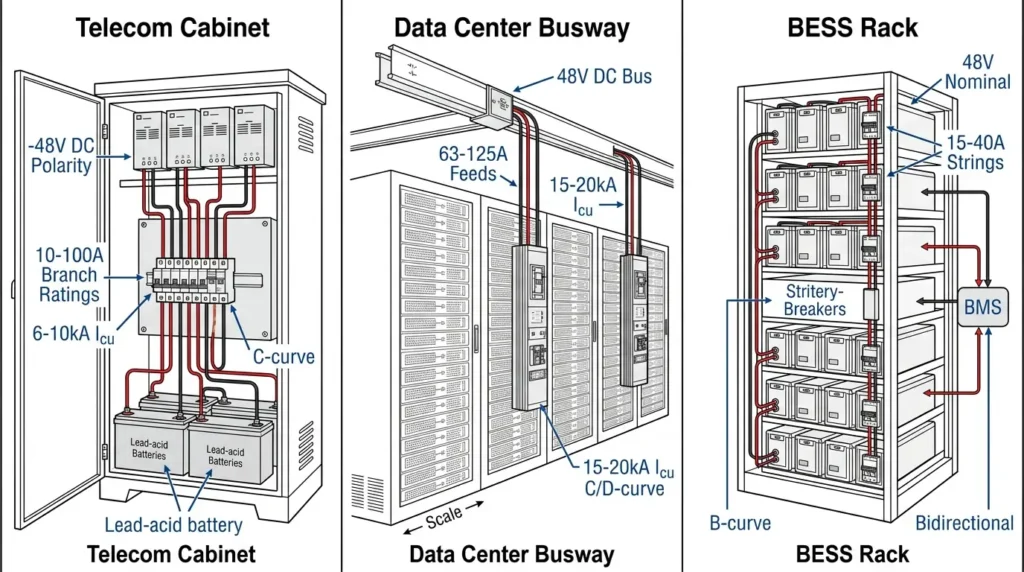
[Expert Insight: Application Selection Quick Reference]
- Telecom: C-curve, 6–10 kA Icu, -40°C to +70°C rating, polarity-sensitive
- Data center: C-curve or D-curve, 15–20 kA Icu, current-limiting preferred
- BESS: B-curve, bidirectional rated, coordinate with battery management system
- All applications: verify DC voltage rating on nameplate—AC ratings do not apply
Proper coordination ensures selective tripping—the breaker nearest the fault opens first, minimizing system disruption. In 48V DC systems with multiple protection levels, time-current curve analysis prevents both nuisance trips and protection blind spots.
Main distribution breakers should have higher current ratings and slower trip characteristics than branch breakers. A 125A main with D-curve characteristics coordinates properly with 32A branch breakers using C-curve characteristics, providing at least 0.1 second separation at maximum fault current.
Many telecom installations use DC-Sicherungen at battery terminals with downstream breakers for branch protection. The fuse I²t let-through must exceed the breaker’s I²t withstand rating to ensure the breaker trips before the fuse blows for branch faults, while the fuse clears battery-side faults that exceed breaker capacity.
Modern lithium battery systems include internal protection that must coordinate with external breakers. The BMS typically responds within 10–50 ms to cell-level faults. External breakers provide backup protection and maintenance isolation—select trip times that allow BMS response for minor faults while ensuring breaker intervention for sustained overcurrents.
DIN rail mounting (35 mm) is standard for DC distribution panels in both telecom and data center applications. Torque terminal connections to manufacturer specifications—typically 2.0–2.5 Nm for 10–32A breakers, 2.5–3.5 Nm for 40–125A units. Under-torqued connections cause resistive heating; over-torqued connections damage terminals and reduce contact reliability.
Ambient temperature significantly affects breaker performance. At 50°C ambient (common in enclosed telecom cabinets), derate current capacity by 15–20%. At altitudes above 2000 m, derate breaking capacity by 1% per 100 m due to reduced air density affecting arc extinction.
DC systems require clear polarity marking. Standard convention: red for positive, blue or black for negative, green/yellow for protective earth. Label each breaker with circuit identification and rated current. For -48V telecom systems, clearly mark the positive ground configuration to prevent installation errors.
Five errors account for most 48V DC breaker failures in the field:
Sinobreaker's DC-Schutzschalter portfolio addresses the full range of telecom and data center requirements. The DC MCB series offers ratings from 1A to 125A with breaking capacities up to 10 kA at 60V DC, suitable for branch circuit protection in both applications.
Key specifications for 48V applications:
For project-specific selection assistance, contact Sinobreaker’s technical team with your system voltage, maximum fault current, ambient temperature range, and coordination requirements.
No. AC breakers rely on current zero crossings to extinguish arcs, which do not occur in DC circuits. Using an AC breaker on DC can result in sustained arcing, fire, or explosion during fault conditions regardless of voltage rating.
Most telecom installations require 6–10 kA breaking capacity at 60V DC. Calculate prospective fault current based on battery bank capacity—a 100 Ah lead-acid bank typically delivers 8–12 kA; lithium banks may exceed 15 kA.
Breakers in enclosed cabinets at 50°C ambient should be derated 15–20% from nameplate current rating. A 63A breaker effectively provides 50–54A continuous capacity at elevated temperatures.
B-curve breakers trip magnetically at 3–5× rated current, providing faster response for resistive loads and battery circuits. C-curve breakers trip at 5–10× rated current, better accommodating inrush from rectifiers and power supplies.
Single-pole breakers suffice for branch circuits where only the ungrounded conductor requires interruption. Use 2-pole breakers for battery disconnects, maintenance isolation points, and any circuit requiring simultaneous interruption of both conductors.
The fuse I²t let-through value must exceed the downstream breaker’s I²t withstand rating. This ensures branch faults trip the breaker while faults exceeding breaker capacity clear through the fuse without damaging the breaker.