Adresse
304 North Cardinal
St. Dorchester Center, MA 02124
Heures de travail
Du lundi au vendredi : de 7h00 à 19h00
Le week-end : 10H00 - 17H00
Adresse
304 North Cardinal
St. Dorchester Center, MA 02124
Heures de travail
Du lundi au vendredi : de 7h00 à 19h00
Le week-end : 10H00 - 17H00

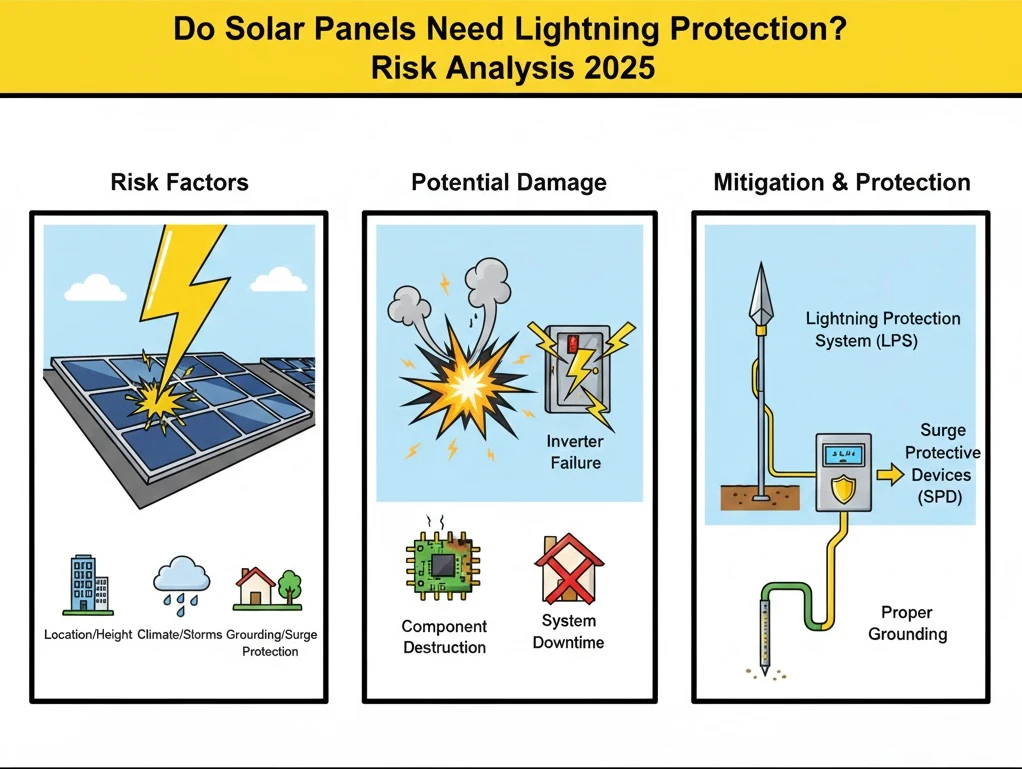
Do solar panels need lightning protection? The short answer is: it depends on your location, system size, and local lightning activity—but most systems benefit from some level of protection.
Lightning damage to solar installations is rare but catastrophic when it occurs. A single strike can destroy inverters, melt wiring, and damage solar panels worth thousands of dollars. The question isn’t whether lightning can damage your system—it’s whether the risk justifies the protection cost.
This guide analyzes lightning risk factors, explains what actually happens when lightning strikes near solar panels, breaks down protection requirements by system type, and helps you make an informed decision based on real data rather than fear.
💡 Réponse rapide: Ground-mounted systems and roof arrays in high-lightning areas (>25 strikes/km²/year) should have dedicated lightning protection. Small residential rooftop systems in low-risk areas often rely on proper grounding and surge protection devices (SPDs) as sufficient protection.
Lightning protection for solar panels is a system of devices and design practices that safely directs lightning strike energy away from sensitive solar equipment and into the ground without causing damage.
Lightning Protection System (LPS): The structural components—air terminals (lightning rods), down conductors, and ground electrodes—that intercept direct strikes and channel current safely to earth.
Surge Protection Devices (SPDs): Electronic components installed in the electrical path that divert voltage surges away from inverters, combiner boxes, and other equipment before damage occurs.
Equipotential Bonding: The practice of electrically connecting all metal parts of the solar array and mounting structure to eliminate dangerous voltage differences during a lightning event.

Lightning protection doesn’t prevent strikes—it manages their effects. Think of it like a building’s fire suppression system: it doesn’t stop fires from starting, but it prevents small problems from becoming total losses.
Three Protection Levels:
1. Direct Strike Protection: Air terminals and down conductors intercept strikes before they hit solar equipment
2. Conducted Surge Protection: SPDs block electrical surges traveling through DC and AC wiring
3. Induced Surge Protection: Shielding and bonding prevents electromagnetic pulses from inducing damaging voltages in cables
Analogie avec le monde réel: Lightning protection is like insurance plus airbags for your solar system. The structural LPS is insurance—you hope never to need it, but it saves everything if the worst happens. SPDs are airbags—they activate during smaller “accidents” (nearby strikes) that happen more frequently.
Solar panels are often the highest point on a building or mounted on open ground, making them preferential strike points during thunderstorms.
Exemple concret: A 10kW rooftop array adds 25-30 square meters of elevated metal surface to a building. This increases the structure’s lightning collection area by approximately 15-20%, depending on panel height above the roofline.
DC wiring from panels to inverters can stretch 50-150 feet in residential systems and over 1,000 feet in commercial installations. These cables act as antennas that pick up electromagnetic pulses from nearby strikes.
Why codes address this: Article 690 du NEC.35 requires surge protective devices specifically because solar wiring creates large electromagnetic loops vulnerable to induced voltages—even from strikes that don’t hit the system directly.
Lightning damage typically destroys the most expensive components: inverters ($1,500-$8,000), charge controllers ($500-$2,000), and monitoring systems ($300-$1,500). Panel damage is less common but costlier when it occurs.
A direct strike on an unprotected 20kW commercial system can result in $15,000-$35,000 in equipment replacement and lost production revenue.
Many commercial property insurance policies exclude lightning damage claims when systems don’t meet IEC 62305 lightning protection standards or local electrical codes.
Residential policies typically cover lightning damage, but multiple claims can increase premiums or lead to non-renewal.
Beyond repair costs, lightning damage creates weeks of system downtime while waiting for replacement parts and scheduling repairs. A 10kW residential system loses approximately $50-$150 in production value per week of downtime depending on local electricity rates.

Lightning doesn’t have to hit your panels directly to cause damage. Understanding the three damage mechanisms helps you prioritize protection.
Think of lightning as having three different ways to attack your solar system—like a burglar who can pick locks, break windows, or climb through vents.
#### Mechanism #1: The Direct Strike (Rarest but Most Catastrophic)
What happens: Lightning current (20,000-200,000 amperes) flows through whatever it hits first—typically solar panel frames, racking, or nearby structures.
How damage occurs: The massive current melts aluminum frames, vaporizes mounting bolts, explodes junction boxes, and creates arc flashes that destroy multiple panels. Current flowing through DC cables to the inverter incinerates electronic components instantly.
Analogie avec le monde réel: Imagine connecting your phone charger to a power plant transmission line. The current is so far beyond design limits that materials physically explode or vaporize.
Probability: Direct strikes to solar arrays are rare—approximately 1 in 400,000 per system per year in average lightning areas—but result in 100% equipment destruction in the current path.
#### Mechanism #2: The Conducted Surge (Most Common Damage Source)
What happens: Lightning strikes nearby (within 1-2 km) and current flows through shared ground systems, utility lines, or communication cables into your solar equipment.
How damage occurs: Voltage surges (5,000-25,000 volts) exceed the insulation ratings of inverter components, SPDs, and control electronics. Semiconductors break down, circuit boards char, and MOV surge protectors fail short-circuit or catch fire.
Probability: Conducted surges occur 10-50 times more frequently than direct strikes. In moderate lightning areas, unprotected systems experience damaging surges every 5-10 years on average.
#### Mechanism #3: The Electromagnetic Pulse (Sneaky Silent Damage)
What happens: Lightning creates a powerful electromagnetic field that induces voltages in nearby cables without any physical contact.
How damage occurs: Long DC cable runs act as loop antennas. The changing magnetic field from a nearby strike (even 500+ meters away) induces voltage spikes (hundreds to thousands of volts) that stress or damage sensitive electronics over time.
Analogie avec le monde réel: Like how passing too close to a powerful magnet can corrupt a credit card, lightning’s electromagnetic pulse can induce damaging voltages in your solar wiring without actually striking anything metal.

Level I – Complete Lightning Protection System
✅ Components:
– Air terminals (lightning rods) positioned above solar array
– Down conductors (copper or aluminum cables) every 10-20 meters
– Ground electrode system with resistance <10 ohms – Type 1+2 coordinated SPD protection – Equipotential bonding of all metal structures
✅ Avantages :
– Protects against direct strikes
– Reduces damage probability to <1% – Meets insurance requirements for high-value systems – Provides whole-facility protection
❌ Inconvénients :
– Initial cost $3,000-$15,000 depending on system size
– Requires professional LPS design and installation
– May require annual inspection and maintenance
Meilleur pour : Ground-mounted systems, commercial/utility-scale installations, areas with >25 lightning days per year, systems near tall trees or structures
Level II – Enhanced Surge Protection
✅ Components:
– Type 1 SPD at service entrance
– Type 2 SPDs at inverter DC inputs
– Type 2 SPD at inverter AC output
– Enhanced grounding with ground rod array
– Cable shielding and separation
✅ Avantages :
– Protects against conducted and induced surges
– Cost-effective ($800-$2,500 installed)
– Covers 80-90% of lightning damage scenarios
– Easier retrofit to existing systems
❌ Inconvénients :
– No protection from direct strikes
– SPDs require replacement after major surge events
– Limited protection if grounding is poor
Meilleur pour : Residential rooftop systems 5-20kW, moderate lightning areas (10-25 days/year), properties with existing building lightning protection
Level III – Basic Code-Minimum Protection
✅ Components:
– Type 2 SPD at inverter DC input (NEC 690.35 requirement)
– Standard grounding electrode system
– Basic equipotential bonding of panel frames
✅ Avantages :
– Meets minimum NEC code requirements
– Low cost ($200-$600)
– Protects against small-to-moderate induced surges
– Standard inclusion in most quality inverters
❌ Inconvénients :
– Minimal protection from direct or nearby strikes
– Relies entirely on utility service entrance protection
– May void equipment warranties in high-risk areas
Meilleur pour : Small residential rooftop systems <5kW, low lightning areas (<10 days/year), urban locations with dense building protection
Integrated Array-Level Protection
Combines structural LPS with array-specific SPD protection. Air terminals mounted on elevated poles above the solar array create a protective cone while Type 1 SPDs at combiner boxes handle surges before they reach the inverter.
Common in: Utility-scale solar farms, large commercial rooftop arrays >100kW
Standalone Equipment Protection
Focuses SPD protection at critical equipment (inverters, charge controllers, battery systems) without structural lightning rods. Relies on the building’s existing lightning protection or location’s low strike probability.
Common in: Residential rooftop systems, carport solar canopies, building-integrated PV
Lightning density is measured in strikes per square kilometer per year (Ng value). This determines your baseline risk.
How to find your Ng value:
– Visit NOAA’s Lightning Data Portal (www.ncdc.noaa.gov)
– Check Vaisala’s Lightning Maps for global data
– Consult local meteorological services
– Use IEC 62305-2 regional maps
Risk Classification:
- Low Risk: Ng < 10 (coastal regions, northern climates) – Moderate Risk: Ng = 10-25 (most of continental US and Europe)
- High Risk: Ng > 25 (Florida, mountain regions, tropical areas)
- Extreme Risk: Ng > 40 (Central Africa, parts of Southeast Asia)
Exemple de calcul :
Location: Orlando, Florida (Ng ≈ 30)
System: 8kW residential rooftop, 40m² collection area
Annual strike probability = (40m² × 30 strikes/km²) / 1,000,000 = 0.12%
Expected strike frequency = 1 in 833 years
🎯 Conseil de pro: While your individual system’s strike probability may seem low, nearby strikes (within 1-2km) occur much more frequently and cause the majority of surge damage. In Orlando’s Ng=30 zone, a nearby damaging surge occurs approximately once every 15-25 years for unprotected systems.
Elevation Multipliers:
– Ground-level rooftop: 1.0× baseline risk
– Elevated 2-5m above roofline: 1.5× baseline risk
– Elevated >5m or on poles: 2.0-3.0× baseline risk
– Mountain or hilltop location: 3.0-5.0× baseline risk
Isolation Factors:
– Surrounded by taller structures: 0.3× risk (shadowed protection)
– Open field or isolated building: 1.5× risk
– Tallest structure in area: 2.5× risk
– Near tall trees or conductors: 1.2× risk (attraction effect)
System Configuration:
– Compact rooftop <10kW: Standard risk – Extended ground-mount: +1.5× risk (larger collection area) – Multiple buildings linked: +2.0× risk (expanded surge pathways)
Compare the cost of protection versus expected loss value over system lifetime (25 years).
| Lightning Risk Level | Damage Probability (25-year period) | Average Loss (if damaged) | Expected Loss Valeur |
|---|---|---|---|
| Low (Ng <10) | 5-8% | $3,500-$8,000 | $175-$640 |
| Moderate (Ng 10-25) | 15-25% | $4,000-$10,000 | $600-$2,500 |
| High (Ng 25-40) | 30-45% | $5,000-$15,000 | $1,500-$6,750 |
| Extreme (Ng >40) | 50-70% | $6,000-$20,000 | $3,000-$14,000 |
Decision Logic:
If (Protection Cost < Expected Loss Value), protection is economically justified.
Example: 12kW Florida system (Ng=30, high risk)
– Expected loss: $3,500 over 25 years
– Enhanced SPD protection cost: $1,800
– Economic benefit: $1,700 savings plus avoided downtime
- Decision: Protect
Regulatory Requirements:
– Building codes in high-risk zones may mandate lightning protection
– Commercial systems often require LPS for occupancy permits
– Grid-interconnection agreements may specify surge protection levels
Insurance Implications:
– Some insurers require IEC 62305-compliant protection for coverage
– Lightning protection can reduce commercial property insurance premiums 5-15%
– Residential policies may exclude repeated lightning claims without protection
System Criticality:
– Off-grid systems have no backup during repairs—protection is essential
– Grid-tied backup systems lose value if damaged during grid outages
– Agricultural or commercial operations depend on continuous solar production

NEC 690.35 – Ungrounded Photovoltaic Power Systems
Requires surge protective devices (SPDs) on the DC side of ungrounded PV systems. While the code doesn’t explicitly mandate full lightning protection systems, it recognizes surge protection as essential safety equipment.
Key requirements:
– Type 1 or Type 2 SPDs rated for maximum system voltage
– SPDs must be listed for DC application
– Installation between PV array and inverter
– Grounding per NEC Article 250
NEC 250.169 – Direct-Current Systems
Establishes grounding electrode system requirements for DC solar installations. Proper grounding is the foundation of effective lightning protection.
Minimum standards:
– Grounding electrode conductor sized per 250.166
– Ground resistance <25 ohms (lower is better for lightning) – Bonding of all non-current-carrying metal parts – Supplementary electrodes if resistance exceeds 25 ohms
⚠️ Important: NEC provides minimum safety standards but doesn’t specifically address complete lightning protection system design. High-risk installations should follow IEC 62305 for comprehensive protection.
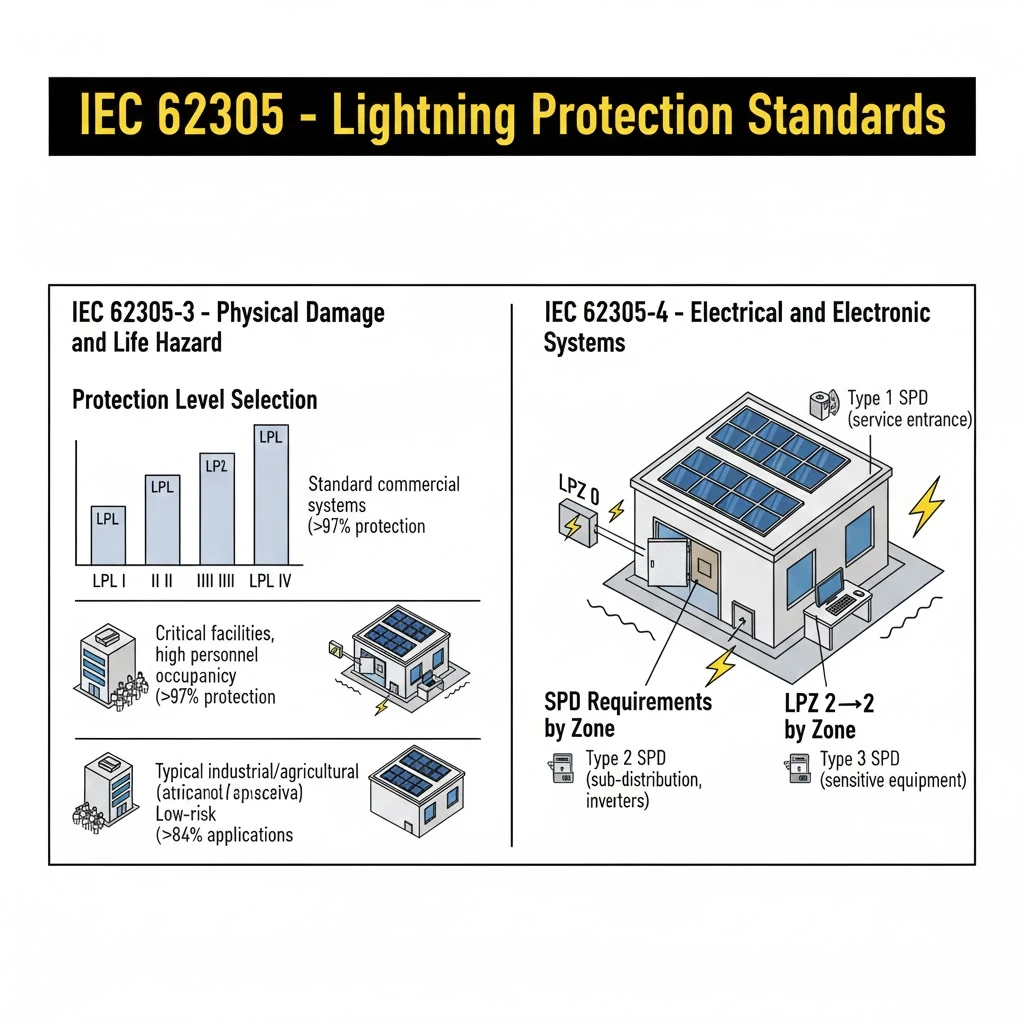
The international standard for lightning protection system design, widely adopted for commercial and utility-scale solar installations worldwide.
IEC 62305-3 – Physical Damage and Life Hazard
Defines lightning protection levels (LPL I through IV) and structural protection requirements. Most solar installations use LPL II or III.
Protection Level Selection:
- LPL I: Critical facilities, high personnel occupancy (>99.5% protection)
- LPL II: Standard commercial systems (>97% protection)
- LPL III: Typical industrial/agricultural (>91% protection)
- LPL IV: Low-risk applications (>84% protection)
IEC 62305-4 – Electrical and Electronic Systems
Covers SPD selection, coordination, and installation for protecting sensitive electronics—directly applicable to solar inverters and control systems.
SPD Requirements by Zone:
- LPZ 0→1 boundary: Type 1 SPD (service entrance)
- LPZ 1→2 boundary: Type 2 SPD (sub-distribution, inverters)
- LPZ 2→3 boundary: Type 3 SPD (sensitive equipment)
US standard for lightning protection system components. Requires all LPS materials (air terminals, conductors, connectors) to meet specific construction and performance criteria.
Certified components ensure:
– Adequate current-carrying capacity (200kA typical)
– Corrosion resistance for 20+ year lifespan
– Mechanical strength for wind/weather exposure
– Proper electrical conductivity
Many jurisdictions add requirements beyond national codes:
Florida Building Code: Requires enhanced protection in high-risk coastal zones (Ng >30)
California Title 24: Specifies SPD ratings for solar installations based on local lightning flash density
Insurance Requirements: Commercial property insurers often mandate IEC 62305-compliant protection for coverage in areas exceeding Ng=20
Problème : Many homeowners believe metal solar panels make their property more likely to experience lightning strikes compared to unprotected roofs.
Reality: Lightning seeks the path of least resistance to ground, not specifically metal objects. A building with solar panels is no more attractive to lightning than the same building without panels. The concern isn’t increased strike probability—it’s the expensive equipment at risk if a strike does occur.
Scénarios courants :
– Homeowners declining solar quotes due to lightning fears
– Property owners removing solar to “reduce risk”
Correction : Solar panels don’t increase strike probability significantly. The decision should focus on protecting valuable equipment, not avoiding installation altogether.
⚠️ Avertissement: While panels don’t attract strikes, elevated ground-mount systems on open land do become preferential strike points simply due to height, similar to any elevated structure.
Problème : Building owners with existing lightning protection systems (air terminals on roof peaks) assume this automatically protects roof-mounted solar panels.
Scénarios courants :
– Industrial buildings with LPS installed pre-solar
– Commercial buildings adding rooftop solar to structures with lightning rods
Correction : Solar arrays must be within the protective cone of existing air terminals (45-60° angle from rod tip) to be covered. Arrays extending beyond this cone need additional air terminals or their own protection. Importantly, building LPS protects against direct strikes but doesn’t eliminate the need for SPDs to protect solar equipment from conducted surges.
Problème : Contractors install surge protective devices but neglect grounding system upgrades, rendering SPDs ineffective.
Why this fails: SPDs divert surge energy to ground. If ground resistance is high (>25 ohms) or bonding is incomplete, surge current has nowhere to go and damages equipment anyway. It’s like installing a drain without connecting it to a sewer line.
Scénarios courants :
– SPD installed but ground rod resistance never tested
– SPD ground wire undersized (<6 AWG) – Multiple ground points creating ground loops Correction : Measure ground resistance before installing SPDs. Achieve <10 ohms for effective surge protection (may require ground rod arrays or chemical ground enhancement). Use 6 AWG or larger bonding conductors with minimal bends.
Problème : Electricians unfamiliar with solar use standard AC surge protectors on DC solar circuits because “they’re cheaper and should work the same.”
Why this fails: AC and DC arcs behave differently. AC current naturally crosses zero 120 times per second, helping extinguish arcs. DC current is continuous—once an arc starts in an AC-rated device on DC, it won’t self-extinguish and may cause fires.
Scénarios courants :
– Residential electricians doing their first solar job
– DIY solar installers using hardware store surge protectors
Correction : Always use DC-rated SPDs with voltage ratings exceeding maximum system voltage (multiply Voc × 1.25 for safety margin). Verify UL 1449 Type 1 or Type 2 DC listing.
Problème : SPDs protect by sacrificing themselves during surge events. Without monitoring indicators, failed SPDs remain installed, providing false security.
Scénarios courants :
– SPDs installed and never inspected
– Indicator lights not visible or checked
– No maintenance schedule established
Correction : Install SPDs with visual indicators (LED lights or mechanical flags). Check indicators every 6-12 months. Replace immediately if indicators show failure. Consider SPDs with remote monitoring capability for commercial systems.

Residential Rooftop Systems (5-15kW):
Basic Protection (SPDs only):
– Equipment: $200-$600 (Type 2 DC SPDs)
– Installation: $150-$400 (1-3 hours labor)
- Total: $350-$1,000
Enhanced Protection (SPDs + Grounding):
– Equipment: $600-$1,200 (Type 1+2 SPDs, grounding materials)
– Installation: $500-$1,000 (4-6 hours labor, ground testing)
- Total: $1,100-$2,200
Complete LPS (Full Structural Protection):
– Equipment: $1,500-$3,000 (air terminals, conductors, electrodes, SPDs)
– Design: $500-$1,000 (engineering assessment)
– Installation: $2,000-$4,000 (8-16 hours specialized labor)
- Total: $4,000-$8,000
Commercial Systems (50-250kW):
Enhanced Protection:
- Total: $3,000-$8,000 (scales with system size)
Complete IEC 62305 LPS:
- Total: $10,000-$35,000 (engineering, materials, specialized installation)
Utility-Scale (>1MW):
- Total: $50,000-$250,000 (comprehensive array-level protection with remote monitoring)
Typical Lightning Damage Claims:
Minor surge (nearby strike, SPDs absorb most energy):
– Inverter communication board: $300-$800
– Monitoring system: $200-$500
- Total: $500-$1,300
Major surge (nearby strike, no or failed SPDs):
– Inverter replacement: $1,500-$8,000
– Charge controller (if off-grid): $500-$2,000
– Damaged string wiring: $400-$1,500
– Emergency service call: $200-$500
– Lost production (2-4 weeks): $100-$400
- Total: $2,700-$12,400
Direct strike (no structural LPS):
– Multiple panel replacements (6-12 panels): $2,000-$4,800
– Inverter destroyed: $1,500-$8,000
– Combiner box melted: $800-$2,000
– Racking damage: $1,000-$3,000
– Rewiring labor: $1,500-$4,000
– Lost production (4-8 weeks): $200-$800
- Total: $7,000-$22,600
Scenario 1: Low-Risk Residential (Ng=8, 10kW system)
Expected damage over 25 years: $400-$800
Basic SPD protection cost: $800
Break-even probability: ~8-10% (borderline economic justification)
Recommendation: SPD protection provides peace of mind and code compliance at minimal cost. Economically neutral but worthwhile for warranty protection and avoiding hassle.
Scenario 2: Moderate-Risk Residential (Ng=18, 12kW system)
Expected damage over 25 years: $1,500-$3,000
Enhanced protection cost: $1,800
Break-even probability: 15-20% (economically justified)
Recommendation: Enhanced SPD + grounding protection is cost-effective and significantly reduces risk.
Scenario 3: High-Risk Commercial (Ng=32, 150kW system)
Expected damage over 25 years: $8,000-$18,000
Complete LPS protection cost: $22,000
Break-even probability: 25-35% (strong economic justification)
Additional factors: Insurance premium reduction ($300-$800/year) and avoided business disruption improve ROI significantly.
Recommendation: Complete IEC 62305-compliant protection is essential for business continuity and insurance requirements.
💡 Key Insight: Lightning protection economics improve dramatically as system size increases. Large commercial and utility systems should always invest in comprehensive protection—the break-even point occurs within 5-10 years even in moderate-risk zones.
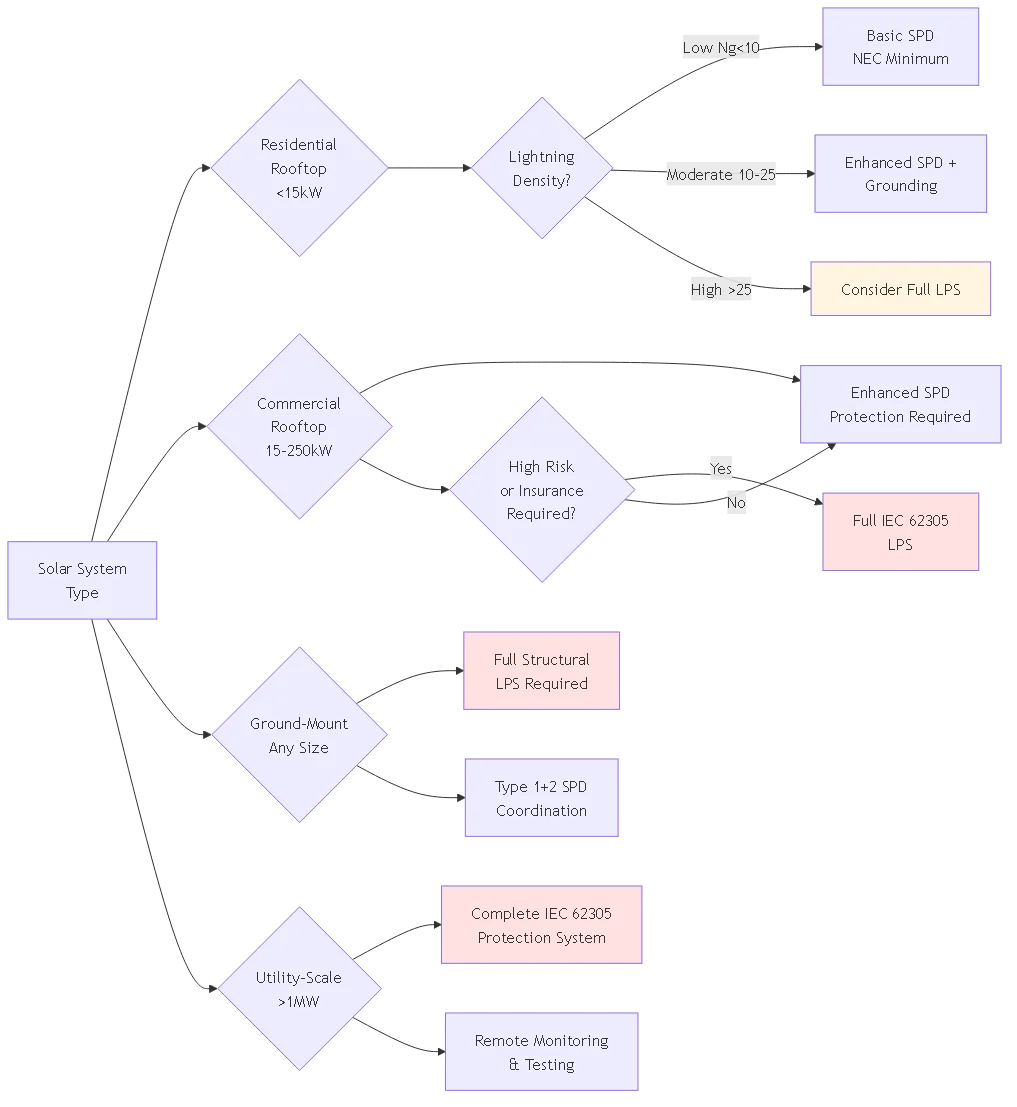
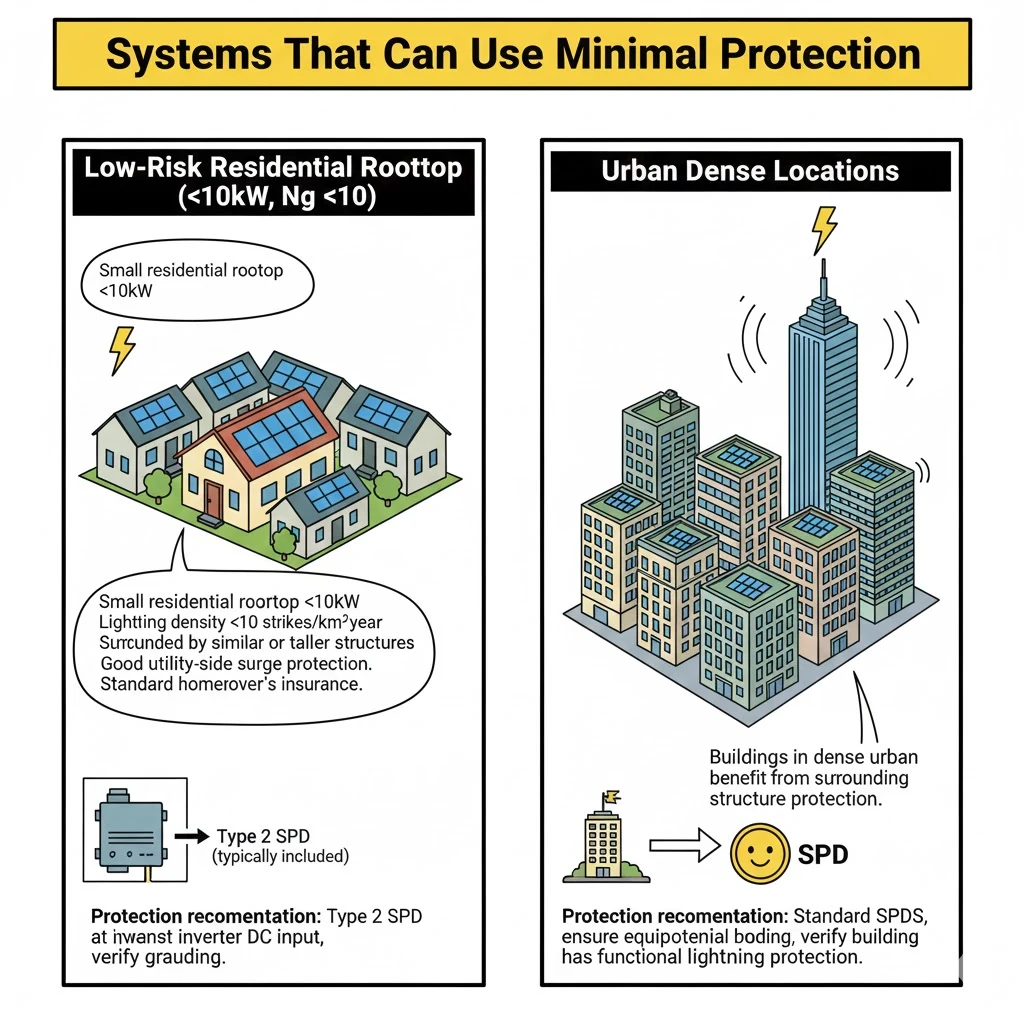
Low-Risk Residential Rooftop (<10kW, Ng <10)
If your system meets all these criteria, basic NEC-minimum protection may be adequate:
– Small residential rooftop under 10kW
– Lightning density under 10 strikes/km²/year
– Surrounded by similar or taller structures (shadowing effect)
– Good utility-side surge protection (check main panel SPDs)
– Standard homeowner’s insurance covering lightning damage
Protection recommendation: Type 2 SPD at inverter DC input (typically included with quality inverters), verify grounding meets NEC 250 requirements.
Urban Dense Locations
Buildings in dense urban areas benefit from surrounding structure protection. Lightning tends to strike the tallest points, and mid-rise buildings surrounded by similar structures have reduced exposure.
Protection recommendation: Standard SPDs, ensure equipotential bonding, verify building has functional lightning protection if present.
Ground-Mount Arrays (Any Size)
Ground-mounted systems cannot skip structural lightning protection. They create isolated elevated strike points without building protection.
Minimum requirements:
– Air terminals meeting rolling sphere method criteria (typically every 15-20m)
– Down conductors to ground electrode array
– Type 1 SPD at combiner boxes
– Type 2 SPDs at inverters
– Equipotential bonding grid under array
Commercial/Industrial Installations (>50kW)
Insurance, code requirements, and business continuity concerns mandate comprehensive protection regardless of lightning density.
Minimum requirements:
– IEC 62305 Level III or better LPS design
– Coordinated Type 1+2 SPD protection
– Ground resistance <10 ohms verified by testing – Annual inspection and maintenance program High-Lightning-Density Zones (Ng >25)
Any system in regions exceeding 25 lightning strikes/km²/year should have enhanced or complete protection. The damage probability over 25 years approaches 40-60% without protection.
Critical Facilities and Off-Grid Systems
Systems supporting critical loads (medical, safety, communications) or off-grid installations without backup power cannot tolerate extended outages. Protection is essential regardless of statistical risk.
Even in low-risk areas with under 10 lightning days per year, solar panels benefit from basic surge protection devices (SPDs) at minimum. While direct strike probability is minimal, conducted surges from nearby strikes or utility disturbances can still damage inverters and electronics.
The NEC requires SPDs on ungrounded PV systems regardless of location (Article 690.35), recognizing that surge protection is fundamental safety equipment. For low-risk areas, focus on quality Type 2 SPDs at the inverter rather than expensive structural lightning protection systems. The cost of basic SPD protection ($200-$600) is negligible compared to inverter replacement costs ($1,500-$8,000) and provides code compliance and warranty protection.
A direct lightning strike to unprotected solar panels causes catastrophic damage through multiple mechanisms simultaneously. The strike current (typically 20,000-200,000 amperes) melts aluminum panel frames, vaporizes mounting hardware, and creates explosive pressure that shatters glass and silicon cells. Junction boxes explode from the energy release.
Current flowing through DC wiring to the inverter instantly destroys semiconductor components, melts circuit boards, and may ignite surrounding materials. Multiple panels in the current path are destroyed beyond repair. Nearby panels suffer indirect damage from electromagnetic pulses and ground potential rises. A direct strike typically results in total system loss ($10,000-$50,000+ depending on system size) and requires complete equipment replacement, rewiring, and racking repairs. This is why structural lightning protection systems use air terminals and down conductors to intercept strikes before they reach panels.
Yes, lightning protection can be retrofitted to existing solar installations, though it’s more challenging and expensive than installing protection during initial construction. For surge protection (SPDs), retrofit is straightforward—qualified electricians can add Type 2 SPDs at inverter DC inputs and AC outputs in 2-4 hours with minimal system downtime.
Adding structural lightning protection (air terminals, down conductors) to existing arrays requires more extensive work including array penetrations for conductor routing, bonding to existing racking, and ground electrode installation. Costs increase 30-50% compared to new installation due to working around existing equipment. Ground-mounted systems are easier to retrofit than rooftop arrays. Before retrofitting, verify that adding lightning protection won’t void existing equipment warranties and ensure work is performed by qualified lightning protection specialists certified under NFPA 780 or equivalent standards.
Solar lightning protection systems require inspection on different schedules depending on protection level and system criticality. Basic SPD protection should be visually inspected every 6-12 months to check indicator lights showing SPD functionality—failed SPDs provide no protection and must be replaced immediately.
Complete structural lightning protection systems (air terminals, down conductors, ground electrodes) need comprehensive inspection annually, including visual examination of all connections, testing of ground electrode resistance (<10 ohms required), verification of bonding conductor integrity, and inspection of air terminal mounting security. High-value commercial systems and critical facilities should schedule professional lightning protection system testing every 3-5 years using specialized equipment. After any known lightning strike to the structure or nearby area, conduct immediate inspection of all SPDs and test ground resistance. Many insurance policies require documented annual inspections to maintain coverage for commercial installations.
Most standard homeowner’s insurance policies cover lightning damage to solar equipment as part of dwelling coverage or personal property coverage, treating solar panels similarly to other attached home improvements like HVAC systems or water heaters. Coverage typically includes panel replacement, inverter repair, wiring damage, and necessary labor for repairs.
However, coverage has important limitations: high deductibles ($500-$2,500) may exceed damage costs for minor surge events, repeated lightning claims can increase premiums or lead to non-renewal, and some policies exclude lightning damage if the homeowner didn’t install basic surge protection required by code. Commercial solar installations face stricter requirements—many commercial property policies require IEC 62305-compliant lightning protection systems for coverage and may exclude claims if proper protection isn’t installed and maintained. Before relying on insurance, review your specific policy’s electrical damage provisions, verify coverage limits include full system replacement value, and document that installation meets NEC requirements.
Lightning protection and surge protection serve different but complementary roles in a complete defense strategy. Lightning protection (LPS) is the structural system—air terminals (lightning rods), down conductors, and ground electrodes—that intercepts direct lightning strikes and safely conducts current to earth before it reaches electrical systems. LPS prevents physical damage from direct strikes but doesn’t protect equipment from conducted surges.
Surge protection devices (SPDs) are electronic components installed in electrical pathways that divert voltage surges away from sensitive equipment like inverters and controllers. SPDs protect against conducted surges from nearby lightning strikes, utility disturbances, and switching transients—threats occurring 10-100 times more frequently than direct strikes. Complete solar protection requires both: structural LPS handles direct strikes (rare but catastrophic) while SPDs handle conducted surges (common but typically non-catastrophic with proper protection). Think of LPS as the building’s fire-resistant structure and SPDs as the fire suppression system inside—you need both for comprehensive protection.
The National Electrical Code (NEC) doesn’t explicitly require complete lightning protection systems for most solar installations, but it does mandate surge protective devices (SPDs) for ungrounded PV systems under Article 690.35. Local building codes vary—some high-risk jurisdictions (Florida, mountain regions) require structural lightning protection for ground-mounted systems or installations exceeding certain sizes (typically >50kW).
Commercial installations face more stringent requirements: building codes may mandate IEC 62305-compliant protection for structures with public occupancy, and insurance requirements often force compliance even when codes don’t specifically require it. The AHJ (Authority Having Jurisdiction) makes final determinations about protection requirements during permit review. While structural LPS may not be code-required for small residential rooftop systems in moderate-risk areas, meeting current NEC standards requires at minimum proper grounding per Article 250 and SPDs at appropriate locations. Ground-mounted arrays and commercial systems should assume complete lightning protection is required and plan accordingly during design phases.
The question “do solar panels need lightning protection” doesn’t have a universal answer—it depends on lightning density, system type, installation configuration, and risk tolerance. However, clear patterns emerge from the data.
Principaux enseignements :
1. Basic surge protection is non-negotiable: All solar systems need at minimum Type 2 SPDs at inverters to meet NEC requirements and protect expensive equipment from the common threat of conducted surges.
2. Ground-mounted systems require structural protection: Any solar array on open ground needs complete lightning protection systems with air terminals and down conductors—the direct strike risk is too high to ignore.
3. Lightning density drives decisions: Systems in high-risk zones (Ng >25) need enhanced or complete protection regardless of size; low-risk zones (<10) can use basic protection for small residential rooftop arrays.
4. Economics favor protection for valuable systems: The break-even analysis clearly justifies enhanced protection for systems over $30,000 value or in moderate-to-high lightning areas where expected damage costs exceed protection investment.
5. Grounding matters as much as SPDs: Surge protection devices are ineffective without proper grounding—achieving ground resistance below 10 ohms is essential for protection system performance.
The most cost-effective approach implements layered protection matching actual risk: basic SPDs for low-risk small systems, enhanced SPD plus grounding for moderate situations, and complete IEC 62305-compliant protection for high-risk or high-value installations. Investing in appropriate lightning protection provides not only equipment security but also peace of mind and compliance with evolving insurance requirements.
Ressources connexes :
- DC SPD for Solar Systems: Type 1 vs Type 2 Applications
- Solar Panel Surge Protector: Sizing & Coordination
- PV System Protection: Arc Fault & Ground Fault Detection
Ready to assess your system’s lightning protection needs? Contact our technical team for a site-specific risk assessment and protection system recommendations based on your location, system configuration, and local lightning density. We help specify cost-effective protection solutions meeting all code requirements and insurance standards.
Dernière mise à jour : Décembre 2025
Auteur : L'équipe technique de SYNODE
Révisé par : Département de génie électrique