住所
304ノース・カーディナル
セント・ドーチェスター・センター(マサチューセッツ州02124
勤務時間
月曜日~金曜日:午前7時~午後7時
週末午前10時~午後5時
住所
304ノース・カーディナル
セント・ドーチェスター・センター(マサチューセッツ州02124
勤務時間
月曜日~金曜日:午前7時~午後7時
週末午前10時~午後5時


A 3 string PV combiner box serves residential and small commercial solar installations in the 15-25 kW range, consolidating three independent PV string circuits into a single DC output feeding the inverter. Proper sizing of fuses, busbars, enclosures, and conductors ensures safe operation while meeting NEC第690条 requirements. Understanding component selection criteria prevents oversizing that wastes budget and undersizing that creates safety hazards or code violations.
The 3-string configuration represents the sweet spot for many residential installations using modern 400-450W panels. Three strings of 12-14 panels each produce 14-19 kW under standard test conditions, matching popular residential inverter capacities. This configuration balances cost-effectiveness with adequate string-level monitoring and protection, avoiding the complexity of larger combiners while providing better granularity than 2-string systems.
Residential roof installations frequently accommodate three distinct roof planes or orientations, each supporting one PV string. South-facing, east-facing, and west-facing arrays benefit from independent string circuits, enabling maximum power point tracking (MPPT) optimization for different sun exposure profiles. A 3 string combiner box provides the infrastructure for this multi-orientation configuration without requiring three separate inverter inputs.
Split-level homes and complex roof geometries create natural separation between panel groups. Rather than routing conductors from three widely separated arrays directly to the inverter, a centrally located combiner box consolidates circuits, reducing conduit runs and conductor costs. This approach proves especially cost-effective when strings originate from opposite ends of the building.
Small commercial installations in the 20-25 kW range use 3 string configurations as a modular building block. Multiple 3-string combiners distribute across large roof areas, each serving a logical grouping of panels. This distributed architecture simplifies troubleshooting and enables phased installation expansion compared to single large combiners handling 9-12 strings.
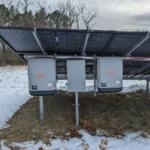
Ground-mounted residential arrays exceeding typical roof capacity also employ 3 string combiners. A backyard array with 45 panels naturally divides into three 15-panel strings, requiring combiner capacity for three inputs. Proper sizing ensures voltage drop remains minimal across conductor runs from array to combiner to inverter locations.
重要な洞察: Three-string systems offer optimal balance between protection granularity and cost for most residential installations. Each string has independent overcurrent protection, enabling isolation of individual faulted circuits without affecting the other two strings.
| システム・サイズ | Panels per String | String Voltage (Voc) | String Current (Isc) | 代表的なアプリケーション |
|---|---|---|---|---|
| 15 kW (3×5kW) | 12 panels × 400W | 550-600V | 9-10A | Small residential, single-story |
| 18 kW (3×6kW) | 13 panels × 450W | 600-650V | 10-11A | Medium residential, two-story |
| 21 kW (3×7kW) | 15 panels × 450W | 700-750V | 10-11A | Large residential, ground-mount |
| 24 kW (3×8kW) | 18 panels × 450W | 850-900V | 10-11A | Small commercial, barn/shed |
String fuse sizing follows NEC 690.9(B) requiring 1.56× the string short-circuit current (Isc). For strings with 9.5A Isc, minimum fuse rating equals 9.5A × 1.56 = 14.82A, requiring 15A fuses. This calculation prevents nuisance fuse operation during high irradiance conditions while providing adequate overcurrent protection. Always use DC-rated gPV fuses certified for photovoltaic applications per UL 2579.
Fuse voltage rating must exceed the system maximum open-circuit voltage (Voc) at lowest expected temperature. Strings with 550V Voc at standard test conditions reach 600-650V at -10°C. Select 1000V DC fuses providing adequate margin for temperature effects and manufacturing tolerances. Using 600V fuses in 550V nominal systems violates code and creates safety hazards.
Class gPV fuses differ from general-purpose fuses through specialized DC arc interruption and time-current characteristics. The “g” designation indicates full-range breaking capacity, while “PV” confirms photovoltaic application suitability. Never substitute automotive, AC, or non-photovoltaic DC fuses in solar combiners—these lack proper voltage ratings and arc-quenching capabilities.
Fuse holders must accommodate the selected fuse dimensions and voltage rating. Residential 3-string combiners typically use 10×38mm fuses (common European size) or 13/32×1-1/2″ fuses (North American sizing). Verify fuse holder interrupt capacity exceeds system available fault current, typically 150-200A for residential 3-string applications with short conductor runs.
⚠️ 重要: Each string requires an individual fuse even in 3-string systems. Omitting fuses or using a single combined protection device violates NEC 690.9 requirements and eliminates string-level fault isolation capability.
Busbar current capacity must accommodate combined output of all three strings plus 25% safety factor per NEC 690.8(A). Three strings at 10A each produce 30A combined, requiring busbar capacity of 37.5A minimum. Standard practice specifies 100A busbars in residential 3-string combiners, providing significant margin and accommodating future system expansion if a string is added.
Copper busbars dominate residential combiner applications due to excellent conductivity, ease of drilling for connections, and corrosion resistance. Standard 1/4″ × 1″ copper bar (6.35mm × 25.4mm) handles 100-125A continuously with minimal temperature rise. Larger 1/4″ × 2″ bars suit applications with higher current or elevated ambient temperatures.
Aluminum busbars cost 40-60% less than copper but require 1.6× larger cross-section for equivalent current capacity. Aluminum also demands special attention to connector types—copper-to-aluminum connections require antioxidant compound and compatible hardware to prevent galvanic corrosion. Most residential 3-string applications use copper for simplicity and reliability.
Busbar insulation prevents accidental contact with energized conductors during maintenance. Heatshrink tubing, PVC sleeving, or phenolic insulators cover busbars except at connection points. Some manufacturers provide pre-insulated busbars with factory-applied coverage, ensuring compliance with NFPA 70E arc flash safety requirements. Minimum creepage distance of 12mm per kV applies between energized busbars and grounded enclosure.
| Busbar Size | Current Capacity | Typical Cost (Copper) | 申し込み |
|---|---|---|---|
| 1/8″ × 1″ (3.2×25mm) | 60-75A | $8-12 per foot | Small 2-string, <12kW |
| 1/4″ × 1″ (6.4×25mm) | 100-125A | $15-20 per foot | Standard 3-string, 15-20kW |
| 1/4″ × 2″ (6.4×51mm) | 175-225A | $25-35 per foot | Enhanced 3-string, high ambient |
| 3/8″ × 2″ (9.5×51mm) | 275-350A | $40-55 per foot | 4-6 string commercial |
Main breaker current rating equals 125% of the maximum system output current per NEC 690.8(A)(1). For three strings producing 10A each, maximum output is 30A, requiring breaker rating of 37.5A minimum. Standard available ratings of 40A or 50A both satisfy this requirement. Select the 40A rating for better overload protection without risk of nuisance tripping.
DC voltage rating must equal or exceed system maximum Voc at coldest expected temperature. A 650V cold-weather Voc requires 1000V DC-rated breakers minimum. Never use AC breakers in DC applications—AC breakers lack DC arc interruption capability and can sustain dangerous arcs indefinitely. Verify “DC” marking on breaker label and consult manufacturer datasheets for voltage derating curves.
Pole count depends on system grounding configuration. Two-pole (2P) breakers switch both positive and negative conductors in ungrounded or bipolar systems. Single-pole (1P) breakers suffice for negative-grounded systems, switching only the positive conductor. Most residential applications use 2P breakers for maximum safety and flexibility regardless of grounding method.
Breaking capacity (interrupt rating) must exceed available fault current at the combiner location. Residential 3-string systems with typical conductor lengths produce 150-250A maximum fault current. Standard 5 kA or 10 kA interrupt ratings easily exceed this requirement. Confirm the breaker’s DC interrupt rating specifically—AC interrupt ratings don’t apply to DC circuits.
NEMA 3R enclosures provide minimum weather protection for outdoor combiner installations, featuring rain-tight gaskets and drainage provisions. These economical enclosures suit covered locations under roof eaves or on shaded walls. Dimensions of 12″×12″×6″ accommodate typical 3-string components with adequate working space for terminations and future modifications.
NEMA 4X enclosures offer superior protection with gaskets sealing against driving rain, windblown dust, and corrosion from coastal environments. Stainless steel or fiberglass construction withstands UV exposure and harsh weather for 20+ year service life. The premium cost of $75-150 additional over NEMA 3R proves worthwhile for exposed roof-mounted installations and coastal regions.
Internal component layout requires 6″ minimum clearance between energized busbars and enclosure walls per NEC 110.26. Three fuse holders, two busbars, one breaker, one SPD, and a ground bus typically fit within 12″×12″ footprint with proper arrangement. Larger 14″×12″ or 16″×14″ enclosures provide easier wire routing and future expansion space.
Mounting provisions must support the combined weight of enclosure, components, and conductor entry strain relief. Typical populated 3-string combiners weigh 8-15 pounds. Use minimum 1/4″ stainless hardware anchored into structural members, not just siding. Ground-mounted installations require concrete pads or galvanized post mounts elevated 18″ minimum above grade for drainage and rodent protection.
Output conductor sizing follows NEC 690.8(B) requiring 125% of maximum current. For 30A combined output, conductors must handle 37.5A continuous. NEC Table 310.16 shows 10 AWG copper at 90°C rating handles 40A, satisfying the requirement. String input conductors also use 10 AWG despite lower individual current, maintaining consistency and future-proofing for higher-wattage panel upgrades.
Temperature derating applies when conductors run through hot attics or exposed conduit on sun-facing walls. Ambient temperatures of 60-70°C require derating factors from NEC Table 310.15(B)(1). In severe cases, 8 AWG conductors may be necessary even though ampacity calculations suggest 10 AWG suffices. Always calculate worst-case temperature scenarios for reliability.
Conduit fill follows NEC Chapter 9, Table 4, limiting conductor cross-section to 40% of conduit internal area. Three 10 AWG string input pairs (6 conductors total) plus two 10 AWG output conductors (8 conductors total) require 1″ conduit minimum. Adding ground conductors increases the requirement to 1-1/4″ for comfortable installation without conductor damage during pulling.
String homerun distances affect voltage drop calculations. NEC recommends limiting voltage drop to 3% from array to inverter. For 600V systems, this allows 18V drop maximum. Three strings at 10A each over 50-foot runs require voltage drop calculation: VD = 2 × K × I × D / CM, where K=12.9 (copper), I=10A, D=50ft, CM=10380 (10 AWG). Result: 6.2V drop, acceptable for this application.
🎯 プロのアドバイス: Specify USE-2 or RHW-2 photovoltaic wire rated for wet locations and 90°C operation. Standard THHN wire isn’t rated for wet locations and can degrade from moisture intrusion at outdoor combiner boxes.
Type 2 SPD protection at the combiner box prevents lightning-induced surges from damaging inverters and monitoring equipment. For 600-700V systems, select SPDs with 1000-1200V MCOV rating, providing margin for cold-weather voltage increases. SPDs connect between the positive busbar and ground bus, with parallel connection on the negative busbar for complete protection.
SPD voltage protection level (Up) should remain below inverter maximum input voltage. Most residential inverters withstand 1000V input; select SPDs with Up ≤ 3.0 kV. This margin ensures surge clamping protects the inverter under worst-case conditions. Lower Up values (2.5 kV) provide better protection but cost 20-30% more.
SPD current rating of In=20 kA with Imax=40 kA suits typical residential applications. Higher ratings prove unnecessary unless the installation has external lightning protection systems or documented high lightning exposure. The SPD grounding conductor must be #10 AWG minimum per NEC 690.35(C), routed as short and straight as possible to minimize inductance.
Visual indicators or remote monitoring contacts enable SPD status verification without testing equipment. For residential applications without monitoring systems, simple visual indicators (green=operational, red=failed) suffice. Commercial installations benefit from remote contacts integrated with SCADA systems, providing immediate failure notification and maintenance alerts.
Equipment grounding conductor (EGC) sizing follows NEC Table 250.122 based on upstream overcurrent protection. A 40A main breaker requires #10 AWG copper EGC minimum. This conductor connects the combiner enclosure to the array frame grounding and returns to the main service grounding electrode system. The EGC provides fault current return path and ensures safe disconnection during ground faults.
Bonding jumpers connect the negative busbar to the grounding bus in negative-grounded systems. This connection establishes the system reference point and must be removable for testing or reconfiguration. Use #10 AWG minimum with appropriate lugs and ensure only one grounding point exists—never ground both the combiner and inverter negative conductors simultaneously, which creates ground loops.
Array frame grounding requires #6 AWG copper conductor minimum per NEC 690.43, running from the combiner ground bus to module frame connections. This larger conductor handles lightning strike currents and accommodates potential ground fault currents from multiple strings. Route the frame grounding conductor separately from power conductors where practical, avoiding parallel runs exceeding 6 feet.
Grounding electrode conductor (GEC) connection depends on installation location. Combiners on buildings connect to the building grounding electrode system via the EGC. Ground-mounted combiners may require dedicated grounding electrodes—driven ground rods or ground plates—connected via GEC sized per NEC Table 250.66. Always consult local AHJ for specific grounding requirements.
問題だ: Using 10A fuses when calculations require 15A leads to nuisance fuse operation during high irradiance or cold weather.
よくあるシナリオ:
– Installer assumes smaller fuses provide better protection
– Using nearest available fuse without calculating 1.56× Isc requirement
– Failing to account for Isc increase at high irradiance (1.25× standard)
訂正する: Always calculate minimum fuse size as 1.56 × module Isc from datasheet. Round up to next standard fuse rating. For 9.5A Isc, use 15A fuses minimum. Document calculations on combiner schematic for inspection approval.
問題だ: Installing AC-rated circuit breakers in DC combiner boxes creates deadly arc flash hazards due to lack of DC arc interruption.
よくあるシナリオ:
– Using leftover AC breakers from electrical supply inventory
– Assuming higher AC current ratings provide adequate DC protection
– Not verifying “DC” marking on breaker label
訂正する: Verify every circuit breaker has explicit DC voltage rating equal to or exceeding system Voc. Check manufacturer datasheet for DC interrupt capacity. Never assume AC ratings apply to DC circuits—arc physics differ fundamentally between AC and DC.
問題だ: Using indoor-rated or insufficiently sealed enclosures leads to moisture intrusion, corrosion, and equipment failure.
よくあるシナリオ:
– Installing NEMA 1 (indoor) enclosures on exterior walls
– Using NEMA 3R on exposed roof mounts where wind-driven rain occurs
– Ignoring coastal environment corrosion requirements
訂正する: Specify NEMA 3R minimum for covered outdoor locations, NEMA 4X for exposed installations. Use stainless steel or fiberglass construction in coastal environments within 5 miles of saltwater. Ensure all conduit entries use proper hubs with gaskets preventing moisture ingress.
問題だ: Omitting surge protection or using incorrect SPD specifications leaves expensive inverters vulnerable to lightning damage.
よくあるシナリオ:
– Treating SPDs as optional rather than essential protection
– Using 600V SPD in 700V+ systems (inadequate MCOV)
– Excessive SPD grounding lead length adding inductance
訂正する: Install Type 2 SPDs as standard in all combiner boxes. Select MCOV rating 1.2× system maximum Voc. Limit grounding conductor length to 12″ maximum, avoiding loops. Mount SPD close to busbars for minimal connection length.
Basic 3 string combiner components including NEMA 3R enclosure, three 15A fuses with holders, 100A copper busbars, 40A DC breaker, and basic SPD cost $400-600 in materials. Labor for assembly and installation adds $300-500 depending on location complexity and conduit runs required. Total installed cost ranges from $700-1,100 for typical residential applications.
Premium 3 string combiners with NEMA 4X enclosures, enhanced SPD with remote monitoring, and integrated string monitoring terminals cost $800-1,200 in materials. These upgrades provide better long-term reliability and simplified maintenance. Labor costs remain similar at $300-500. Total installed cost reaches $1,100-1,700 for high-specification systems.
Pre-assembled combiner boxes from manufacturers like Midnite Solar or Schneider Electric reduce installation labor by 50-60% through factory wiring and testing. These units cost $600-900 but install in 1-2 hours versus 3-4 hours for field-built assemblies. Total cost comparison: $900-1,200 for pre-assembled versus $700-1,100 for field-built, with better quality control and warranty coverage justifying the premium.
Maintenance costs over system lifetime include fuse replacement after rare surge events ($15-25 per fuse), SPD replacement every 5-7 years ($150-300), and periodic inspection labor ($100-150 annually). Total 20-year maintenance cost of $800-1,500 should factor into initial component selection—spending $200 more initially for premium components saves $400-600 in maintenance over system life.
Open-circuit voltage measurement verifies proper string connections before energizing the combiner. Measure each string Voc at the fuse inputs—readings should match within 5% indicating balanced strings. Significant voltage differences suggest wiring errors, shaded panels, or defective modules. Perform testing early morning or late evening when lower irradiance reduces voltage to safer levels.
Insulation resistance testing confirms no ground faults exist before connecting to the inverter. Using a 1000V megohmmeter, measure resistance from positive busbar to ground and negative busbar to ground with all fuses installed but main breaker open. Readings should exceed 1 MΩ/kV of system voltage (≥600 MΩ for 600V systems). Values below 100 MΩ indicate insulation damage or moisture problems.
Polarity verification prevents reverse connection that could damage inverters or monitoring equipment. Use a multimeter to confirm positive string conductor connects to positive busbar and negative to negative busbar. Color-coded conductors (red=positive, black/white=negative) help prevent errors. Mark polarity on combiner interior labels for future maintenance reference.
Functional testing includes verifying SPD indicator shows green/operational status, main breaker operates smoothly through on-off cycles, and all fuse holders make solid electrical contact. Check for excessive temperature rise after 30 minutes of operation—busbars and connections should remain near ambient temperature. Hot spots indicate loose connections requiring tightening to specified torque values.
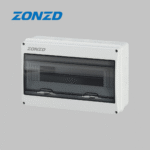
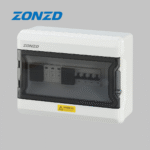
A 12″×12″×6″ NEMA 3R or 4X enclosure accommodates standard 3 string combiner components including three fuse holders, positive and negative busbars, 40A main breaker, Type 2 SPD, and grounding bus. For installations planning future expansion or string monitoring integration, specify 14″×12″×8″ or 16″×14″×8″ enclosures providing additional working space. The enclosure must maintain 6″ minimum clearance between energized components and walls per NEC 110.26. Total component weight typically ranges 8-15 pounds requiring sturdy mounting hardware.
No. Fuse sizing must equal or exceed 1.56× the string short-circuit current per NEC 690.9(B). For typical residential panels with 9-10A Isc, minimum fuse rating is 14-15.6A, requiring standard 15A fuses. Using 10A fuses causes nuisance operation during high irradiance conditions or cold weather when string current increases 10-20%. Always calculate fuse size based on module datasheet Isc, then select the next standard rating above the calculated minimum.
Each string requires an individual fuse per NEC 690.9(A). Using a single combined fuse (like one 40A fuse for three 10A strings) eliminates string-level protection and violates code. Individual fuses enable isolation of single faulted strings while other strings continue operating. They also provide reverse current protection preventing backfeed from paralleled strings into a faulted string. Never omit string-level fusing to save cost—the protection function is essential for safety and code compliance.
NEMA 3R enclosures provide rain-tight protection suitable for covered outdoor locations under eaves or on shaded walls. They feature drainage provisions and gaskets preventing water intrusion from rainfall. NEMA 4X enclosures offer superior protection against driving rain, windblown dust, and corrosion, with completely sealed gaskets and stainless or fiberglass construction. Use NEMA 3R for covered installations saving $50-100, or NEMA 4X for exposed roof mounts and coastal environments where the premium cost ensures 20+ year service life.
Calculate maximum combined string current (typically 9-10A per string × 3 = 27-30A), then multiply by 1.25 safety factor per NEC 690.8(A). For 30A combined current, minimum breaker rating is 37.5A. Select next standard size of 40A or 50A. The 40A rating provides better overload protection without risk of nuisance tripping. Verify the breaker has DC voltage rating exceeding system maximum Voc (use 1000V DC breaker for 600-700V systems). Never use AC breakers—they lack DC arc interruption capability.
Most jurisdictions require licensed electricians for any work on PV systems exceeding 1kW capacity. Even if local code permits DIY installation, proper combiner assembly requires knowledge of NEC Article 690, DC circuit protection principles, and safe electrical practices. Mistakes like using AC breakers in DC applications, undersized fuses, or improper grounding create serious safety hazards and void equipment warranties. For systems above 10kW, professional installation proves cost-effective compared to liability and insurance complications from improper DIY work.
Mount the combiner centrally between the three string origins, minimizing total conductor length from arrays to combiner. Position it on a north-facing wall or shaded location to reduce internal temperature. Keep the combiner within 10-15 feet of the inverter input to minimize voltage drop and simplify conduit routing. Maintain 36″ minimum working clearance in front of the combiner per NEC 110.26 for maintenance access. For ground-mount arrays, use weatherproof post mounts 18-24″ above grade preventing moisture and debris accumulation.
Ready to properly size and specify your 3 string PV combiner box with confidence in code compliance and long-term reliability? Contact SYNODE’s technical team for detailed component recommendations matching your specific panel specifications, system voltage, and installation environment. We provide complete combiner solutions with pre-calculated fuse sizing, busbar ratings, and NEC-compliant designs eliminating guesswork and ensuring first-time inspection approval.
Related Articles:
- PV Combiner Box Selection: String Count & Current Capacity
- 2 String PV Combiner Box Design for Residential Systems
- DC Circuit Breaker Selection for Solar Applications
フォーカスキーワード – **Primary Focus Keyword**: `3 string pv combiner box`
URLスラッグ
メタ・タイトル How to Size 3 String PV Combiner Boxes: Component Selection
メタディスクリプション 3 string PV combiner box sizing guide: component selection, busbar ratings, fuse coordination, enclosure sizing, and NEC compliance for residential solar systems.
コンテンツの階層: Tier 2 (Standard Content)
コンバージョンファネル: ファネルの真ん中(検討)
目標語数 2800-4000ワード
ターゲット・マーメイド・ダイアグラム 3
ランク数学の設定でこれらを設定し、公開する前にこのボックスを削除してください。.
A 12×12×6 inch NEMA 3R or 4X enclosure accommodates standard 3 string combiner components including three fuse holders, positive and negative busbars, 40A main breaker, Type 2 SPD, and grounding bus. For installations planning future expansion or string monitoring integration, specify 14×12×8 or 16×14×8 inch enclosures providing additional working space.
No. Fuse sizing must equal or exceed 1.56 times the string short-circuit current per NEC 690.9(B). For typical residential panels with 9-10A Isc, minimum fuse rating is 14-15.6A, requiring standard 15A fuses. Using 10A fuses causes nuisance operation during high irradiance conditions or cold weather when string current increases.
Each string requires an individual fuse per NEC 690.9(A). Using a single combined fuse eliminates string-level protection and violates code. Individual fuses enable isolation of single faulted strings while other strings continue operating. They also provide reverse current protection preventing backfeed from paralleled strings into a faulted string.
NEMA 3R enclosures provide rain-tight protection suitable for covered outdoor locations under eaves. NEMA 4X enclosures offer superior protection against driving rain, windblown dust, and corrosion, with completely sealed gaskets and stainless or fiberglass construction. Use NEMA 3R for covered installations or NEMA 4X for exposed roof mounts and coastal environments.
Calculate maximum combined string current (typically 9-10A per string × 3 = 27-30A), then multiply by 1.25 safety factor per NEC 690.8(A). For 30A combined current, minimum breaker rating is 37.5A. Select next standard size of 40A or 50A. Verify the breaker has DC voltage rating exceeding system maximum Voc.
Most jurisdictions require licensed electricians for any work on PV systems exceeding 1kW capacity. Even if local code permits DIY installation, proper combiner assembly requires knowledge of NEC Article 690, DC circuit protection principles, and safe electrical practices. For systems above 10kW, professional installation proves cost-effective.
Mount the combiner centrally between the three string origins, minimizing total conductor length. Position it on a north-facing wall or shaded location to reduce internal temperature. Keep within 10-15 feet of the inverter input to minimize voltage drop. Maintain 36 inch minimum working clearance in front per NEC 110.26 for maintenance access.