住所
304ノース・カーディナル
セント・ドーチェスター・センター(マサチューセッツ州02124
勤務時間
月曜日~金曜日:午前7時~午後7時
週末午前10時~午後5時
住所
304ノース・カーディナル
セント・ドーチェスター・センター(マサチューセッツ州02124
勤務時間
月曜日~金曜日:午前7時~午後7時
週末午前10時~午後5時

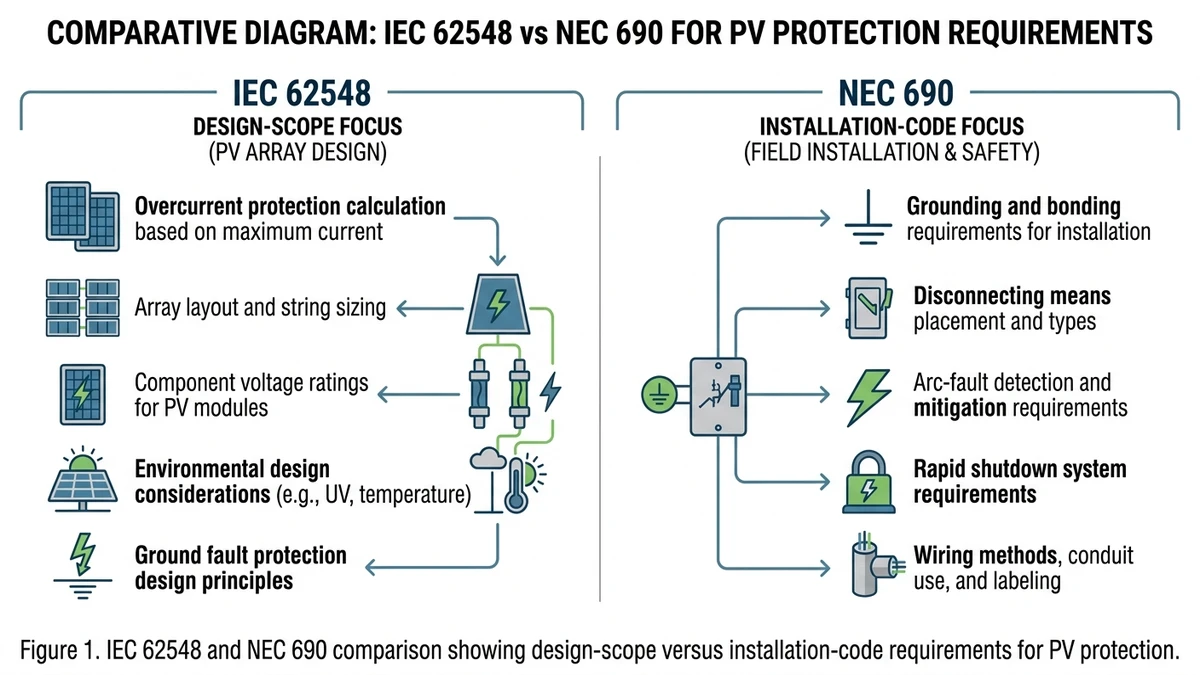
Choosing between IEC 62548 and NEC 690 starts with a simple question: are you designing to an international PV system standard, or installing under a binding U.S. electrical code?
IEC 62548 governs the design requirements for photovoltaic power systems globally, covering DC circuit protection from string level to inverter input. NEC 690 is a U.S. installation code enforced under NFPA 70, specifying wiring methods, disconnecting means, rapid shutdown, and overcurrent protection for PV systems. Both address DC protection in solar arrays, but they do so from different angles: IEC 62548 defines design intent, while NEC 690 defines what must be installed to pass inspection in the United States.
IEC 62548 is an international design standard rather than a prescriptive installation code. It sets system-level requirements for PV arrays up to 1500 VDC, including string overcurrent protection thresholds, reverse current protection for parallel strings, and selection of protective devices based on the prospective short-circuit current at the point of installation. In practice, engineers commonly begin with a minimum sizing baseline of 1.25 × Isc per string, then verify the selected device against module limits and related product standards such as IEC 60269-6 and IEC 60947.
NEC 690 is a U.S. installation code under NFPA 70. It mandates specific field requirements including disconnecting means, rapid shutdown systems, overcurrent protection, grounding and bonding provisions, and labeling. NEC 690.9 requires overcurrent protection where source-circuit current can exceed conductor ampacity, and compliance is enforced through permitting and inspection. A design that is technically sound under IEC principles can still fail U.S. approval if the installed components, markings, or shutdown functions do not meet NEC rules.
Both standards converge on DC overcurrent protection and fault isolation, yet device ratings, listing pathways, and mandatory functions can differ enough to derail procurement. A 直流遮断器 or gPV fuse suitable for a 1500 VDC IEC-based design may still lack the UL listing or installation attributes needed for NEC 690 compliance. In a 72 MW ground-mount project in Zhejiang Province in 2024 supplying equipment to a U.S. off-taker, that gap triggered full component re-qualification and added six weeks to procurement. For NEC disconnect rules specifically, the NEC 690.13 compliance checklist is a useful field reference.
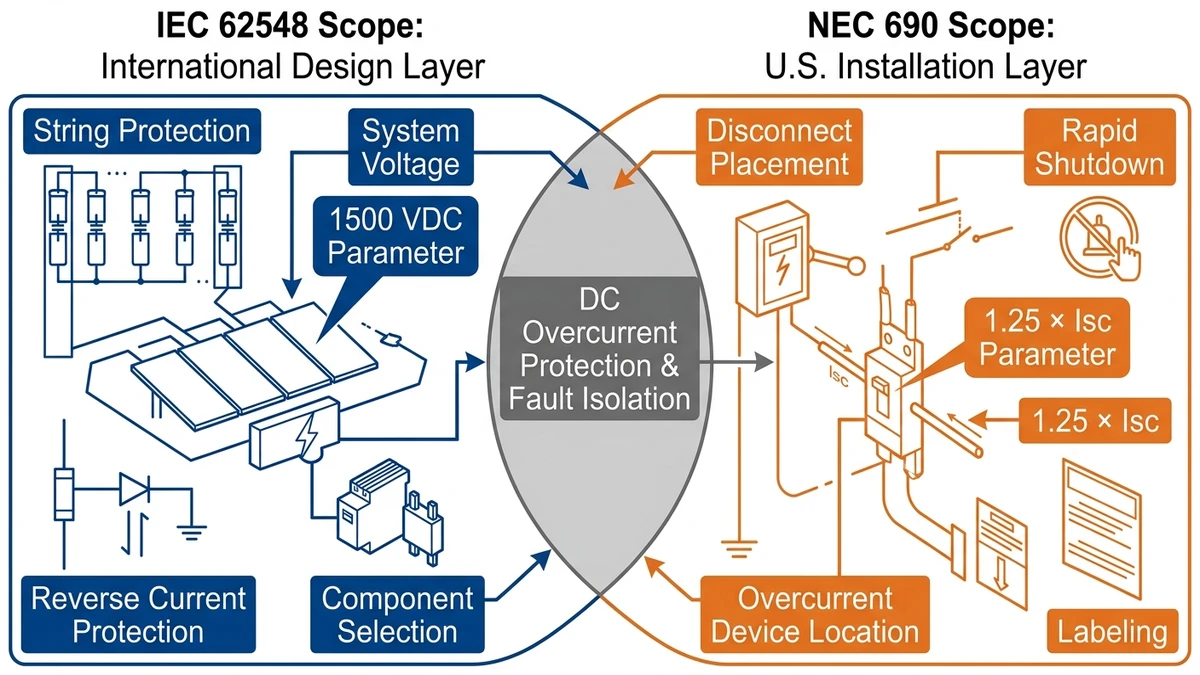
A category-by-category comparison shows where compliance paths separate in practice.
| Protection Category | IEC 62548 (EU/Global) | NEC 690 (North America) |
|---|---|---|
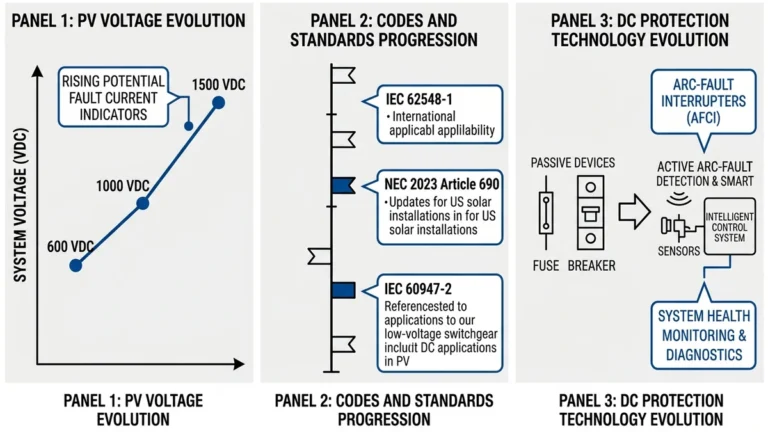
| Maximum System Voltage | Up to 1500 VDC per IEC 62548-1 §6.3 | 1500 VDC max for utility-scale; 600 VDC typical legacy boundary for many residential/commercial applications under NEC 690.7 |
| String Overcurrent Protection | Required when parallel strings create reverse current risk; gPV fuses typically selected per IEC 60269-6 | Required per NEC 690.9 when source-circuit current can exceed conductor ampacity |
| DC Disconnect Requirements | Isolator rated for full load current at system voltage; IEC 60947-3 governs load-break switches | Readily accessible disconnect per NEC 690.13; must be rated for maximum circuit voltage and current |
| Arc Fault Protection | Addressed as a risk-control topic, not universally mandated as dedicated hardware | Mandatory AFCI protection for PV systems on or penetrating buildings per NEC 690.11 |
| サージ保護 | IEC 61643-11 Type 1/2 SPDs; Up level commonly coordinated around system insulation limits | SPD use may be project-driven and product-standard-driven rather than universally mandated in Article 690 |
| Rapid Shutdown | No equivalent mandatory requirement in IEC 62548 | NEC 690.12 mandates voltage reduction for rooftop arrays |
Three categories create the biggest compliance split. Arc-fault protection is mandatory under NEC 690.11 for applicable building-mounted systems, while IEC 62548 treats it more as a design risk to be mitigated through layout and equipment choice. Rapid shutdown has no direct IEC equivalent, which is why IEC-only rooftop products often run into U.S. permitting barriers. Surge protection can also diverge because IEC practice tends to define coordination and protection levels more explicitly, while U.S. requirements often depend on the wider installation context and the listed device selected.
In a 35 MW ground-mount project in Zhejiang Province in 2024 designed for dual-market export, the engineering team had to retrofit NEC 690.12-compliant rapid shutdown controllers after IEC-only string inverters failed U.S. permitting review, adding roughly 6 to 8 weeks to commissioning. For component selection, DC MCB and gPV fuses should be chosen to the governing jurisdiction first; dual-certified products reduce risk substantially.
[Expert Insight]
– Lock the target market before BOM release; “IEC-ready” and “U.S.-permit-ready” are not the same procurement category.
– For rooftop exports to the U.S., check rapid shutdown and AFCI requirements before finalizing inverter and combiner selections.
– Ask suppliers for both the voltage rating and the certification pathway, not just a datasheet maximum VDC number.
String protection is one of the first places where cross-market projects discover that the same array does not automatically use the same fuse.
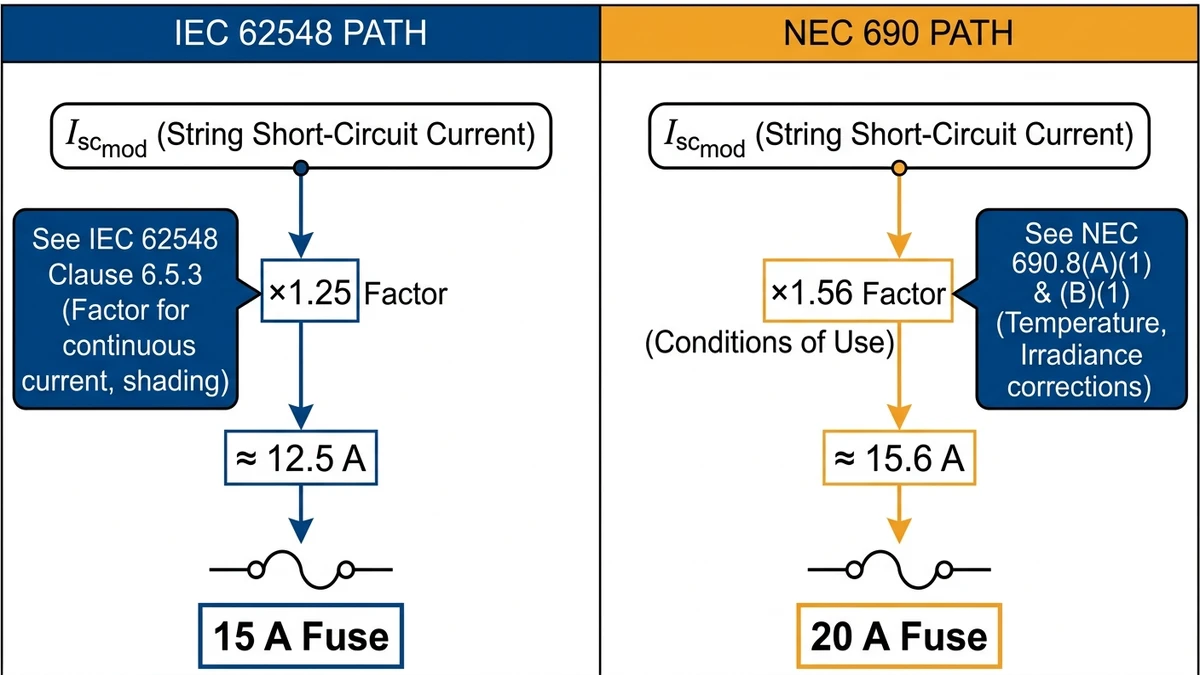
Both approaches begin with the same physical input: the string short-circuit current, I鱗, at Standard Test Conditions. For this worked example, assume a module with I鱗 = 10 A in a combiner box serving 10 parallel strings.
IEC 62548-1 Clause 9.4 governs overcurrent protection for PV string circuits. The standard requires that the fuse rated current meet the minimum current basis while staying within the module manufacturer’s maximum series fuse rating.
In ≥ 1.25 × Isc,mod and In ≤ Imax,module
Where Isc,mod = 10 A, the minimum fuse rating = 1.25 × 10 = 12.5 A. Rounded to the next standard size: 15 A.
The upper bound is set by the module’s maximum series fuse rating (typically 20 A for this module class), so the IEC-compliant selection is a 15 A gPV fuse rated to IEC 60269-6.
NEC 690.9(B) uses the familiar 1.56× result derived from 125% current treatment and 125% continuous-load treatment for PV source calculations.
In ≥ 1.56 × I鱗 = 1.56 × 10 = 15.6 A → rounded up to 20 A.
| パラメータ | IEC 62548 | NEC 690 |
|---|---|---|
| Multiplier applied | 1.25× I鱗 | 1.56× I鱗 |
| Calculated minimum | 12.5 A | 15.6 A |
| Selected fuse rating | 15 A | 20 A |
| Governing clause | IEC 62548-1 Cl. 9.4 | NEC 690.9(B) |
That 5 A difference has direct purchasing consequences. In a 62 MW ground-mount installation in Hebei Province in 2023, a procurement team sourced fuses to IEC ratings for a U.S.-bound project and then had to replace the entire combiner fuse inventory after the AHJ flagged NEC non-compliance. The gPV fuse selection guide and this overview of PV combiner box wiring standards both help teams identify the target code path before purchasing.
The difference between design guidance and mandatory hardware is especially clear when fault detection shifts from overcurrent protection to ignition prevention and personnel safety.
DC arc faults are particularly dangerous in photovoltaic systems because they lack the natural current zero crossing that helps extinguish AC arcs. According to the IEA’s 2024 Solar Integration Report, DC arc faults account for roughly 12–18% of unplanned outages in utility-scale PV plants operating above 1000 V, which helps explain the U.S. emphasis on rapid detection. NEC 690.11-compliant AFCI systems are generally expected to detect and interrupt hazardous arcs under UL 1699B test conditions.
IEC 62548 addresses arc-fault risk indirectly through wiring practices, segregation, insulation selection, and general system design, but it does not universally require dedicated AFCI hardware. NEC 690, by contrast, imposes hardware-level arc-fault protection requirements for applicable systems on or in buildings.
Ground fault protection shows a similar difference in philosophy. NEC 690.5 requires ground-fault protection for certain rooftop PV systems, with fault detection and disconnection behavior defined through the code and listed equipment. IEC 62548 commonly points designers toward insulation monitoring for IT-type systems and sound earthing practice, but without the same blanket device mandate. In a 35 MW rooftop installation across industrial facilities in Zhejiang Province in 2023, retrofitting NEC-compliant AFCI capability to an IEC-designed string architecture required replacing combiner-level protection hardware because the original DC circuit breakers had no series-arc detection function.
For dual-market projects, a practical baseline is to pair AFCI-capable inverters with properly rated gPV string fuses. That does not make IEC and NEC identical, but it closes one of the most common approval gaps.
[Expert Insight]
– On rooftop projects, verify whether AFCI functionality sits in the inverter, combiner, or module electronics before shop drawings are frozen.
– For troubleshooting nuisance trips, inspect connector compatibility and torque records first; many arc-fault alarms start as installation-quality issues.
– If the project uses IT earthing on an IEC design, confirm early whether the U.S. authority will accept the topology and what extra monitoring hardware is needed.
Beyond fault detection, NEC 690 also introduces operational safety functions that many IEC-only designs never have to accommodate.
NEC 690.12 requires PV systems on buildings to reduce conductor voltage within the array boundary to prescribed levels within 30 seconds of shutdown initiation. This requirement has driven broad adoption of module-level power electronics and rapid shutdown initiators in the U.S. rooftop market.
IEC 62548 has no direct equivalent. It addresses string-level protection and isolation but does not impose a firefighter-oriented voltage reduction timeline. In a 6.2 MW commercial rooftop project in Zhejiang Province in 2023, the team added NEC 690.12-compliant rapid shutdown initiators to satisfy a U.S.-based insurance underwriter, increasing BOS cost by roughly 4–6%.
Earthing philosophy also differs. NEC 690.47 ties PV grounding to the wider U.S. grounding and bonding framework, including conductor sizing rules in NEC 250.122 and explicit equipment grounding continuity. IEC 62548, via related IEC earthing standards, leaves more flexibility in conductor sizing and bonding topology, especially for IT-earthed utility-scale systems common in Europe.
For installers, that means U.S. projects usually demand more explicit grounding documentation, listed bonding hardware, and field-verifiable continuity. Additional guidance on U.S. disconnect obligations is covered in this DC disconnect switch compliance checklist.
For projects that may move between markets or serve multinational owners, the most reliable strategy is to design to the stricter requirement in each category instead of trying to retrofit later.
IEC 62548 bases maximum system voltage on expected operating conditions including low-temperature Voc. NEC 690.7 uses its own voltage calculation rules for equipment selection. In dual-market practice, select components to the higher resulting value, usually 1000 VDC or 1500 VDC. DC MCBs and MCCBs rated to 1500 VDC are often the safest common platform.
NEC sizing is typically the binding constraint. If IEC logic would permit a smaller string fuse but NEC requires the next standard size up, use the NEC-based value provided the module’s maximum series fuse rating still permits it.
Where rooftop or building-mounted U.S. compliance is possible, specify AFCI-capable equipment from the outset. An inverter or protection platform built to U.S. arc-fault requirements removes one of the hardest retrofit items later.
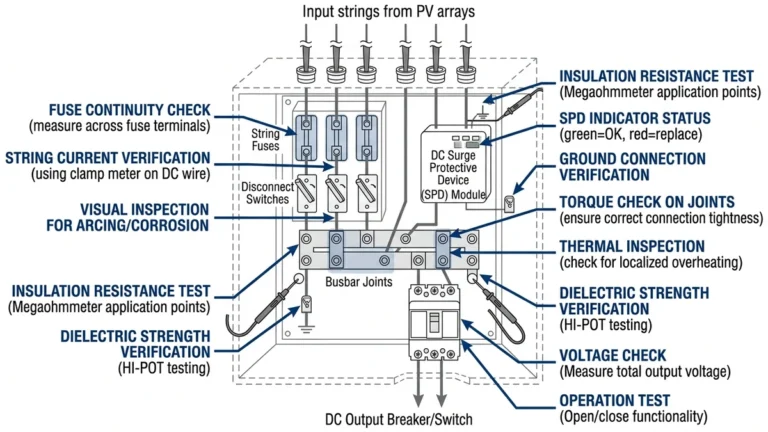
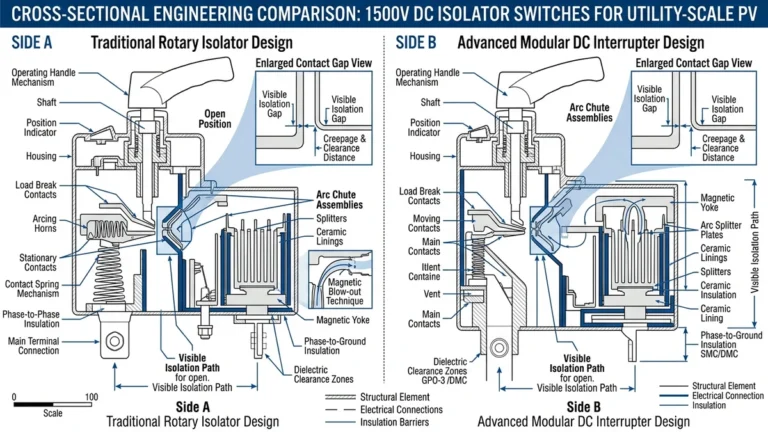
NEC 690.13 requires accessible disconnecting means, while IEC 62548 focuses on safe isolation for service and fault conditions. A properly rated 直流開閉器 placed at the array or combiner level can often satisfy both operating intent and serviceability needs, provided the U.S. accessibility rules are met.
For SPDs, verify both the protection level and the relevant product certification path. In a 60 MW ground-mount project in Hebei Province in 2024, engineers aligned both frameworks by selecting SPDs with a protection level around 2.5 kV and impulse capacity suitable for the installation environment. See surge protection device selection and this guide on installing surge protection to NEC 690.35 requirements for coordination details.
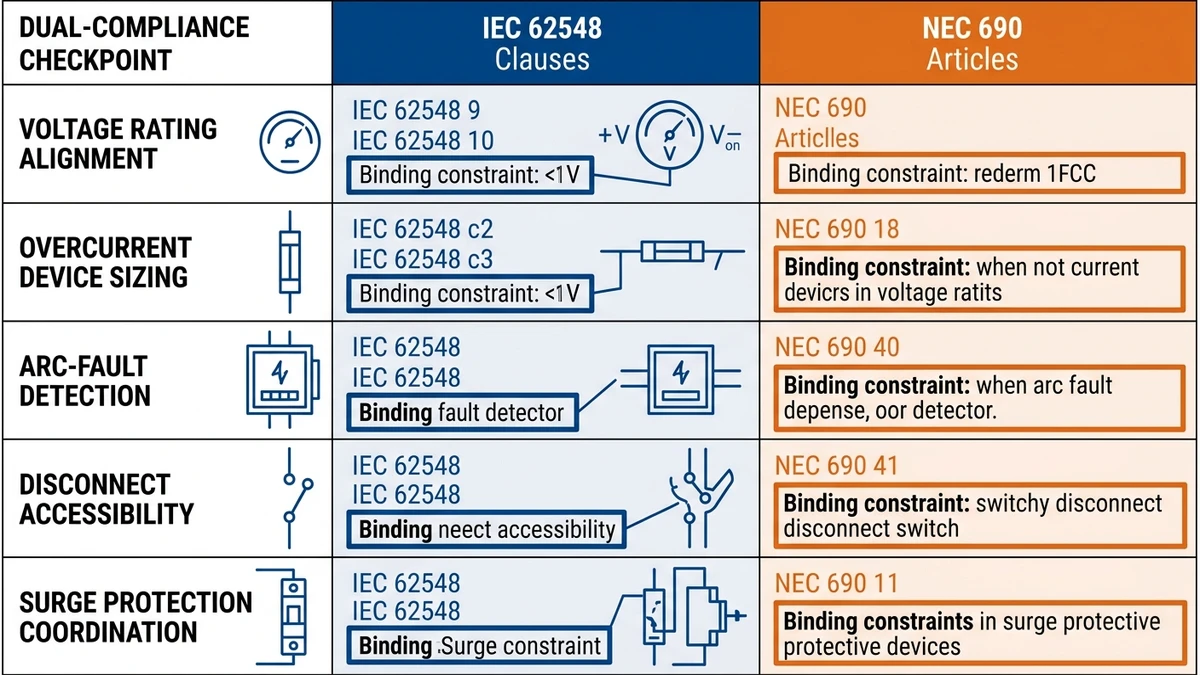
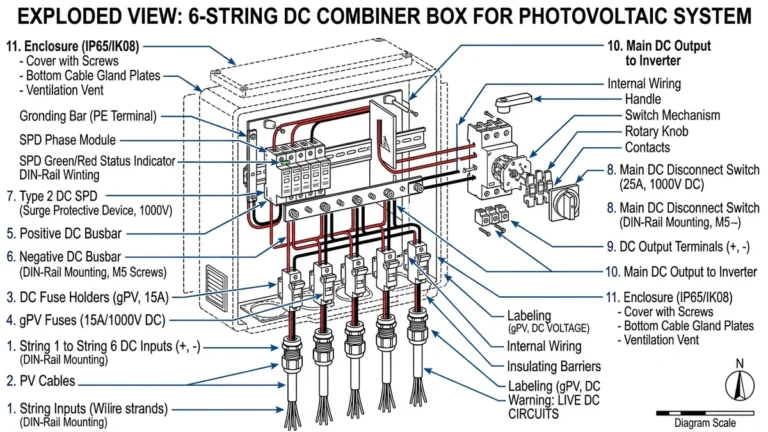
For combiner-level wiring that must satisfy both frameworks, the NEC 690.15 combiner box compliance guide covers conductor sizing and overcurrent coordination in more detail.
Once the standards are mapped to the target market, component selection depends on matching ratings, listings, and functions to the applicable code path.
For IEC 62548 projects, prioritize products aligned with IEC device standards such as IEC 60269-6 for gPV fuses and IEC 60947-based DC switching and breaker equipment. String protection should withstand the actual system Voc and fault conditions of the array, commonly at 1000 VDC or 1500 VDC utility-scale levels.
For NEC 690 projects, product listing matters as much as electrical rating. Overcurrent devices, disconnects, and shutdown-related hardware must be suitable for U.S. installation approval, not merely capable of operating at the voltage involved. A practical compliance reference for disconnect selection is available at DC disconnect switch NEC 690.13 compliance.
For formal reference, IEC 62548 is available through the IECウェブストア. In every market, start with verified voltage, current, interrupting capacity, and certification status before comparing price.
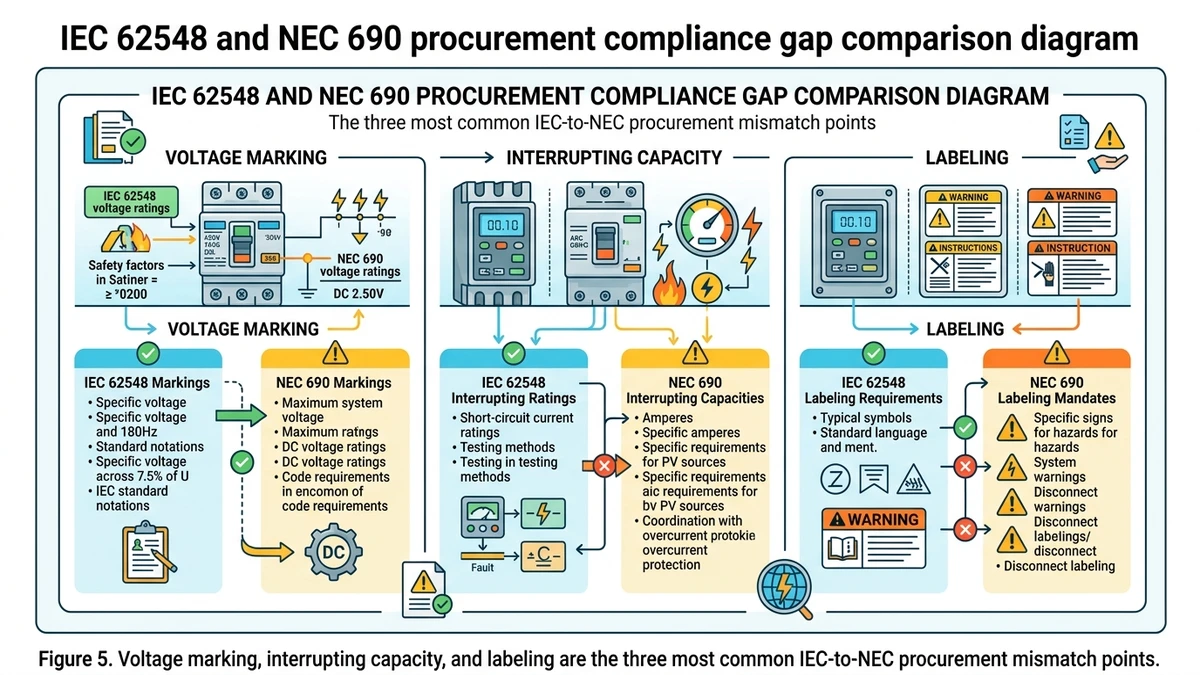
The last review step is to identify the recurring mismatches most likely to cause approval delays or rework.
IEC and NEC both require voltage calculations based on worst-case conditions, but they package the calculation differently. That can create a false sense of equivalence when teams compare only nominal string voltage. A string acceptable under an IEC-based design review may still require a higher marked equipment voltage for U.S. submission, especially in cold-climate applications.
Even when the selected fuse ampere rating looks correct, interrupting capacity can still become the failure point. Parallel-string combiners destined for U.S. projects often produce higher prospective fault calculations than the IEC purchasing team initially assumed. In a 60 MW ground-mount installation in Hebei Province in 2024, that mismatch caused pre-qualification failure when European-certified gPV fuses met the IEC design brief but not the U.S. project review criteria.
Labeling is another frequent blind spot. NEC 690 requires field-applied markings at disconnects and other PV equipment locations, while IEC compliance often relies more heavily on product-level markings and documentation. A system that is electrically sound and IEC-compliant may still need additional labels, warning notices, and directory information to satisfy a U.S. AHJ reviewing a PV combiner box or disconnect installation.
IEC 62548 is primarily a PV system design standard used internationally, while NEC 690 is a U.S. installation code enforced through permits and inspections.
Yes. A system can be properly designed under IEC rules but still fail U.S. approval if it lacks required listings, rapid shutdown capability, AFCI protection, or NEC-specific labeling.
NEC applies a more conservative current sizing approach for PV source circuits, which often pushes the selected fuse to the next higher standard ampere rating.
No. Rapid shutdown is a specific NEC requirement for applicable building-mounted PV systems and does not have a direct mandatory counterpart in IEC 62548.
Not in the same way. NEC can require dedicated arc-fault protection hardware, while IEC 62548 generally addresses arc risk through system design and installation practice.
Start by checking whether the final installation will be reviewed under NEC, then specify products with the necessary U.S. listings and functions from the beginning to avoid retrofit costs.
Yes, but it usually means designing to the stricter requirement in each category, especially for fuse sizing, arc-fault protection, disconnects, and rooftop shutdown functions.