Endereço
304 North Cardinal
St. Dorchester Center, MA 02124
Horas de trabalho
De segunda a sexta-feira: das 7h às 19h
Fim de semana: 10:00 - 17:00
Endereço
304 North Cardinal
St. Dorchester Center, MA 02124
Horas de trabalho
De segunda a sexta-feira: das 7h às 19h
Fim de semana: 10:00 - 17:00


A fusível do painel solar é um dispositivo especializado de proteção contra sobrecorrente projetado para interromper a corrente excessiva em sistemas fotovoltaicos antes que a fiação superaqueça ou o equipamento falhe. Diferentemente dos fusíveis de uso geral, os fusíveis de painéis solares precisam lidar com características exclusivas de CC: sem cruzamento zero de corrente natural, alta irrupção durante efeitos de borda de nuvem e operação contínua em alta temperatura em caixas combinadoras externas.
Este abrangente guia do produto explica os fundamentos do fusível do painel solar desde o início. Abordamos o que torna os fusíveis com classificação CC diferentes dos fusíveis CA, como ler as especificações dos fusíveis, a distinção fundamental entre fusíveis com classificação gPV e aM e os padrões internacionais (IEC 60269-6, UL 2579) que garantem a segurança e a confiabilidade do fusível.
Para instaladores de sistemas solares, projetistas de sistemas, proprietários de residências e profissionais de manutenção, entender a tecnologia de fusíveis de painéis solares evita os dois erros de especificação mais comuns: usar fusíveis com classificação AC em aplicações DC (risco de falha catastrófica) e selecionar classificações de corrente incorretas (queima incômoda ou proteção inadequada).
💡 Conceito de fundação: Um fusível de painel solar é um dispositivo de sacrifício que contém um elemento metálico que derrete quando a corrente excede a classificação. A principal diferença para aplicações solares: Os arcos de corrente contínua não se extinguem automaticamente em cruzamentos zero como os de corrente alternada, exigindo cargas especiais para extinção de arcos e classificações de tensão contínua.
Um sistema completo de proteção por fusível de painel solar consiste em dois componentes:
Elo fusível (elemento fusível):
- Elemento metálico: Condutor fino (cobre, prata ou liga de zinco) com seção transversal calibrada
- Enchimento de têmpera por arco: Areia de sílica (SiO₂) que envolve o elemento
- Corpo: Tubo de cerâmica (porcelana ou esteatita) classificado para altas temperaturas
- Tampas das extremidades: Contatos de cobre ou latão com indicador (alguns modelos)
- Classificações marcadas: Tensão (por exemplo, 1500V CC), corrente (por exemplo, 15A), padrão (gPV, IEC 60269-6)
Suporte do fusível (base do fusível):
- Clipes de contato: Tampas de extremidade do fusível de fixação em liga de cobre com mola
- Montagem: Trilho DIN, montagem em painel ou montagem em PCB
- Terminais de fios: Terminais de parafuso ou terminais de compressão
- Classificação do gabinete: IP20 (interno) a IP67 (externo à prova de intempéries)
- Janela do indicador: Detecção visual de fusível queimado (opcional)
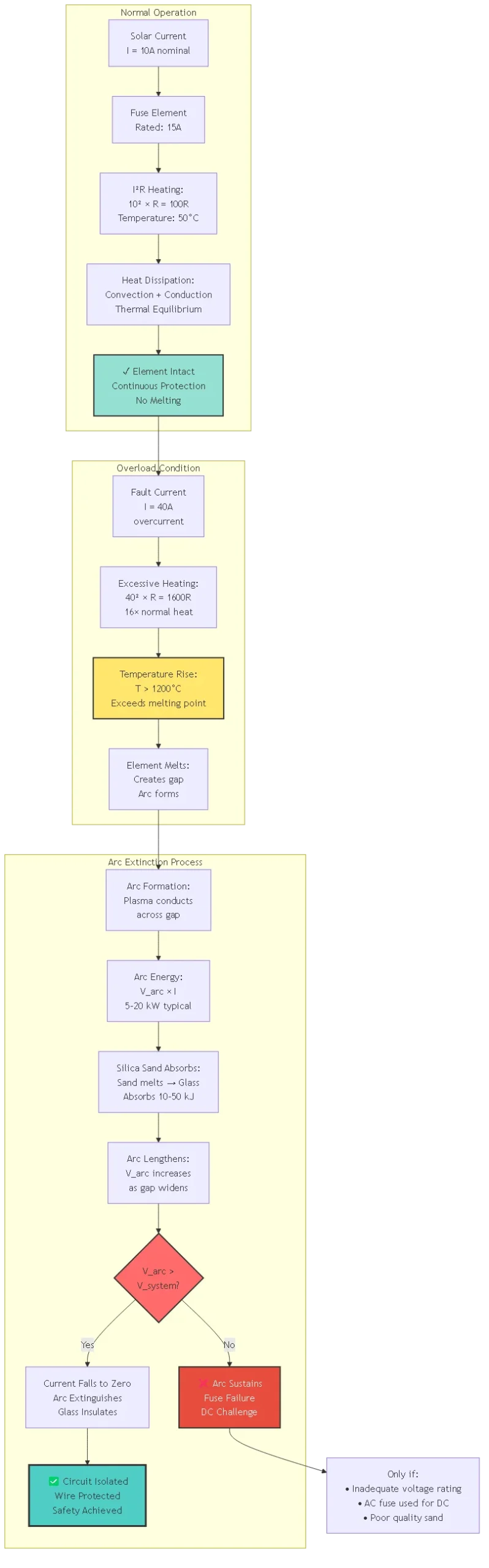
Estágio 1 - Operação normal:
- A corrente flui através do elemento metálico
- Aquecimento do elemento devido a perdas de I²R
- Temperatura em estado estável: 40-70°C (dependente do projeto)
- Seção transversal do elemento dimensionada para corrente contínua sem derretimento
- Equilíbrio térmico: geração de calor = dissipação de calor
Estágio 2 - Condição de sobrecarga:
- A corrente excede o valor nominal
- O aquecimento I²R aumenta com o quadrado da corrente
- A temperatura do elemento aumenta acima do ponto de fusão (1000-1400°C, dependendo da liga)
- O tempo de fusão depende da magnitude da sobrecorrente (característica inversa de tempo-corrente)
- Exemplo: a sobrecarga de 150% pode levar de 30 a 60 minutos, a sobrecarga de 300% leva de 2 a 5 segundos
Estágio 3 - Interrupção de arco:
- O elemento metálico derrete, criando uma lacuna
- Forma-se um arco através da lacuna (plasma condutor)
- A areia de sílica absorve a energia do arco
- O arco aquece a areia, criando vidro (fulgurita)
- O vidro não é condutor, extingue o arco elétrico
- Estado final: circuito aberto permanente
Desafio crítico de DC: Os arcos de CC têm tensão contínua para tentar manter o plasma. Areia de sílica de alta qualidade e comprimento adequado do fusível (38 mm, 58 mm ou mais para alta tensão) são essenciais para a extinção confiável do arco CC.
Classificações de tensão CA vs. CC:
| Tipo de fusível | Classificação de tensão CA | Classificação de tensão CC | Motivo da diferença |
|---|---|---|---|
| Fusível de uso geral | 250V CA | 60V CC (se classificado) | O cruzamento zero de CA ajuda na extinção |
| Fusível fotovoltaico (gPV) | Não classificado para CA | 1000V ou 1500V CC | Resfriamento de arco aprimorado para CC |
| Comprimento do fusível Impacto | 10 mm × 38 mm (10A) | 14 mm × 51 mm (corpo mais longo) | Caminho de arco mais longo para interrupção de CC |
Por que você não pode usar fusíveis CA para CC:
Os fusíveis CA dependem do fato de a corrente cruzar naturalmente o zero 100 a 120 vezes por segundo. No cruzamento do zero, o arco se extingue facilmente. A CC não tem cruzamento zero - o arco se mantém continuamente. Um fusível com classificação AC em um circuito DC pode:
- Falha ao interromper a corrente (o arco continua indefinidamente)
- Superaquecimento e explosão
- Causa incêndio na caixa combinadora
⚠️ Segurança crítica: Sempre verifique se o fusível está marcado com a classificação de tensão CC igual ou superior à tensão do sistema. Um fusível de 250 V CA NÃO é seguro para 250 V CC (ele pode suportar apenas 60-125 V CC).
Tamanhos de fusíveis padrão IEC:
| Código de tamanho | Diâmetro × Comprimento | Faixa de corrente típica | Classificação de tensão | Aplicativo |
|---|---|---|---|---|
| 10×38 | 10 mm × 38 mm | 1-32A | Até 1000V CC | Proteção de cordas residenciais |
| 14×51 | 14 mm × 51 mm | 2-63A | Até 1500V CC | Proteção de cordas comerciais |
| 22×58 | 22 mm × 58 mm | 10-125A | Até 1500V CC | Rede de matriz, saídas de combinador |
Tamanhos de classe UL (América do Norte):
| Classe | Dimensões | Faixa atual | Tensão | Aplicativo |
|---|---|---|---|---|
| CC | 13/32″ × 1-1/2″ | 1-30A | 600V CC | Energia solar residencial |
| T | 13/32″ × 1-1/4″ | 1-15A | 300V CC | Sistemas de baixa tensão |
| Anão | 13/32″ × 1-1/2″ | 1-30A | 600-1000V CC | Proteção de cordas |
Compatibilidade física: Os suportes de fusíveis são de tamanho específico. Um fusível de 10×38 não caberá em um suporte de 14×51. Ao substituir os fusíveis, faça a correspondência entre o tamanho físico e as classificações elétricas.
Classificação de gPV:
A designação “gPV” significa “fusível fotovoltaico de uso geral”, de acordo com a norma IEC 60269-6:
- g = uso geral (interrupção em toda a faixa, desde pequenas sobrecargas até curto-circuito máximo)
- PV = específico para aplicações fotovoltaicas
- Substitui a antiga designação “gR” (ação rápida de uso geral) para PV
Principais requisitos:
1. Classificação de tensão CC:
- Deve ser marcado com a tensão CC (por exemplo, 1000V CC, 1500V CC)
- Não pode exceder a tensão de circuito aberto do sistema (V_oc) na temperatura mais fria
- Redução de altitude: -10% por 1000m acima de 2000m de elevação
2. Classificação de corrente (I_n):
- Corrente nominal: o fusível carrega indefinidamente sem queimar
- Classificado a 25°C ambiente
- Deve ser desclassificado para temperaturas mais altas dentro das caixas combinadoras (geralmente de 50 a 70 °C)
3. Capacidade de ruptura (I_max):
- Mínimo de 50 kA para fusíveis gPV (suficiente para aplicações solares)
- Alguns fusíveis industriais com classificação de 120 kA
- As correntes de falha solar raramente excedem 5-10 kA (limitadas pelo módulo I_sc)
4. Característica de tempo-corrente:
- Corrente de fusão convencional (I_f): Corrente que causa a fusão em 2 horas
- Normalmente, I_f = 1,45 × I_n (fusível de 15 A com 21,75 A em 2 horas)
- Corrente convencional sem fusível (I_nf): Corrente transportada por 2 horas sem fusível
- Normalmente, I_nf = 1,25 × I_n (o fusível classificado como 15A carrega 18,75A por 2 horas)
5. Classificação I²t (energia de passagem):
- Energia permitida pelo fusível antes da liberação: ∫ I²(t) dt
- Crítico para a proteção de semicondutores (entradas do inversor)
- Menor I²t = fusível mais rápido, melhor proteção para equipamentos sensíveis
Escopo e aplicação:
A UL 2579 abrange fusíveis projetados especificamente para sistemas fotovoltaicos, inclusive:
- Fusíveis de cadeia (módulos conectados em série)
- Fusíveis combinadores (cadeias paralelas)
- Fusíveis da matriz (proteção principal)
Principais diferenças em relação à IEC:
| Aspecto | IEC 60269-6 | UL 2579 |
|---|---|---|
| Classes de tensão | 1000V DC, 1500V DC padrão | 600V CC comum, 1000V CC, 1500V CC |
| Designação de tamanho | 10×38, 14×51, 22×58 (mm) | Classe CC, T, Midget (polegadas) |
| Requisitos de marcação | Marcação gPV obrigatória | Marcação fotovoltaica, tensão CC, corrente |
| Teste de temperatura | 25°C, 40°C, 70°C ambiente | 40°C, 60°C ambiente (superior) |
| Teste de interrupção de arco | L/R = constante de tempo de 15 ms | A relação X/R varia de acordo com a classificação |
Requisitos NEC:
O Artigo 690.9 do Código Elétrico Nacional exige:
- Dispositivo de sobrecorrente classificado para tensão CC
- Localizado nos condutores positivo e negativo (sistemas não aterrados)
- Acessível para manutenção
- Capacidade de interrupção ≥ corrente de falha disponível
Classificação aM (proteção do motor):
- a = interrupção parcial da faixa (interrompe apenas curtos-circuitos, não pequenas sobrecargas)
- M = proteção do circuito do motor
- Ação rápida para curtos-circuitos (I > 10× I_n)
- NÃO protege contra pequenas sobrecargas (1,5-3× I_n)
Quando aM usado em Solar:
- Projetos mais antigos antes do padrão gPV
- Não deve ser usado em novas instalações
- Risco: não elimina condições de sobrecorrente moderadas
Classificação gPV (PV de uso geral):
- g = quebra de faixa completa (protege contra todas as sobrecorrentes)
- Elimina sobrecargas E curtos-circuitos
- Necessário para proteção completa do fio por NEC 690.9
🎯 Regra de especificação: Sempre especifique fusíveis com classificação gPV para a proteção do painel solar. Nunca use fusíveis de classificação aM para proteção de string ou combinador - eles fornecem proteção incompleta.

Fórmula para fusível de corda solar:
I_fuse ≥ I_sc × 1,56
Onde:
- I_sc = corrente de curto-circuito do módulo (da folha de dados)
- 1,56 = fator combinado (1,25 para alta irradiância × 1,25 para operação contínua)
Exemplo passo a passo:
Sistema: Telhado residencial, módulos de 400W, I_sc = 11,24A
Etapa 1 - Identificar I_sc:
- Folha de dados do módulo: I_sc = 11,24A em STC (1000 W/m², 25°C)
Etapa 2 - Aplique o multiplicador NEC:
- I_fuse_min = 11,24A × 1,56 = 17,53A
Etapa 3 - Selecione a classificação padrão:
- Classificações de fusíveis padrão: 10A, 12A, 15A, 16A, 20A, 25A...
- Selecionado: Fusível de 20A (próximo tamanho acima de 17.53A)
Etapa 4 - Verifique se a operação não é incômoda:
- Corrente convencional sem fusível do fusível: I_nf = 20A × 1,25 = 25A
- Corrente máxima da string: 11,24A × 1,25 (alta irradiância) = 14,05A
- 14,05A < 25A ✓ (o fusível não queimará durante a operação normal)
Os fusíveis são classificados para um ambiente de 25°C. Dentro de uma caixa combinadora em um telhado, o ambiente pode chegar a 50-70°C.
Fórmula de derivação:
I_actual = I_rated × k_temp
Onde k_temp é o fator de correção de temperatura:
| Temperatura ambiente | k_temp | Classificação de corrente efetiva (exemplo de fusível de 15A) |
|---|---|---|
| 25°C | 1.00 | 15.0A |
| 40°C | 0.95 | 14.25A |
| 50°C | 0.90 | 13.5A |
| 60°C | 0.85 | 12.75A |
| 70°C | 0.80 | 12.0A |
Exemplo com correção de temperatura:
- Mínimo calculado: 17.53A
- Fusível padrão: 20A
- Temperatura da caixa combinadora: 60°C (telhado típico no verão)
- Capacidade reduzida: 20A × 0,85 = 17,0A
- Problema: 17,0A < 17,53A necessários
Solução: Selecione o próximo tamanho acima:
- Fusível de 25 A nominal
- A 60°C: 25A × 0,85 = 21,25A ✓
- Margem adequada para operação a quente
⚠️ Prática de design: Para caixas combinadoras em telhados, considere um mínimo de 60°C no ambiente. Para instalações no deserto, use 70°C. Selecione a classificação do fusível com a redução de temperatura aplicada.
Reverter o cenário atual:
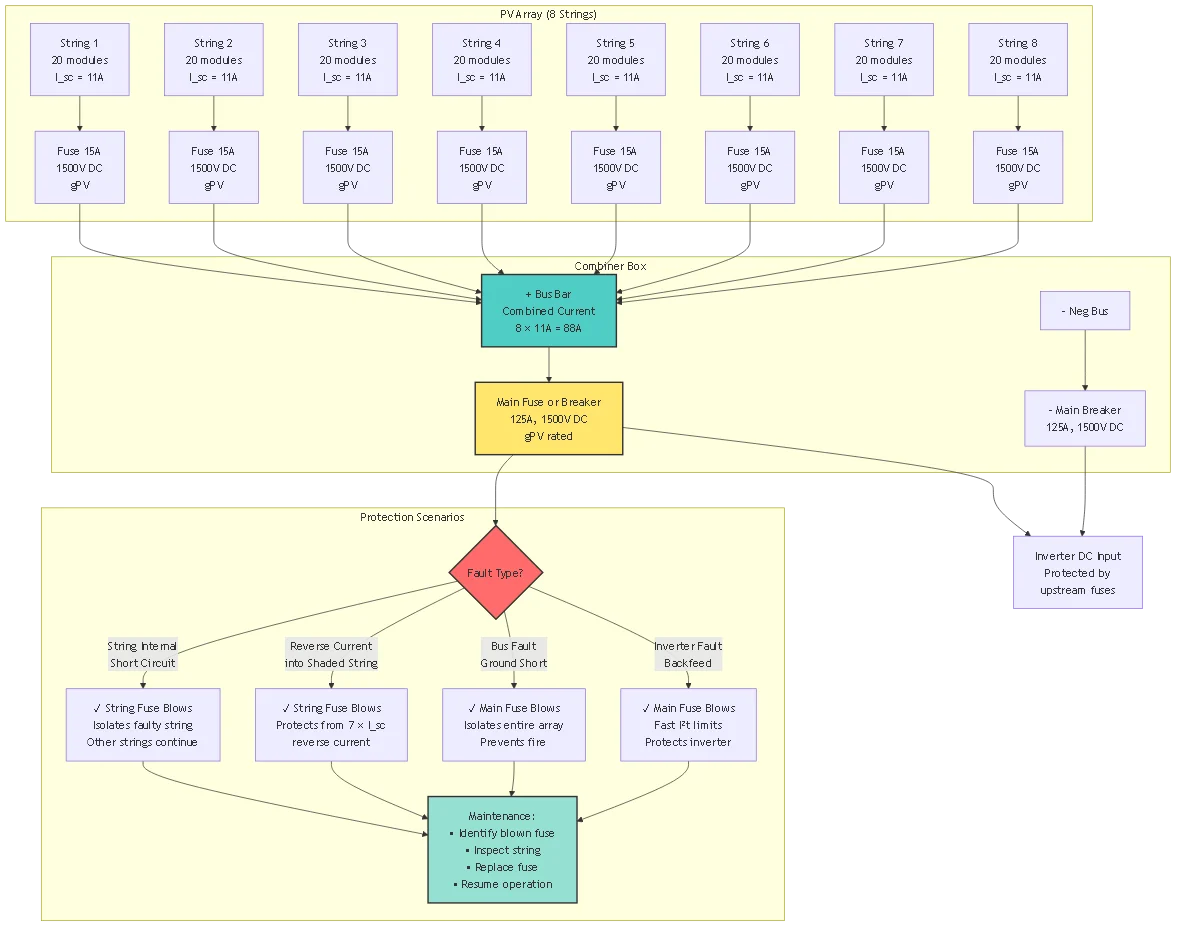
Em matrizes com vários strings paralelos, se um string estiver sombreado ou sofrer um curto-circuito, os outros strings poderão descarregar nele:
- Matriz: 8 cadeias paralelas, I_sc = 10A cada
- String #3 em curto-circuito com o terra
- Corrente reversa na cadeia de caracteres #3: 7 cadeias de caracteres × 10A = 70A
Requisito NEC 690.9(A):
Os cabos devem ser protegidos contra corrente reversa se:
Corrente reversa calculada > classificação do fusível × 1,35
Cálculo:
I_reverse = (N - 1) × I_sc
Onde:
- N = número de cadeias paralelas
- I_sc = corrente de curto-circuito por string
Exemplo:
- 8 cadeias paralelas, I_sc = 10A
- I_reverse = (8 - 1) × 10A = 70A
- Folha de dados do módulo Classificação máxima do fusível em série: 20A (especificação típica)
- 70A > 20A × 1,35 → Fusíveis necessários ✓
Quando os fusíveis não são necessários:
Para matrizes pequenas:
- 2 cordas paralelas: I_reverse = 1 × I_sc = I_sc → Geralmente não é necessário fusível
- Verifique a folha de dados do módulo “Classificação máxima do fusível da série”
- Se I_reverse < a classificação de fusível especificada, os fusíveis podem ser omitidos
Prática moderna: A maioria dos instaladores funde todos os fios para facilitar a manutenção e a solução de problemas, mesmo que a NEC não exija isso.

Caixas combinadoras internas (ambiente controlado):
- IP20 mínimo: Protegido contra objetos de >12 mm, sem proteção contra água
- Aplicação típica: Sala de equipamentos, porão, armário de utilidades
- Custo: $5-15 por porta-fusível
Caixas combinadoras externas (montagem no teto e no solo):
- IP65 mínimo: À prova de poeira, protegido contra jatos de água
- IP67 recomendado: À prova de poeira, protegido contra imersão temporária
- Recursos necessários: Gaxetas, terminais selados, tampa à prova de intempéries
- Custo: $15-35 por porta-fusível
Ambientes costeiros/marinhos:
- IP67 mínimo com materiais resistentes à corrosão
- Terminais de aço inoxidável ou de latão niquelado
- Carcaça de polímero resistente a UV
- Custo: $25-50 por porta-fusível
Porta-fusíveis para montagem em trilho DIN:
Vantagens:
Instalação sem ferramentas (encaixe no trilho de 35 mm)
Alta densidade (largura estreita: 6-12 mm por fusível)
Fácil rearranjo e adição
Design modular para expansão do sistema
Desvantagens:
Requer infraestrutura de trilho DIN na caixa combinadora
Acomodação limitada do tamanho do fio (normalmente de 6 a 10 AWG)
Mais caro por posição ($12-25)
Porta-fusíveis para montagem em painel:
Vantagens:
Custo mais baixo ($5-15 por suporte)
Terminais de fios maiores (capacidade de 4-1/0 AWG)
Pode ser posicionado em qualquer lugar do painel
Montagem simples (2 a 4 parafusos)
Desvantagens:
Requer a perfuração de orifícios de montagem
Posição fixa (mais difícil de reconfigurar)
Menor densidade (espaçamento típico de 3-4″)
Guia de seleção:
- Sistemas residenciais (<20kW): Trilho DIN para instalação limpa e profissional
- Sistemas comerciais (20-500kW): Montagem em painel para capacidade de fios pesados
- Escala de utilidade pública (>500kW): Sistemas de barramento personalizados com fusíveis aparafusados
Indicadores visuais:
Indicador de pino de ataque:
- Um pequeno pino se projeta da tampa da extremidade do fusível quando o elemento derrete
- Visível através da janela do porta-fusível
- Operação mecânica (sem componentes eletrônicos)
- Custo: +$2-5 por fusível versus não indicador
Módulos indicadores de LED:
- Módulo de LED separado detecta queda de tensão no fusível
- Acende quando o fusível está queimado
- Requer uma pequena potência auxiliar (2-5W)
- Custo: $20-40 por módulo indicador
Monitoramento remoto:
- Status do fusível transmitido ao sistema de monitoramento
- Integração com SCADA ou monitoramento do inversor
- Contato seco ou saída Modbus
- Custo: $50-150 por posição monitorada
Análise de valor:
- Sistemas pequenos (1-4 cordas): Indicadores visuais adequados
- Sistemas médios (5 a 20 strings): Os indicadores LED aumentam a velocidade de solução de problemas
- Sistemas grandes (>20 cordas): Monitoramento remoto justificado pela redução do número de caminhões

| Aspecto | Fusível de painel solar | Disjuntor CC |
|---|---|---|
| Tempo de resposta | Muito rápido (1-5 ciclos) I²t limited | Rápido (3-10 ciclos) Maior taxa de transferência |
| Resetabilidade | Uso único Deve ser substituído | Reinicializável Viagens ilimitadas |
| Custo | Inicial baixo: $3-15 Custo de reposição em cada viagem | Inicial alto: $30-120 Sem custo de substituição |
| Precisão | Tolerância apertada ±10% classificação de corrente | ⚠️ Tolerância mais ampla Classificação de corrente ±20% |
| Tamanho | Compacto: 10-22 mm de diâmetro Alta densidade | Maior: 18-72 mm de largura Menor densidade |
| Manutenção | Substituir após a viagem Peças de reposição necessárias | Chave de reinicialização Sem estoque de peças |
| Modo de falha | Circuito aberto (seguro) | Pode soldar fechado (perigo) |
Use fusíveis para:
✅ Proteção no nível da corda: Strings fotovoltaicas individuais em caixas combinadoras
- Motivo: Baixo custo por string (8 strings × $10 = $80 vs. 8 disjuntores × $40 = $320)
- Falhas pouco frequentes (os strings raramente falham)
- Alta precisão de proteção
✅ Proteção da entrada do inversor: Entrada CC para o inversor
- Motivo: Limites ultrarrápidos de I²t protegem semicondutores sensíveis
- I²t do fusível (10-50 A²s) << passagem do disjuntor (200-1000 A²s)
✅ Proteção em nível de célula do banco de baterias: Cadeias de células individuais
- Motivo: Resposta rápida ao curto-circuito interno da célula
- Tamanho compacto para pacotes de bateria densos
Use disjuntores para:
✅ Saída do combinador (matriz principal): Desconexão principal após a combinação de todas as cordas
- Motivo: Reinicializável para solução de problemas e manutenção
- Menor custo a longo prazo (várias viagens incômodas durante o comissionamento)
✅ Locais acessíveis: Equipamento acessível aos operadores
- Motivo: Reinicialização sem envio de técnico
- Indicação visível de disparo
✅ Troca frequente: Aplicativos que exigem isolamento regular
- Motivo: Operações mecânicas ilimitadas
- Os fusíveis não foram projetados para o serviço de abertura e fechamento
Abordagem híbrida (comum em sistemas comerciais):
- Nível da cadeia de caracteres: Fusíveis (15A gPV, 1500V CC)
- Saída do combinador: Disjuntor (160A, 1500V CC)
Custo total do sistema de 10 cordas:
- Fusíveis: 10 × $12 + 10 × $8 suportes = $200
- Disjuntor principal: $250
- Total: $450
Compare com a abordagem de todos os disjuntores:
- 10 disjuntores de corda: 10 × $40 = $400
- Disjuntor principal: $250
- Total: $650
O híbrido economiza $200 (31%) e mantém o alto desempenho.
Não, absolutamente não. Os fusíveis de CA dependem do fato de a corrente cruzar naturalmente o zero 100 a 120 vezes por segundo, onde o arco se extingue automaticamente. A CC não tem cruzamentos de zero; o arco se mantém continuamente. Um fusível de 250 V CA só pode lidar com segurança com 60 a 125 V CC devido aos desafios de extinção de arco. O uso de fusíveis CA em aplicações solares CC cria um risco catastrófico de falha: o arco pode não se extinguir, causando explosão do fusível, incêndio na caixa combinadora ou corrente de falha contínua que danifica a fiação e os módulos. Verifique sempre se os fusíveis estão marcados com a classificação de tensão CC (por exemplo, “1500V CC”) e a designação gPV de acordo com a certificação IEC 60269-6 ou UL 2579 para aplicações fotovoltaicas.
Use a fórmula NEC 690.9: I_fuse ≥ I_sc × 1,56, em que I_sc é a corrente de curto-circuito do módulo da folha de dados. O fator 1,56 leva em conta as condições de alta irradiância (1,25 × normal) e a redução da operação contínua (1,25 × térmica). Selecione a próxima classificação de fusível padrão acima do valor calculado. Exemplo: módulo I_sc = 11A dá 11 × 1,56 = 17,16A mínimo, portanto, selecione o fusível de 20A. Em seguida, verifique a redução de temperatura para o ambiente da caixa do combinador - as caixas de teto podem atingir 60-70°C, exigindo uma margem de capacidade de 15-20%. Se o combinador estiver a 60°C, o fusível de 20A se tornará efetivamente 20 × 0,85 = 17A, o que é marginal; em vez disso, selecione 25A.
“gPV” significa “fusível fotovoltaico de uso geral”, de acordo com a norma IEC 60269-6. O “g” significa capacidade de interrupção em toda a faixa: o fusível protege contra pequenas sobrecargas (1,5 a 3 vezes a corrente nominal) e altos curtos-circuitos (até 50kA+). A designação “PV” significa que o fusível foi aprovado em testes especializados para aplicações fotovoltaicas: Interrupção de arco CC a 1000-1500 V CC, desempenho em alta temperatura ambiente (70 °C) e proteção contra corrente reversa. Isso o diferencia dos fusíveis “aM” (motor), que interrompem apenas curtos-circuitos, não sobrecargas, fornecendo proteção incompleta. A norma NEC 690.9 exige proteção total contra sobrecorrente, o que torna os fusíveis com classificação gPV obrigatórios para a proteção adequada da cadeia fotovoltaica e do combinador.
Os fusíveis são dispositivos de “substituição em caso de falha”, sem intervalo de substituição programado se não estiverem queimados. Um fusível de tamanho adequado e não queimado pode permanecer em serviço por 20 a 30 anos (a vida útil do sistema). Entretanto, recomenda-se uma inspeção visual durante a manutenção anual: verifique se há descoloração (superaquecimento), corrosão nas tampas das extremidades ou rachaduras no corpo de cerâmica. Substitua se houver alguma degradação visível. Em ambientes agressivos (névoa salina costeira, poeira do deserto, ciclos de temperaturas extremas), considere a substituição por 10 anos como medida preventiva. Após a queima de um fusível, nunca o substitua sem investigar a causa raiz - falhas repetidas do fusível indicam falha do sistema (sombreamento, falha do módulo, falha de aterramento ou classificação de fusível subdimensionada).
O tamanho físico determina a classificação de tensão e a capacidade de interrupção, não a classificação de corrente. Um fusível de 15A / 1000V CC é fornecido nos tamanhos de 10×38 mm e 14×51 mm. O tamanho maior de 14×51 mm oferece: (1) Maior capacidade de interrupção - o corpo mais longo permite que mais areia de sílica absorva a energia do arco, possibilitando a interrupção de correntes de falta mais altas; (2) Melhor dissipação de calor - a maior área de superfície mantém o elemento mais frio em altas temperaturas ambientes; (3) Maior capacidade de tensão - alguns fusíveis de 14×51 mm são classificados como 1500 V CC, enquanto os de 10×38 mm normalmente atingem no máximo 1000 V CC. Escolha 10×38 mm para sistemas residenciais (com restrição de espaço) com níveis de falta moderados; use 14×51 mm para sistemas comerciais/utilitários com correntes de falta disponíveis mais altas e sistemas de 1500 V CC. Certifique-se de que o porta-fusível corresponda ao tamanho físico.
A NEC 690.9(A) exige proteção contra sobrecorrente em ambos os condutores não aterrados na maioria dos sistemas fotovoltaicos. Para sistemas típicos não aterrados (flutuantes) sem referência direta de aterramento, isso significa fusíveis em AMBOS os condutores positivos e negativos. Se o sistema estiver aterrado (condutor negativo ligado ao terra), somente o condutor positivo precisará de fusível de acordo com a NEC 690.9(B). Motivo: a falha do positivo para o terra cria um caminho de retorno através do negativo aterrado, exigindo que o fusível positivo seja eliminado. Prática moderna: mesmo em sistemas aterrados, muitos instaladores fundem ambas as polaridades para simetria e simplicidade na solução de problemas. A diferença de custo é mínima (2 fusíveis em vez de 1), mas simplifica a manutenção e garante a proteção independentemente do local da falha de aterramento.
Métodos de inspeção visual: (1) Pino indicador - muitos fusíveis de gPV têm um pequeno pino marcador que se projeta da tampa da extremidade quando o elemento derrete; visível através da janela do porta-fusível; (2) Inspeção da janela - alguns corpos de fusíveis de cerâmica têm uma seção transparente que mostra o elemento; se o elemento parecer cortado ou enegrecido, o fusível está queimado; (3) Comportamento do sistema - se a tensão de uma cadeia for 0 V enquanto as outras forem normais, o fusível dessa cadeia provavelmente está queimado. Para verificação definitiva sem remover o fusível: use a medição de tensão nos terminais do fusível; uma queda de >0,5 V indica fusível aberto (queimado). NÃO confie apenas na aparência do fusível - o elemento pode derreter internamente sem sinais externos visíveis. Para uma verificação rápida em campo, mantenha um fusível de sacrifício “bom conhecido” para testar a posição suspeita.
Os fusíveis de painel solar representam uma tecnologia crítica de proteção contra sobrecorrente projetada especificamente para aplicações fotovoltaicas. Diferentemente dos fusíveis CA de uso geral, os fusíveis solares precisam interromper arcos CC sustentados em tensões de até 1.500 V CC, suportar operação contínua em alta temperatura em caixas combinadoras externas e fornecer classificações de corrente precisas que correspondam às especificações do módulo solar.
Principais fundamentos tecnológicos:
Projeto específico para DC: Os fusíveis para painéis solares empregam cargas aprimoradas de areia de sílica para extinção de arcos e comprimentos de corpo mais longos (14×51 mm, 22×58 mm) para extinguir de forma confiável os arcos CC que não possuem cruzamentos zero naturais. A classificação gPV de acordo com a norma IEC 60269-6 certifica a proteção contra sobrecorrente de faixa completa, desde sobrecargas de corrente nominal de 1,25 × até curtos-circuitos de 50kA+.
Metodologia de dimensionamento adequado: A norma NEC 690.9 exige classificação de corrente do fusível ≥ I_sc × 1,56 (1,25 para alta irradiância × 1,25 para operação contínua). A redução da temperatura é essencial para instalações em telhados - caixas combinadoras de 60°C reduzem a capacidade do fusível 15%, exigindo o próximo tamanho a partir do cálculo.
Conformidade com os padrões: IEC 60269-6 (padrão internacional gPV) e UL 2579 (padrão norte-americano de fusíveis fotovoltaicos) garantem características adequadas de interrupção de arco CC, resistência à tensão e tempo-corrente. Nunca substitua os fusíveis com classificação AC ou aM (motor) - proteção incompleta e risco de falha catastrófica.
Aplicativo estratégico: Os fusíveis são excelentes para proteção em nível de string, onde o tamanho compacto, o baixo custo ($8-15) e a limitação ultrarrápida de I²t protegem os módulos e a fiação. Os disjuntores são mais adequados para redes de matriz e posições comutadas com frequência. A abordagem híbrida (strings com fusíveis + disjuntor principal) otimiza o custo e o desempenho.
Para instaladores de energia solar, projetistas de sistemas e profissionais de manutenção, a seleção e a aplicação adequadas de fusíveis de painéis solares garantem sistemas fotovoltaicos seguros e confiáveis que protegem o pessoal, os equipamentos e a propriedade durante 25 a 30 anos de vida útil do sistema.
Recursos relacionados à proteção solar:
- Projeto do sistema de fusíveis solares - Estratégias de proteção em vários níveis
- Projeto da caixa combinadora fotovoltaica - Especificações completas do combinador
- Coordenação do DC SPD - Integração de proteção contra surtos
Suporte ao produto: A SYNODE oferece suporte de engenharia de aplicação para a seleção de fusíveis solares, cálculos de redução de temperatura e verificação de conformidade com a NEC. Entre em contato com nossa equipe técnica para obter recomendações específicas do sistema e serviços de revisão do projeto da caixa combinadora.
Última atualização: Outubro de 2025
Autor: Equipe de engenharia de produtos SYNODE
Revisão técnica: Engenheiros de projeto solar, especialistas certificados pela NABCEP
Padrões referenciados: IEC 60269-6:2016, UL 2579:2021, Artigo 690 do NEC:2023