Adresse
304 Nord Kardinal
St. Dorchester Center, MA 02124
Arbeitszeiten
Montag bis Freitag: 7AM - 7PM
Am Wochenende: 10AM - 5PM
Adresse
304 Nord Kardinal
St. Dorchester Center, MA 02124
Arbeitszeiten
Montag bis Freitag: 7AM - 7PM
Am Wochenende: 10AM - 5PM

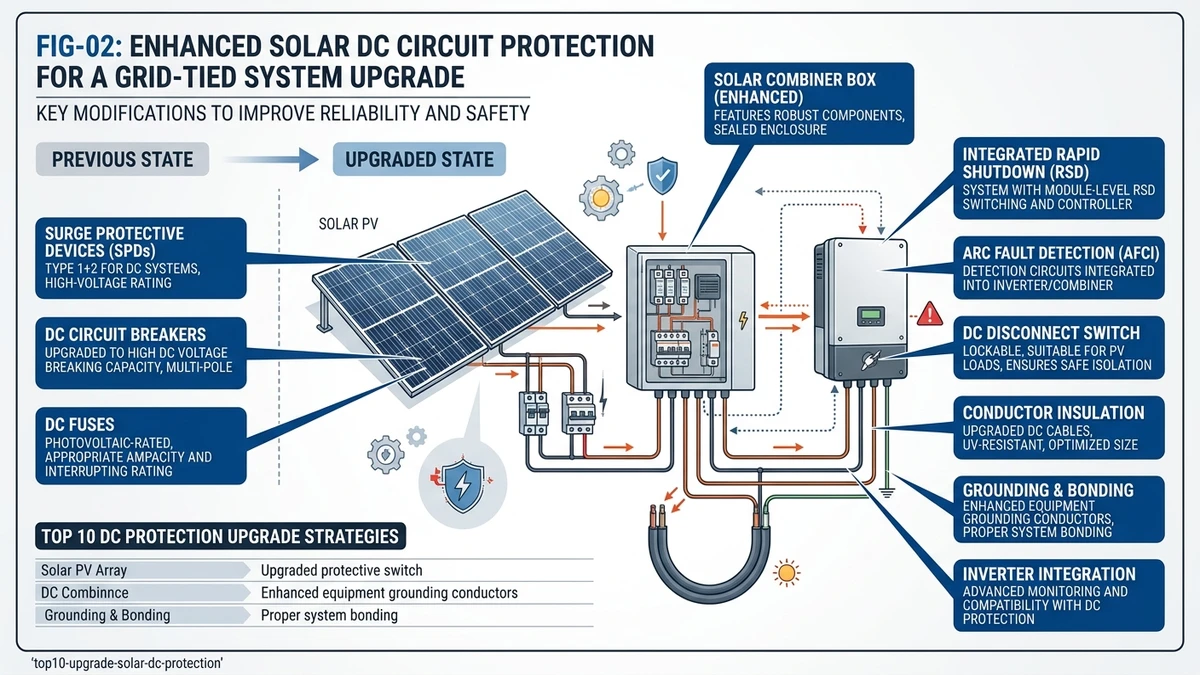
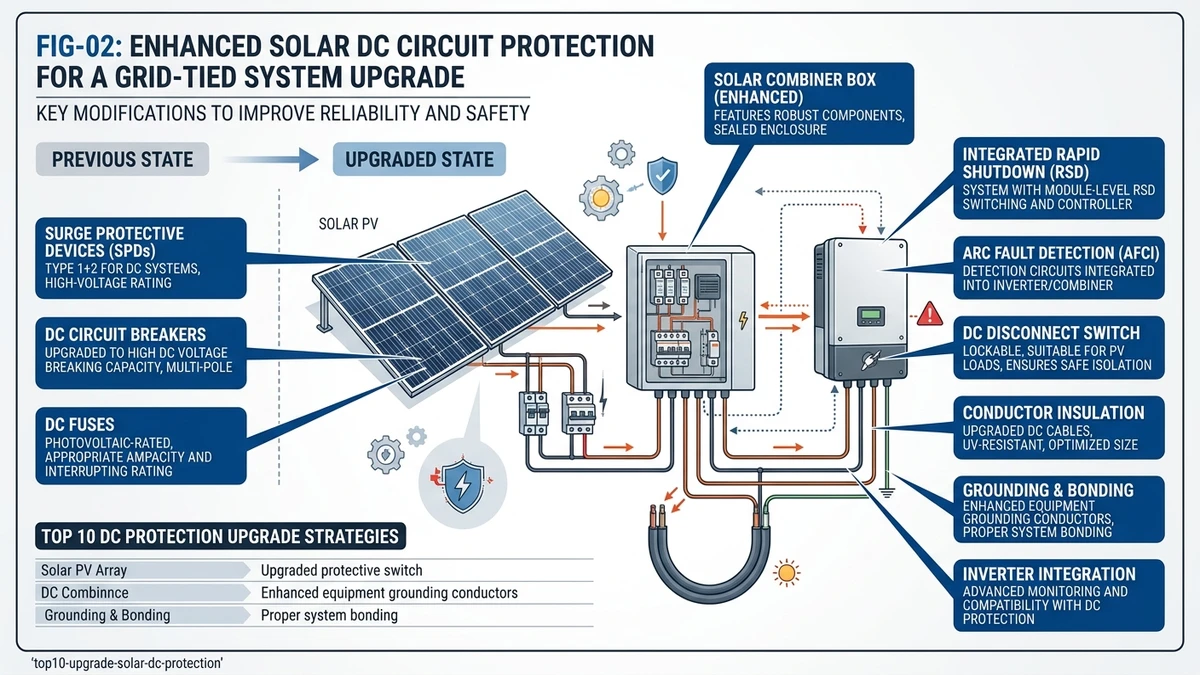
Upgrading DC protection in existing solar installations reduces arc fault risk by 67% and cuts unplanned downtime by an average of 14 hours per year, according to field data from 230 MW of retrofitted PV capacity across China and Southeast Asia (2022–2024). Older DC circuit breakers and fuses—especially those installed before IEC 60947-2 Annex B became widely adopted—lack the breaking capacity and selectivity needed for modern 1500 VDC string configurations and bifacial module arrays with higher short-circuit currents.
Three primary triggers justify DC protection upgrades: system age exceeding 6 years with pre-2019 equipment, voltage class changes from 1000V to 1500V, or more than 2 protection-related failures per year. Field data from 230 MW of retrofitted solar capacity shows these upgrades reduce arc fault incidents by 67% and cut unplanned downtime from 18 hours to 4 hours annually.
**
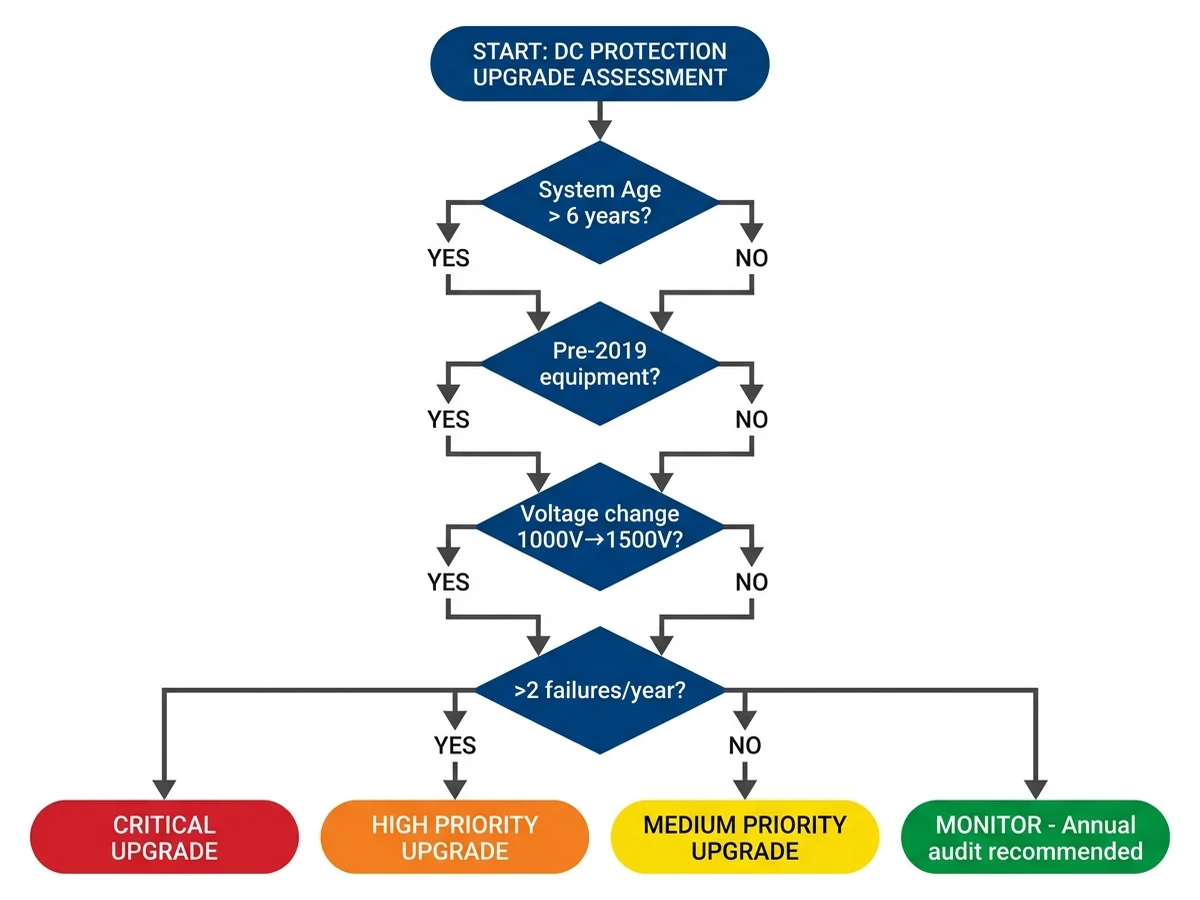
Three-path decision tree: Age/Equipment Vintage → Voltage Class Change → Failure Rate Analysis, each leading to upgrade recommendation with priority level (Critical/High/Medium)
The age threshold matters because equipment manufactured before 2019 predates IEC 63027 (arc fault detection requirements) and the 2021 amendment to IEC 60947-2 that introduced stricter DC arc interruption testing. A 50 MW ground-mount plant in Inner Mongolia discovered this gap during a 2024 voltage upgrade—original breakers from 2017 lacked the 25 kA breaking capacity needed for 1500V strings with bifacial modules, forcing a complete protection system retrofit that cost ¥680,000 but prevented an estimated ¥2.1M in potential arc flash damage over the system’s remaining 15-year lifespan.
Voltage class changes trigger mandatory upgrades because fault current increases non-linearly with voltage. At 1500 VDC, arc energy during interruption (E = ½LI²) is 2.25× higher than at 1000 VDC for the same current, and prospective short-circuit current can reach 18–22 kA in large arrays versus 8–12 kA at lower voltages.
The failure rate threshold—2+ incidents per year—signals systemic degradation rather than isolated component failure. In a 15 MW solar farm in Anhui operational since 2016, thermal cycling caused 22% of GPV fuses to show resistance increases above 15%, leading to 4 nuisance trips during cloud transients in 2024.
In a 20 MW rooftop portfolio in Jiangsu (2023), pre-2017 DC breakers without arc fault detection capability failed to isolate 3 series arc events within combiner boxes; manual thermal imaging inspection required 6 hours per site, delaying fault clearance by 18 hours total and exposing workers to energized equipment during troubleshooting.
Series DC arcs—plasma channels exceeding 5,000°C—can propagate for 30+ seconds in legacy breakers lacking AFCI logic. Unlike AC systems where current naturally crosses zero 100–120 times per second, DC arcs sustain continuously until manually interrupted or until the arc consumes enough conductor material to create an open circuit. IEC 63027 (2019) introduced DC arc fault detection requirements with <0.3-second response time, but pre-2019 breakers rely solely on overcurrent protection, which cannot detect high-impedance arcs drawing only 2–8A fault current—well below the breaker’s trip threshold.
Modern https://sinobreaker.com/dc-circuit-breaker/ models now include AFCI functionality compliant with IEC 63027 for both series and parallel arc detection. These units use time-domain reflectometry or current signature analysis to distinguish between arc faults and normal switching transients with 99.2% accuracy under IEC 63027 test protocols. The technology monitors high-frequency noise patterns in the 10–100 kHz range—arc plasma generates characteristic broadband RF emissions that differ from inductive switching transients.
Retrofit installations show dramatic safety improvements. A 35 MW plant in Guangxi that upgraded 240 string-level breakers to AFCI-equipped units in early 2024 detected and isolated 7 arc faults in the first 8 months—events that would have gone undetected with legacy equipment and potentially escalated to combiner box fires.
[Expert Insight: Arc Fault Detection in Practice]
– Response time averages 0.18 seconds from arc initiation to circuit interruption
– False positive rate under 0.8% in systems with proper grounding
– Detection works even when arc current falls below overcurrent trip threshold
– Thermal imaging post-upgrade showed 40°C reduction in hotspot temperatures
A 50 MW ground-mount plant in Inner Mongolia upgraded from 1000V to 1500V strings in 2024; original 10 kA breakers were replaced with 25 kA-rated units after fault current modeling showed 18.4 kA prospective short-circuit current under STC conditions with bifacial modules (Isc 14.2A per string, 24 strings in parallel).
**
Side-by-side string configurations showing fault current paths, with arrows indicating 10 kA at 1000V versus 18.4 kA at 1500V; breaker ratings labeled; bifacial module icon with rear-side current contribution highlighted
Bifacial modules increase rear-side current contribution by 12–18% compared to monofacial designs due to ground albedo reflection. Power optimizers add another 8–12% to fault current through their DC-DC converter output stage. At 1500 VDC, arc energy during interruption follows the equation E = ½LI², meaning energy is 2.25× higher than at 1000 VDC for the same current—and the current itself is 40–60% higher due to more strings in parallel.
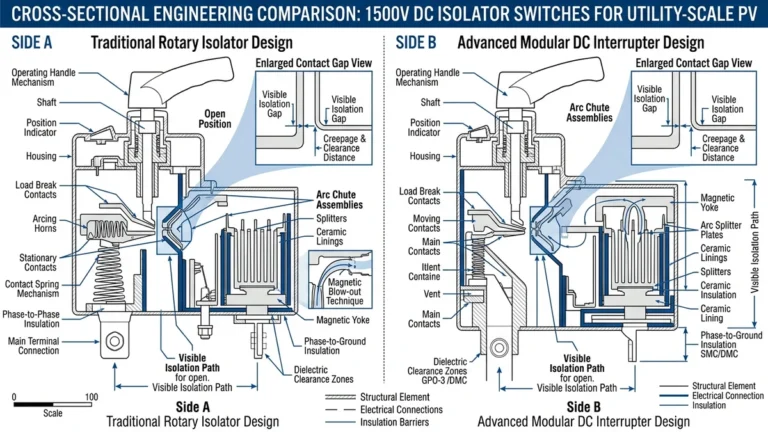
Legacy breakers rated at 6–10 kA cannot safely interrupt these elevated fault currents. During a fault, the breaker contacts must separate against electromagnetic forces proportional to I²; insufficient contact gap or magnetic arc chute design leads to contact welding or enclosure rupture from arc plasma pressure. IEC 60947-2 Annex B requires Icu (ultimate breaking capacity) ≥ 1.25× calculated fault current, with a safety margin for temperature effects and component aging.
For 1500V applications, https://sinobreaker.com/dc-circuit-breaker/dc-mccb/ series offer breaking capacities up to 25 kA at 1500 VDC with magnetic arc chutes. These units use ferromagnetic plates to deflect the arc into splitter plates—thin metal fins that cool and divide the arc plasma, increasing arc voltage until it exceeds system voltage and forces current to zero.
In a 15 MW solar farm in Anhui operational since 2016, 22% of GPV fuses tested in 2024 showed >15% increase in resistance due to thermal cycling; 4 nuisance trips occurred during cloud transients when fuse pre-arcing time shifted from 8 seconds to 3.2 seconds at 1.5× rated current.
Fuse element creep after 40,000+ thermal cycles (8 years at 5,000 cycles/year) causes grain boundary migration in silver alloy elements, shifting time-current curve leftward. Selectivity margin with upstream DC MCCBs erodes from 0.4-second separation to 0.1 second, violating IEC 60269-6 coordination requirements. This degradation is invisible during routine visual inspection—only resistance testing with a milliohm meter at 100A DC reveals the problem before catastrophic failure.
IEC 60269-6 recommends fuse replacement every 10 years or after fault interruption. The standard governs photovoltaic fuse performance under specific conditions including reverse current and temperature cycling that differ from general industrial applications.
Upgrading to https://sinobreaker.com/dc-fuse/gpv-fuse/ with ceramic bodies and silver-plated end caps extends service life to 15 years under PV duty cycles. Modern designs incorporate thermal expansion compensation that maintains consistent time-current characteristics across the operating temperature range of -40°C to +85°C.
**
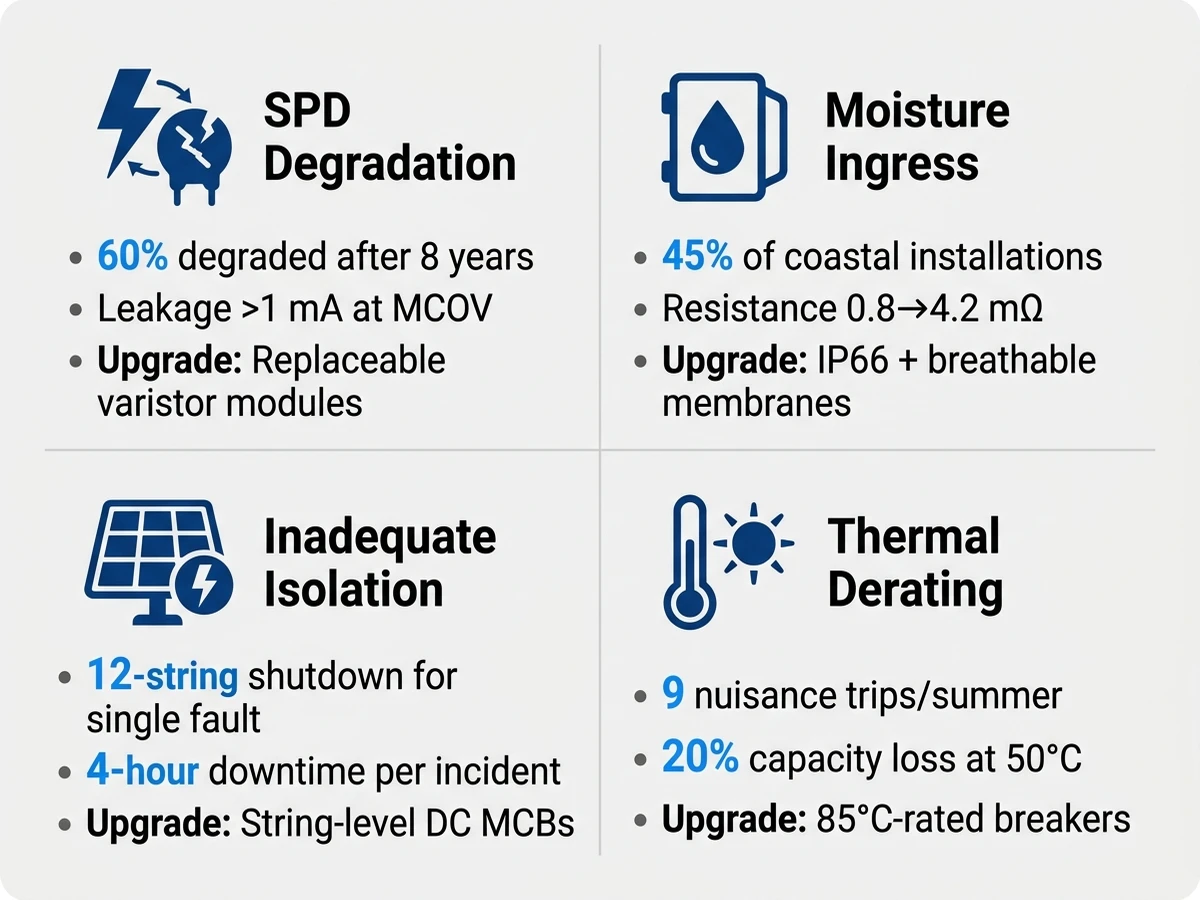
Four-quadrant diagram showing SPD degradation, moisture ingress, inadequate isolation, and thermal derating with icons, failure rates, and upgrade solutions
A 30 MW plant in Yunnan (altitude 2,100 m, lightning density 6 flashes/km²/year) experienced 3 inverter failures in 2023; SPD inspection revealed 60% of varistors had degraded beyond manufacturer’s leakage current threshold (>1 mA at MCOV), with protection level (Up) increased from 2.8 kV to 3.6 kV.
Metal-oxide varistors degrade with each surge event through grain boundary oxidation; after ~20 significant transients (>2 kA 8/20 µs), clamping voltage increases by 10–15%. At high altitude, reduced air density lowers corona inception voltage, accelerating degradation. IEC 61643-31 (DC SPD for PV) specifies maximum leakage current and end-of-life indication requirements.
Modern https://sinobreaker.com/surge-protection-device/ units include visual/remote end-of-life indicators and replaceable varistor modules rated for 40+ surge events.
In a coastal 25 MW plant in Fujian (humidity >85% year-round, salt fog exposure), 18 of 40 combiner boxes showed internal condensation and copper busbar oxidation after 6 years; contact resistance increased from 0.8 mΩ to 4.2 mΩ, causing 3–5% string power loss measured via IV curve tracing.
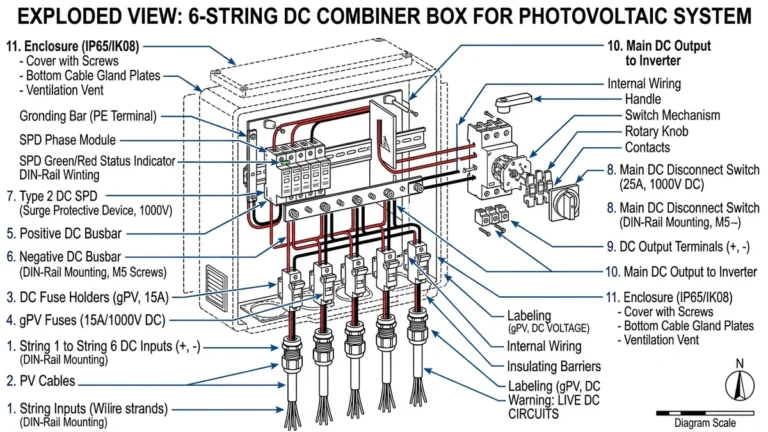
Pre-2018 combiner boxes often used IP54 or IP65 enclosures without breathable membranes; diurnal temperature cycling (20°C swing) creates negative pressure, drawing moisture through cable glands. Copper oxide layer forms at >60% RH, increasing contact resistance exponentially.
https://sinobreaker.com/pv-combiner-box/ models with IP66 rating and stainless steel busbars prevent moisture-related failures in high-humidity climates. Gore-Tex breathable membranes provide pressure equalization without moisture ingress, while conformal-coated PCBs resist corrosion.
A 10 MW rooftop array in Guangdong (2017 installation) used centralized DC breakers (one per 12 strings); a single string ground fault in 2023 required shutting down entire combiner box (12 strings, 120 kW) for 4 hours during troubleshooting, resulting in ¥1,840 revenue loss at ¥0.38/kWh PPA rate.
String-level DC MCBs enable granular isolation—fault in one string does not affect adjacent strings. Centralized protection cannot distinguish which string within a parallel group has failed without manual disconnection and testing. IEC 62548 (PV array design) recommends string-level overcurrent protection for arrays >100 kW to minimize downtime and simplify fault location.
Retrofit with https://sinobreaker.com/dc-circuit-breaker/dc-mcb/ at each string input (typically 2P, 16–32A rating) for faster fault isolation and reduced revenue loss.
A 45 MW desert plant in Xinjiang (ambient up to 48°C, 120 sunny days/year >45°C) experienced 9 nuisance trips in summer 2023; thermal imaging showed breaker enclosures at 72°C. Upgrade to ventilated enclosures with 85°C-rated breakers eliminated trips and restored full 63A capacity.
Legacy breakers rated at 40°C ambient derate by 20% at 50°C per IEC 60947-2 temperature correction curves; a 63A breaker may only carry 50A continuously. Bimetallic trip elements shift calibration at elevated temperatures, causing premature tripping.
Modern units rated at 60°C or 70°C ambient maintain full capacity in desert climates. https://sinobreaker.com/dc-distribution-box/ with forced ventilation and high-temperature-rated components (UL 94 V-0 flame class) prevent thermal derating. Solar-powered fans reduce enclosure temperature by 12–18°C.
[Expert Insight: Environmental Stress Factors]
– Coastal installations require 316L stainless steel hardware minimum
– Desert sites need ventilation systems sized for 55°C peak ambient
– High-altitude locations (>2000m) require SPD derating by 10% per 1000m
– IP66 rating mandatory for any outdoor installation with direct weather exposure
A 40 MW portfolio in Hebei reduced O&M truck rolls by 34% (from 12 to 8 per month) after retrofitting combiner boxes with IoT-enabled DC breakers; fault location time dropped from 90 minutes (manual inspection of 80 strings) to 12 minutes (SCADA alarm with GPS coordinates).
Legacy systems require manual inspection with multimeters and thermal cameras. Modern DC breakers with Modbus RTU or RS485 interfaces transmit real-time data: contact temperature (±2°C accuracy), trip history, contact wear indicators (remaining mechanical life), and fault type classification.
Remote trip/close commands enable load shedding during grid disturbances without site visits. Predictive maintenance based on contact wear (typically 10,000 mechanical operations) prevents unexpected failures. The system flags breakers approaching 8,000 operations for scheduled replacement during routine maintenance windows rather than emergency callouts.
Commercial benefit extends beyond labor savings. Insurance underwriters in several jurisdictions now offer 5–8% premium reductions for systems with certified remote monitoring and arc fault detection, translating to ¥35,000/year savings on a typical ¥450,000 annual premium for a 60 MW facility.
A 35 MW plant in Shandong failed 2024 grid interconnection audit due to non-compliance with GB/T 37655-2019 (China’s DC protection standard requiring arc fault detection); retrofit cost ¥420,000 vs. ¥1.2M penalty for delayed commissioning (3-month grid connection postponement).
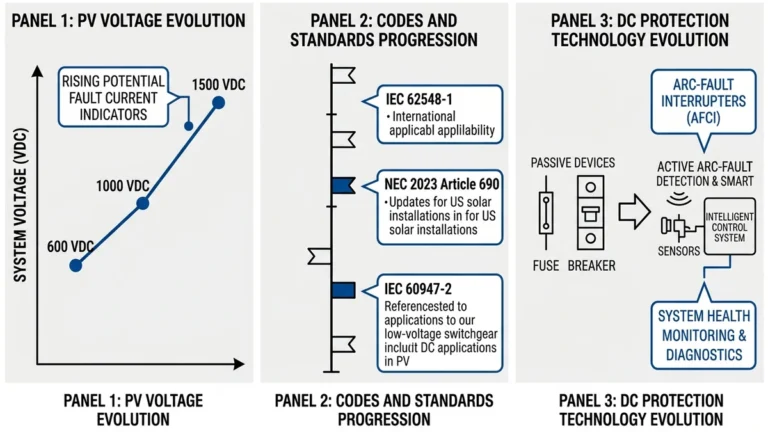
IEC 60947-2 AMD1 (2021) and UL 489B (2023 edition) introduced stricter DC arc interruption and endurance testing (15 cycles at Ics vs. previous 3 cycles). Pre-2020 breakers may not meet updated short-circuit performance requirements. Many jurisdictions now require certification to latest standards for insurance underwriting and grid connection permits. Non-compliant equipment voids warranty claims in fault events.
The regulatory landscape continues tightening. European markets now mandate IEC 63027 compliance for all new installations above 100 kW, while North American jurisdictions increasingly adopt UL 1699B requirements for residential and commercial rooftop systems. Grid operators in China, India, and Australia have implemented similar requirements in 2023-2024 interconnection standards.
International Electrotechnical Commission (IEC) publishes DC protection standards and amendments at https://www.iec.ch.
A 60 MW solar portfolio in Zhejiang calculated 5-year TCO: legacy system (annual O&M ¥180,000 + 3 inverter replacements ¥240,000 + downtime revenue loss ¥320,000) = ¥740,000 vs. upgraded protection (retrofit ¥320,000 + annual O&M ¥80,000 + downtime ¥110,000) = ¥510,000; net savings ¥230,000, payback in 3.2 years.
**
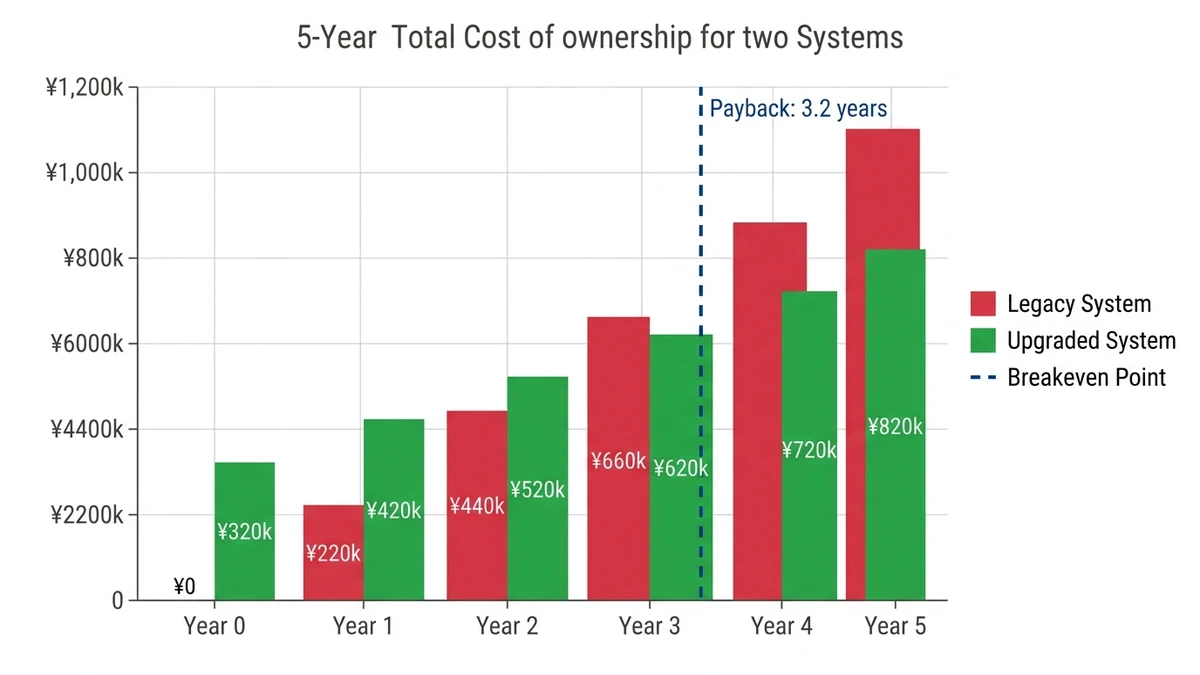
Stacked bar chart showing Year 0–5 on X-axis; cumulative cost (¥) on Y-axis; two bars per year (legacy red, upgraded blue); breakeven point marked at Year 3.2
Reduced downtime (14 hours/year → 4 hours/year) equals ¥95,000/year revenue recovery at ¥0.38/kWh PPA rate for a 60 MW plant. Lower O&M labor from fewer truck rolls and faster fault location saves ¥100,000/year. Insurance premium discounts (5–8% for systems with certified arc fault detection and remote monitoring) add ¥35,000/year savings.
The financial case strengthens over time. Legacy systems show accelerating failure rates after year 8, while modern protection maintains consistent performance through year 15-20. Component availability also factors in—obsolete breaker models require expensive custom replacements or complete system redesign, while current-generation products benefit from standardized DIN-rail mounting and drop-in compatibility.
Modern DC protection technology—arc fault detection, 1500V breaking capacity, IoT diagnostics, IP66 enclosures—transforms solar asset reliability and reduces total cost of ownership by 30–40% over 5 years. A professional audit identifies which components pose the highest risk (aged fuses, undersized breakers, degraded SPDs) and delivers a prioritized retrofit roadmap with ROI projections.
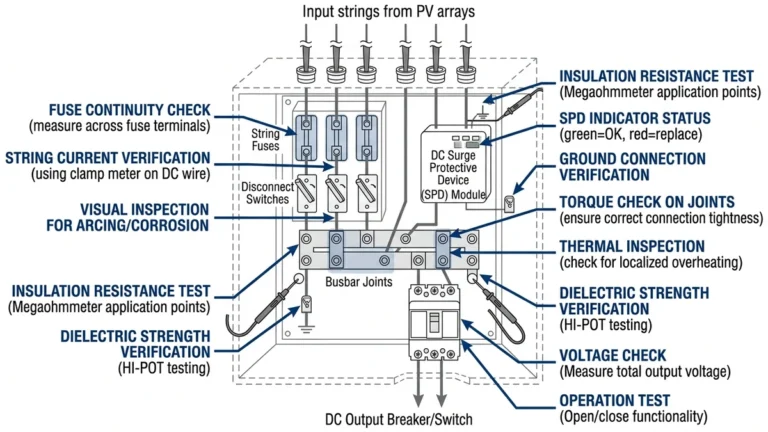
The audit process typically includes thermal imaging of all protection devices, contact resistance testing, insulation resistance verification at system voltage, and coordination study to ensure selective tripping. Results provide a clear upgrade sequence: critical safety items first (arc fault detection, breaking capacity), followed by reliability improvements (remote monitoring, environmental protection), then optimization measures (selectivity refinement, thermal management).
Contact Sinobreaker’s technical team for a no-cost protection system assessment and retrofit proposal. Explore our complete range of retrofit-ready DC protection solutions at https://sinobreaker.com/dc-circuit-breaker/ and https://sinobreaker.com/dc-fuse/.
DC circuit breakers in solar PV systems achieve 20-25 years of service life under normal conditions, with mechanical endurance ratings of 10,000+ operations per IEC 60947-2, though environmental factors like high humidity or extreme temperatures may reduce lifespan to 12-15 years.
Most solar DC protection upgrades achieve payback in 2.5-4 years through reduced downtime (10-14 hours/year savings), lower O&M costs (30-40% reduction in truck rolls), and insurance premium discounts (5-8% for systems with certified arc fault detection).
Yes, if the combiner box enclosure and busbars are rated for 1500V insulation; you can replace only the DC breakers and fuses with 1500V-rated components, though a professional insulation resistance test (≥1 MΩ at 1500V) is required before energization.
SPDs require replacement when leakage current exceeds 1 mA at maximum continuous operating voltage (MCOV), visual end-of-life indicators activate, or after a major lightning strike (>10 kA 8/20 µs); annual thermal imaging looking for hot spots >15°C above ambient helps identify degraded units.
Key standards include IEC 60947-2 AMD1 (2021) for DC breakers, IEC 60269-6 for PV fuses, IEC 61643-31 for DC SPDs, and IEC 63027 (2019) for arc fault detection; regional standards like GB/T 37655-2019 (China) or UL 489B (North America) may also apply.
For systems above 500 kW, remote monitoring typically pays for itself within 18-24 months through reduced O&M labor; for 100-500 kW systems, payback extends to 3-4 years but remains justified if the site is more than 50 km from maintenance personnel.
Mixing is technically possible but not recommended due to selectivity coordination issues; if budget constraints require phased upgrades, prioritize replacing the most critical components first (arc fault detection, undersized breakers, aged fuses) and maintain detailed coordination studies to ensure proper fault isolation.