Dirección
304 North Cardinal
Dorchester Center, MA 02124
Horas de trabajo
De lunes a viernes: de 7.00 a 19.00 horas
Fin de semana: 10.00 A 17.00 HORAS
Dirección
304 North Cardinal
Dorchester Center, MA 02124
Horas de trabajo
De lunes a viernes: de 7.00 a 19.00 horas
Fin de semana: 10.00 A 17.00 HORAS


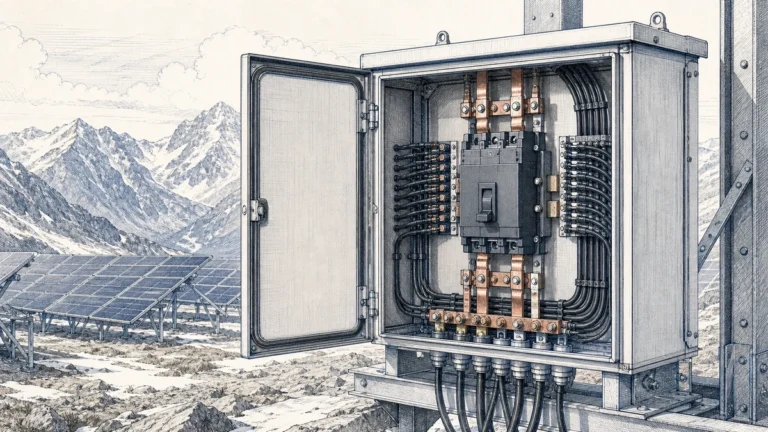
Comprender las aplicaciones solares de los disyuntores de CC es fundamental para diseñar sistemas fotovoltaicos seguros y conformes a la normativa. Las instalaciones solares requieren protección especializada contra sobrecorriente en múltiples puntos, desde circuitos de cadenas individuales hasta cajas combinadoras y más allá, para proteger equipos costosos y evitar riesgos de incendio.
A diferencia de los sistemas eléctricos tradicionales de CA, los circuitos solares de CC presentan retos únicos. Las matrices fotovoltaicas pueden generar corrientes de fallo de múltiples fuentes simultáneamente, y los arcos de CC son más difíciles de extinguir que los de CA. Esto hace que la selección de la estrategia correcta de protección solar con disyuntores de CC sea esencial para la seguridad y el rendimiento del sistema.
Esta guía explica las dos arquitecturas principales de protección solar con disyuntores de CC: protección a nivel de string y protección de caja combinadora. Aprenderá cuándo se requiere cada enfoque, cómo NEC 690.9 dicta los requisitos de instalación y qué especificaciones del interruptor son más importantes para las aplicaciones solares.
💡 Concepto de fundación: Todo circuito fotovoltaico capaz de recibir energía de más de una fuente requiere protección contra sobrecorriente: esta regla fundamental de NEC rige todas las decisiones de aplicación solar de los disyuntores de CC.
La protección solar mediante disyuntores de CC se refiere a la colocación estratégica de disyuntores de CC en un sistema fotovoltaico para evitar situaciones de sobrecorriente, proteger los equipos y permitir una desconexión segura para el mantenimiento.
Protección a nivel de cadena: Disyuntores individuales que protegen cada grupo de paneles solares conectados en serie antes de que se combinen con otras cadenas.
Protección a nivel de combinador: Disyuntores que protegen la salida combinada de varias cadenas que alimentan un inversor o un regulador de carga.
Protección a nivel de matriz: Interruptor principal de CC que protege toda la salida del conjunto combinado entre el punto del combinador y la entrada del inversor.
Los disyuntores de CC en aplicaciones solares cumplen cuatro funciones operativas y de seguridad críticas:
1. Protección contra corriente inversa: Evita que la corriente de los ramales sanos retroalimente a un ramal en avería o sombreado que esté produciendo menos tensión.
2. Protección contra fallos a tierra: Abre el circuito cuando un fallo de aislamiento crea una vía de corriente a tierra, evitando peligros de descarga y riesgos de incendio.
3. Mantenimiento Aislamiento: Proporciona un punto de desconexión visible que permite a los técnicos trabajar con seguridad en cadenas o secciones de combinadores específicos sin desenergizar todo el conjunto.
4. Protección de equipos: Evita daños por sobrecorriente en el cableado, los conectores, los módulos y los inversores interrumpiendo las corrientes de fallo antes de que alcancen niveles destructivos.
Analogía del mundo real: Piense en la protección solar con disyuntores de CC como en un sistema de rociadores en un edificio: los rociadores individuales (disyuntores de ramal) protegen zonas específicas, mientras que las válvulas principales (disyuntores combinadores) controlan plantas enteras. Ambos niveles trabajan juntos para contener los problemas antes de que se propaguen.
El Código Eléctrico Nacional exige protección contra sobrecorriente para cualquier circuito fotovoltaico que pueda alimentarse de varias fuentes. Si su cadena puede recibir corriente de retroalimentación de otras cadenas en paralelo, necesita un dispositivo de protección solar con disyuntor de CC dimensionado para la máxima corriente de fallo disponible.
Ejemplo real: Un conjunto de 10 cadenas con una potencia nominal de 10 A por cadena. Sin disyuntores, una cadena en fallo podría recibir 90 A de corriente inversa de las nueve cadenas sanas, superando con creces los 10 A nominales de los cables y conectores.
Los paneles solares funcionan en condiciones muy duras, con ciclos de temperatura, exposición a los rayos UV e infiltración de humedad. Con el tiempo, las conexiones pueden aflojarse o el aislamiento puede degradarse. Un sistema de protección solar con disyuntor de CC interrumpe el arco antes de que prenda fuego a los materiales de la cubierta o a las cajas de conexiones.
Los arcos de CC generan temperaturas superiores a los 3.000 °C, lo suficientemente altas como para fundir el cobre e inflamar materiales combustibles en cuestión de segundos. Los disyuntores de CC con detección de fallo de arco pueden interrumpir estos eventos en 30-50 milisegundos.
La mayoría de las jurisdicciones exigen que las instalaciones fotovoltaicas cumplan las normas del artículo 690 del NEC. Los inspectores verifican específicamente que los dispositivos de protección solar del disyuntor de CC:
- Apto para tensión continua (no para disyuntores de CA)
- Listado para aplicaciones fotovoltaicas (UL 1077 o UL 489)
- Dimensionado correcto para la corriente del circuito del ramal o del combinador
- Accesible para mantenimiento y parada de emergencia
Por qué lo exigen los códigos: Los datos de campo de 2010-2020 muestran que 64% de los incendios de sistemas solares se originaron por fallos de arco en el lado de CC que podrían haberse evitado o contenido con una protección de circuito adecuada.
Los disyuntores de CC permiten la ampliación modular y la resolución de problemas. Cuando una cadena funciona mal, los técnicos pueden aislar sólo ese circuito sin necesidad de apagar todo el conjunto, lo que minimiza las pérdidas de producción durante las tareas de mantenimiento.
Los principales fabricantes de inversores exigen protección contra sobrecorriente conforme a NEC en todas las entradas de CC. La instalación de sistemas sin la protección solar adecuada del disyuntor de CC puede anular garantías por valor de miles de dólares en sustituciones de inversores.
Los disyuntores de CC diseñados para aplicaciones solares utilizan mecanismos especializados para hacer frente a los retos exclusivos de los circuitos fotovoltaicos: alta tensión, corrientes de fallo sostenidas y arcos de CC difíciles de extinguir.
Un dispositivo solar de disyuntor de CC combina las funciones de un disyuntor y un interruptor de desconexión, como una cerradura de combinación y un cerrojo de seguridad en una puerta, proporcionando tanto seguridad como control de acceso.
#### Disparo Termomagnético: El Guardián de la Sobrecorriente
Para qué sirve: Detecta cuando la corriente del circuito supera los niveles de seguridad y abre automáticamente los contactos para interrumpir el flujo.
Cómo funciona: Una banda bimetálica se calienta cuando fluye una corriente excesiva, doblándose hasta liberar un mecanismo accionado por resorte. Para cortocircuitos más rápidos, una bobina magnética genera la fuerza suficiente para disparar el disyuntor al instante.
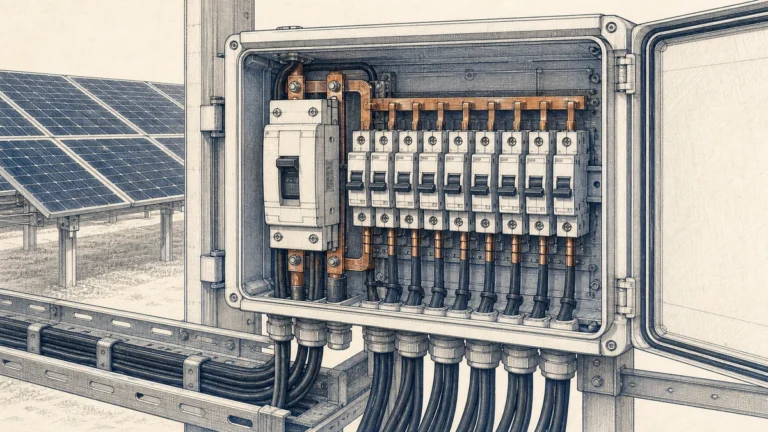
En una caja combinadora solar con ocho cadenas de 10 A que alimentan un disyuntor principal de 100 A, si una cadena sufre un fallo de 15 A, su disyuntor individual de 15 A se disparará en 60 segundos (siguiendo la curva inversa de tiempo-corriente), aislando sólo esa cadena mientras las otras siete siguen funcionando.
#### Detección de fallos de arco: El monitor de seguridad
Para qué sirve: Reconoce la firma eléctrica de condiciones de arco peligrosas, incluso cuando la corriente permanece por debajo de los niveles de disparo por sobrecorriente, y abre el circuito antes de que pueda iniciarse un incendio.
Cómo funciona: Los circuitos del microprocesador analizan la forma de onda de la corriente en busca de patrones de ruido de alta frecuencia característicos del arco eléctrico. Cuando se detectan durante más de 0,5 segundos, el disyuntor se dispara.
Los interruptores de circuito por fallo de arco (AFCI) modernos pueden distinguir entre arcos inofensivos (como la conmutación de inversores) y peligrosos arcos en serie procedentes de conductores dañados o conexiones sueltas, una capacidad crítica ya que los arcos en serie no aumentan la corriente del circuito.

Qué es: Disyuntores individuales instalados en cada circuito de fuente FV antes de que los conductores se combinen con otras cadenas.
✅ Ventajas:
- Máximo control granular: aísle cualquier cadena para su mantenimiento
- Evita daños por corriente inversa de cadenas sanas a cadenas averiadas
- Simplifica la resolución de problemas al permitir la comprobación de cadenas individuales
- Exigido por NEC 690.9(A) cuando la tensión máxima del sistema supera los 30 V y las cadenas pueden retroalimentarse.
❌ Desventajas:
- Mayor coste de los componentes (un disyuntor por cadena)
- Cableado más complejo de la caja combinadora
- Puntos de conexión adicionales (posibles modos de fallo)
Lo mejor para: Matrices con más de 4 cadenas paralelas, sistemas en los que es necesario supervisar cadenas individuales, instalaciones que exigen el máximo cumplimiento de las normas de seguridad.
Configuración típica:
- Arreglo residencial de 8 cadenas: Ocho disyuntores de CC de 15 A en caja combinadora
- Cada disyuntor tiene un valor nominal de 1,56× Isc de cadena según NEC 690.8
- La cadena produce 9,6 A Isc → se requiere un disyuntor de 15 A como mínimo
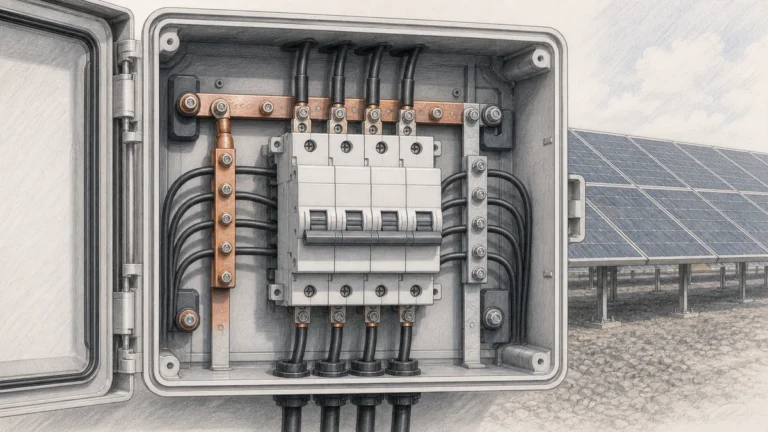
Qué es: Disyuntor único que protege la salida combinada de todas las cadenas una vez puestas en paralelo.
✅ Ventajas:
- Menor coste inicial (un disyuntor en lugar de por cadena)
- Cableado más sencillo en la caja del combinador
- Menos componentes que mantener
- Adecuado para matrices pequeñas (2-3 cadenas)
❌ Desventajas:
- No se pueden aislar cadenas individuales para su mantenimiento
- Sin protección contra la corriente inversa de cadena a cadena
- Todo el conjunto debe ser apagado para cualquier trabajo de servicio
- Es posible que no cumpla la norma NEC 690.9 para matrices de mayor tamaño
Lo mejor para: Pequeños sistemas residenciales (2-3 cadenas como máximo), matrices montadas en el suelo con fácil acceso de apagado total, aplicaciones en las que el coste es la principal limitación.
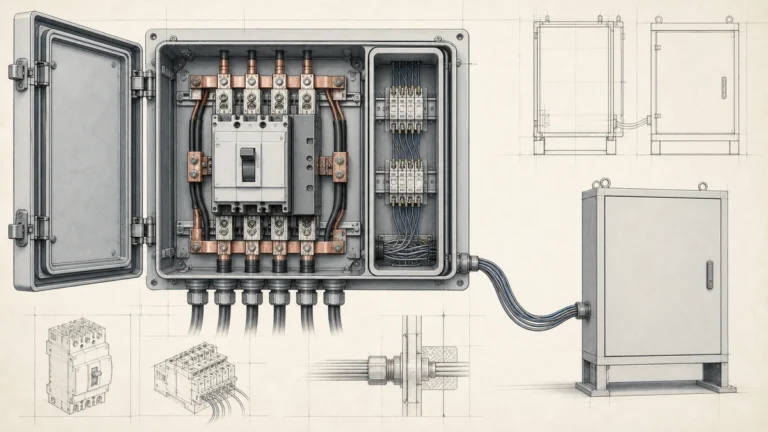
Combina ambos niveles de protección para ofrecer la máxima seguridad:
Rompedores de cadenas (15-20A por circuito) → Barra colectora combinadora → Interruptor principal (100-150A) → Inversor
Este enfoque proporciona:
- Capacidad de aislamiento de cadenas individuales
- Protección contra corriente inversa en la fuente
- Desconexión principal para todo el conjunto
- Cumplimiento de la norma NEC 690.9 en todos los puntos de conexión en paralelo
| Nivel de protección | Número de interruptores | Cumplimiento NEC | Factor de coste | Mejor aplicación |
|---|---|---|---|---|
| Sólo cuerda | N (uno por cadena) | Parcial - necesita principal | Alta | No utilizar nunca solo |
| Sólo combinador | 1 (sólo principal) | Limitado (≤3 cadenas) | Bajo | Pequeño residencial (≤3 cadenas) |
| Híbrido (Cuerda + Principal) | N + 1 | NEC 690.9 completo | Medio-Alto | 4+ hilos, comercial, buenas prácticas |

Las instalaciones residenciales típicas utilizan de 6 a 12 cadenas en paralelo que alimentan a un único inversor. La protección solar mediante disyuntores de CC a nivel de cadena es esencial porque es difícil acceder a las instalaciones en tejado para realizar un apagado de emergencia y los protocolos de seguridad de los bomberos exigen una rápida desactivación.
Requisitos:
- Interruptores automáticos: 15-25A CC nominal, 600V mínimo para sistemas de más de 300V
- Disyuntor del combinador principal: 80-150 A en función de la corriente total del conjunto
- Protección contra arco eléctrico: Exigida por NEC 690.11 para sistemas montados en tejados.
- Caja: NEMA 3R mínimo para cajas de combinadores de exterior
Configuración típica:
Ocho cadenas de diez paneles de 350 W (Voc = 46 V, Isc = 9,8 A cada una):
- Tensión de la cadena: 460 V (diez paneles × 46 V)
- Corriente de la cadena: 9,8 A × 1,25 = 12,25 A mínimo del disyuntor
- Selección del disyuntor real: 15A (siguiente tamaño estándar)
- Interruptor principal: 8 cadenas × 12,25A × 1,25 = 122A mínimo → Interruptor de 125A.
🎯 Consejo profesional: Dimensione siempre el disyuntor del combinador principal para 125% de corriente máxima del sistema según NEC 690.8(B)(1), incluso si el controlador MPPT de su inversor limita la corriente: los dispositivos de protección deben manejar los peores escenarios de fallo, no las condiciones normales de funcionamiento.
Las grandes instalaciones comerciales suelen utilizar varias cajas combinadoras que alimentan un cuadro central de CC antes del inversor. Cada combinador da servicio a 8-12 cadenas, con disyuntores principales de 200-400 A.
Requisitos:
- Interruptores automáticos con capacidad de monitorización remota
- Disyuntores del combinador principal con disparo en derivación para desconexión de emergencia
- Sistema de electrodos de puesta a tierra que conecta todas las cajas combinadoras
- Desconexión accesible a la vista del inversor según NEC 690.13
A esta escala, la selección de componentes solares para disyuntores de CC con capacidad de monitorización de corriente permite realizar un seguimiento del rendimiento y una rápida localización de fallos sin necesidad de inspeccionar manualmente cada cadena.
Los sistemas basados en baterías requieren protección con disyuntores de CC tanto en los circuitos de la fuente FV como en los circuitos de salida del banco de baterías. Esto crea múltiples zonas de protección:
Zona 1 - Fuente FV: Interruptores de cadena y combinadores (como arriba)
Zona 2 - Salida del regulador de carga: Disyuntor para la corriente de salida máxima del controlador
Zona 3 - Banco de baterías: Disyuntor de CC de alto amperaje clasificado para voltaje de batería y corriente de cortocircuito (puede superar los 10.000 A).
Los sistemas de baterías presentan el mayor riesgo de corriente de fallo de CC porque las baterías pueden suministrar una corriente enorme (limitada sólo por la resistencia interna) en cortocircuitos, por lo que una protección solar adecuada con disyuntores de CC es absolutamente crítica para la seguridad.
Las instalaciones de los servicios públicos utilizan aparamenta de CC especializada con disyuntores motorizados, control SCADA remoto y detección integrada de arco eléctrico. Los combinadores de cadenas alimentan las cajas recombinadoras, que a su vez alimentan las estaciones centrales de inversores.
Cada nivel de protección utiliza progresivamente disyuntores de mayor potencia:
- Nivel de cuerda: 20-30A
- Nivel del combinador: 250-400A
- Nivel del recombinador: 800-1200A
- Cuadro principal de CC: 2000-4000A
A escala de la empresa eléctrica, los sistemas de protección solar de los disyuntores de CC deben coordinarse con el análisis del riesgo de arco eléctrico según la norma NFPA 70E, y se requiere un equipo de protección personal con la clasificación adecuada para los trabajos de mantenimiento.

La tensión del sistema solar determina la tensión nominal mínima de CC del disyuntor. Los disyuntores de CC no pueden interrumpir tensiones superiores a su valor nominal.
Fórmula: Valor nominal del disyuntor en V CC ≥ Tensión máxima de circuito abierto del sistema
Ejemplo:
- Configuración de la cadena: 10 paneles × 46V Voc = 460V
- Corrección de temperatura: 460V × 1,14 (factor de temperatura fría) = 524V
- Capacidad mínima del disyuntor: 600 V CC (siguiente tamaño estándar por encima de 524 V)
Valores nominales de tensión solar de los disyuntores de CC comunes:
- 250 V CC: pequeños sistemas de baterías de 12 V/24 V
- 500 V CC: Sistemas residenciales antiguos (poco frecuentes hoy en día)
- 600 V CC: residencial/comercial estándar (más común)
- 1000 V CC: sistemas de alta tensión modernos y a escala comercial
- 1500V CC: Grandes instalaciones de servicios públicos (requiere disyuntores especiales)
⚠️ Advertencia: Nunca asuma que los valores nominales de tensión de CA se aplican a la CC. Un disyuntor de 480 V CA / 250 V CC puede manejar 480 voltios de corriente alterna, pero sólo 250 voltios de CC; si se utiliza en un sistema solar de 400 V, se crearía un riesgo extremo de incendio y explosión al intentar interrumpir una avería.
NEC 690.8 exige que los disyuntores solares tengan una corriente nominal de cortocircuito de al menos 156% (para tener en cuenta las variaciones de temperatura e irradiancia).
Fórmula: Intensidad nominal del disyuntor ≥ Módulo Isc × 1,56
Ejemplo:
- Especificación del panel: Isc = 9,8A
- Potencia mínima: 9,8A × 1,56 = 15,3A
- Interruptor seleccionado: 15A (¡es demasiado pequeño!)
- Selección real: 20A (siguiente tamaño estándar por encima de 15,3A)
Valores nominales de corriente solar del disyuntor de CC estándar:
- Nivel de cadena: 15A, 20A, 25A, 30A
- Nivel de combinador: 63A, 80A, 100A, 125A, 150A
- Matriz principal: 200A, 250A, 315A, 400A
| Panel Isc | Calificación mínima (× 1,56) | Tamaño estándar del disyuntor | Aplicación |
|---|---|---|---|
| 8.5A | 13.3A | 15A | Paneles residenciales estándar (300-350 W) |
| 9.8A | 15.3A | 20A | Residencial de alta eficiencia (350-400W) |
| 11.5A | 17.9A | 20A | Premium residencial (400-450W) |
| 13.2A | 20.6A | 25A | Bifacial comercial (450-500W) |
No todos los disyuntores pueden interrumpir con seguridad la corriente continua. Verifique estas certificaciones:
Listados obligatorios:
- UL 1077: Protectores suplementarios (aceptables para disyuntores de ramal en cajas combinadoras)
- UL 489: Disyuntores de caja moldeada (necesarios para disyuntores principales e instalaciones autónomas)
- UL 1741: Equipos de sistemas fotovoltaicos (certifica la compatibilidad con las aplicaciones solares)
Los interruptores de CC utilizan conductos de arco y materiales de contacto especializados. Un disyuntor solo de CA puede soldarse al interrumpir la corriente CC, creando un cortocircuito permanente.
Las cajas de conexiones solares están sometidas a duras condiciones. Seleccione componentes solares con disyuntor de CC aptos para:
Temperatura: -40°C a +85°C (las cajas combinadoras a pleno sol pueden superar los 70°C de temperatura interna)
Reducción de altitud: Por encima de 2000 m de altitud, la capacidad de interrupción del disyuntor disminuye; consulte las curvas de reducción de potencia del fabricante.
Resistencia a la corrosión: Las instalaciones costeras necesitan cajas estancas y barras colectoras de cobre estañado
Resistencia a los rayos UV: Las cajas combinadoras para exteriores requieren carcasas de policarbonato estabilizado contra los rayos UV o de fibra de vidrio.
Problema: Los disyuntores de CA no están diseñados para interrumpir la corriente CC. La CC crea un arco continuo sin puntos de cruce por cero, y las canaletas de arco clasificadas para CA no pueden extinguir los arcos de CC de forma fiable.
Escenarios comunes:
- “Encontré un disyuntor de 20 A de repuesto en mi panel: ¿puedo usarlo en mi caja combinadora?”.”
- “El disyuntor de CA tiene una tensión nominal de 480 V, pero mi sistema solar sólo tiene 400 V de CC”.”
- Instalación de disyuntores de paneles de CA residenciales en aplicaciones solares exteriores
Corrección: Utilice sólo disyuntores que estén explícitamente etiquetados con los valores nominales de tensión e intensidad de CC. Busque marcas como “600 V CC” o clasificaciones dobles como “240 V CA / 125 V CC”.”
⚠️ Advertencia: La instalación de disyuntores de CA en circuitos de CC infringe la norma NEC 110.3(B) y anula todas las certificaciones eléctricas. Las compañías de seguros pueden denegar las reclamaciones por daños por incendio derivados del uso de equipos no incluidos en la lista.
Problema: Los diseñadores calculan el tamaño del disyuntor principal basándose en la corriente de la cadena sin aplicar el factor de seguridad 125%, lo que provoca disparos molestos en mañanas frías y despejadas cuando los paneles superan la Isc nominal.
Escenarios comunes:
- 8 cadenas × 10A nominales = 80A → el instalador selecciona un disyuntor de 80A (¡equivocado!)
- El coeficiente de temperatura de olvido aumenta Voc e Isc a bajas temperaturas
- Uso de la potencia nominal MPPT del inversor en lugar de la corriente real de la cadena para el dimensionamiento
Corrección: El disyuntor principal debe tener una capacidad nominal mínima de 125% de la suma de las capacidades nominales de los disyuntores de ramal:
- 8 cadenas × disyuntores de cadena de 15 A × 1,25 = disyuntor principal mínimo de 150 A
Por qué es importante: En una fría mañana de enero con una irradiancia de 1200 W/m², la corriente del panel puede alcanzar 110% de la Isc nominal. Un disyuntor de 80 A se dispararía a los 100 A (125% del valor nominal), apagando el sistema durante el pico de producción.
Problema: Llevar todos los conductores de la cadena a una barra colectora común e instalar disyuntores en la salida combinada. Esto proporciona protección cero contra la corriente inversa de cadena a cadena.
Escenarios comunes:
- Caja combinadora con barra colectora en la parte superior, disyuntores en el lado de salida
- Aterrizaje de varias cadenas en el mismo terminal antes del dispositivo de protección
- Combinadores tipo “hub” sólo con bus central y disyuntor de salida
Corrección: Cada conductor de cadena debe pasar por su propio disyuntor dedicado antes de realizar cualquier conexión en paralelo con otras cadenas. El disyuntor debe estar “entre la cadena y la barra colectora”, no “entre la barra colectora y el inversor”.”
Problema: Utilizar disyuntores de CC unipolares o bipolares en sistemas solares conectados a tierra sin la configuración adecuada para la desconexión simultánea.
Escenarios comunes:
- Disyuntor unipolar sólo en conductor positivo conectado a tierra
- Dos disyuntores unipolares separados en lugar de una unidad bipolar de disparo común
- Uso de tándems residenciales que no están homologados para viajes comunes
Corrección: Según NEC 690.13(C), los sistemas de CC conectados a tierra requieren la desconexión simultánea de todos los conductores no conectados a tierra. Utilización:
- Interruptores automáticos bipolares de disparo común para sistemas con toma central de tierra
- Interruptores automáticos tetrapolares para sistemas bipolares con neutro a tierra
Código de referencia: La palanca del disyuntor debe enlazar mecánicamente todos los polos de forma que al abrir un polo se abran todos simultáneamente, lo que garantiza que los conductores positivo y negativo se desconecten a la vez, evitando riesgos de descarga durante el mantenimiento.
Problema: Instalar únicamente disyuntores termomagnéticos sin detección de fallo de arco en sistemas montados en tejados instalados después de 2011.
Escenarios comunes:
- Instalaciones de reequipamiento con cajas combinadoras antiguas
- Sistemas económicos que omiten el AFCI para reducir costes
- Los instaladores desconocen los requisitos de NEC 690.11
Corrección: NEC 690.11 exige que los sistemas FV en tejados de viviendas dispongan de protección de CC contra fallos de arco. Esto puede integrarse en:
- Disyuntores de CC con AFCI integrado (homologados según UL 1699B)
- Cajas combinadoras con módulos de control AFCI
- Inversores con función AFCI de CC interna
Por qué lo exigen los códigos: Los datos de campo muestran que 50% de los incendios en sistemas solares están relacionados con la formación de arcos de CC a partir de conductores dañados o conexiones sueltas: la protección AFCI reduce el riesgo de incendio en 87% según los estudios de campo del NREL.
Problema: Conductores de cadenas y combinadores conectados a terminales solares de disyuntores de CC sin las especificaciones de par de apriete adecuadas, lo que provoca conexiones de alta resistencia, sobrecalentamiento y fallo final.
Escenarios comunes:
- Apriete a mano los tornillos de los terminales “hasta que queden apretados”.”
- Utilización de atornilladores de impacto en lugar de atornilladores dinamométricos calibrados
- Conductores de aluminio instalados sin compuesto antioxidante
Corrección: Siga exactamente las especificaciones de par de apriete del fabricante:
- Terminales típicos de disyuntores de CC: 35-50 in-lbs para #10-#12 AWG
- Barras colectoras combinadoras: 100-150 in-lbs para #6-#4 AWG
- Utilice un destornillador dinamométrico calibrado o una llave dinamométrica
- Aplicar compuesto antioxidante (NOALOX) en los conductores de aluminio.
Consecuencia de campo: Las conexiones sueltas crean resistencia → calor → oxidación → más resistencia → más calor → desbocamiento térmico que provoca fallos en los terminales, arcos eléctricos y posibles incendios. El NEC exige terminales accesibles precisamente para que puedan volver a apretarse durante el mantenimiento anual.


Los interruptores de CC utilizan cámaras de extinción de arco especializadas y materiales de contacto diseñados para interrumpir la corriente continua, que no tiene los puntos de cruce por cero naturales que tiene la corriente alterna dos veces por ciclo. Cuando un interruptor de CA se abre bajo carga, la corriente alterna deja de fluir de forma natural 120 veces por segundo (a 60 Hz), lo que facilita la extinción del arco. La corriente continua fluye continuamente en una dirección, creando un arco sostenido que puede soldar contactos entre sí o seguir conduciendo a través del aire ionizado.
Los disyuntores de CC para aplicaciones solares incorporan conductos de arco magnéticos que fuerzan al arco a seguir trayectorias alargadas, mecanismos de separación rápida de contactos y materiales de contacto especializados resistentes al arco. También están diseñados para manejar los altos voltajes habituales en los sistemas fotovoltaicos (400-1000 V), que pueden crear arcos que saltan importantes entrehierros. Un disyuntor residencial de 20 A/240 V CA puede tener una tensión nominal de sólo 48 V CC; si se utiliza en una cadena solar de 400 V, el disyuntor no interrumpiría el fallo y podría provocar un incendio o la destrucción del equipo.
Comience con la corriente de cortocircuito (Isc) de su panel de la hoja de datos del fabricante. Multiplique este valor por 1,56 según NEC 690.8(A)(1) para tener en cuenta el aumento de la irradiancia y las condiciones de bajas temperaturas. Redondee al siguiente tamaño de disyuntor estándar.
Por ejemplo, si su panel tiene una capacidad nominal de 9,8A Isc: 9,8A × 1,56 = 15,3A mínimo. El siguiente tamaño estándar por encima de 15,3A es 20A, por lo que deberá seleccionar un disyuntor de CC de 20A. Nunca redondee a la baja: un disyuntor de 15 A sería demasiado pequeño y podría provocar disparos molestos durante los picos de producción en las mañanas frías, cuando la corriente real supera la Isc nominal.
Para el disyuntor del combinador principal que protege varias cadenas, sume todos los valores nominales de los disyuntores de cadena y multiplique por 1,25. Si tiene ocho disyuntores de cadena de 20 A: 8 × 20A = 160A, entonces 160A × 1,25 = 200A de capacidad mínima del interruptor principal.
NEC 690.9(A) requiere protección contra sobrecorriente en cualquier circuito de fuente FV que pueda suministrar corriente a un fallo desde más de una fuente. En la práctica, esto significa que cada cadena de un conjunto de varias cadenas necesita su propio disyuntor, ya que las cadenas en buen estado pueden retroalimentar corriente a una cadena en fallo.
Para instalaciones con sólo 2 ó 3 cadenas y una tensión total del sistema inferior a 48 V, es posible cumplir la normativa con sólo un disyuntor combinador principal. Sin embargo, para cualquier sistema residencial de más de 300 V con más de 4 cadenas en paralelo, las mejores prácticas y la mayoría de las jurisdicciones exigen disyuntores a nivel de cadena (uno por cadena) y un disyuntor combinador principal que proteja la salida combinada. Esto proporciona seguridad, acceso para el mantenimiento y cumplimiento de la normativa.
Los sistemas pequeños (1-2 cadenas) que alimentan una sola entrada MPPT pueden utilizar sólo un disyuntor principal, ya que no hay ningún punto de conexión en paralelo por el que pueda fluir corriente inversa. Compruebe siempre las interpretaciones del código local con su AHJ (Autoridad competente) antes de finalizar los diseños.
Los disyuntores de paneles no residenciales están diseñados para circuitos de CA en sistemas de fase dividida de 120 V/240 V y no están clasificados para tensión de CC o aplicaciones fotovoltaicas. Incluso si la tensión nominal de CA del disyuntor parece adecuada (como 480 V CA), su tensión nominal de CC puede ser de solo 125 V CC o puede no tener ninguna tensión nominal de CC.
Las cajas de conexiones solares requieren disyuntores homologados específicamente para la tensión de CC a la tensión máxima de circuito abierto de su sistema (normalmente 600 V CC para sistemas residenciales) y certificados para aplicaciones fotovoltaicas según UL 1077 o UL 489. Estos disyuntores tienen diferentes canaletas de arco internas, materiales de contacto y mecanismos de interrupción diseñados para interrumpir de forma segura la corriente de CC. Estos disyuntores tienen diferentes conductos de arco internos, materiales de contacto y mecanismos de interrupción diseñados para interrumpir de forma segura la corriente CC.
Además, los disyuntores residenciales están diseñados para su instalación en interiores en entornos de clima controlado, mientras que las cajas combinadoras suelen estar a la intemperie en temperaturas extremas. Utilice sólo disyuntores clasificados para las condiciones ambientales (rango de temperatura, exposición a rayos UV, resistencia a la corrosión) que experimentará su caja combinadora. La instalación de equipos no catalogados infringe la norma NEC 110.3(B) y crea importantes problemas de responsabilidad y seguridad.
Los disyuntores de CC suelen dispararse durante los periodos de máxima producción, cuando la corriente real del panel supera los valores previstos debido a las bajas temperaturas de los módulos y a las condiciones de alta irradiancia. La corriente del panel aumenta aproximadamente 0,05%/°C a medida que disminuye la temperatura: un panel de 350W con un valor nominal de 9,8A Isc a 25°C podría producir 10,8A a -10°C en una clara mañana de invierno.
Si su disyuntor de ramal está subdimensionado (utilizando el factor mínimo NEC de 1,56 sin margen), estas condiciones pueden provocar disparos molestos. Por ejemplo, un disyuntor de 15 A que protege un panel Isc de 9,8 A (9,8 × 1,56 = 15,3 A mínimo) se encuentra muy cerca de su punto de disparo. Con una irradiancia elevada (1200 W/m² es posible con la reflexión de la nieve en el suelo) y temperaturas frías, la corriente real de la cadena podría alcanzar los 11,5 A, provocando que el disyuntor de 15 A se dispare en su umbral 125% (18,75 A) si se mantiene durante varios minutos.
Solución: Verifique que el dimensionamiento de sus disyuntores incluye un margen adecuado por encima del mínimo NEC. Considere disyuntores de 20 A en lugar de 15 A para cadenas calculadas cerca del umbral. Compruebe también si hay fallos a tierra, que pueden añadir corriente de fuga que contribuya a los mecanismos de disparo térmico. Si los disparos persisten con disyuntores de tamaño adecuado, investigue si hay aislamiento de cableado dañado o infiltración de humedad en las cajas de conexiones.
Los interruptores de CC de las aplicaciones solares deben ejercitarse manualmente (desconectarse y volverse a conectar en condiciones de vacío) todos los años para evitar la soldadura de los contactos y garantizar el funcionamiento mecánico. A diferencia de los interruptores de CA de los paneles de los edificios, que se activan regularmente cuando se conmutan los circuitos, los interruptores de CC solares suelen permanecer cerrados durante años sin funcionar, lo que permite que las superficies de contacto se oxiden.
La inspección visual debe comprobar:
- Decoloración o fusión alrededor de los terminales (señal de sobrecalentamiento por conexiones sueltas).
- Corrosión en la carcasa del interruptor o en los terminales
- Evidencia de arco eléctrico (depósitos de carbono, picaduras en las barras conductoras)
Vuelva a apretar todas las conexiones de terminales anualmente según las especificaciones del fabricante, ya que los ciclos térmicos causan expansión/contracción que puede aflojar las conexiones con el tiempo. Los terminales típicos de los disyuntores de CC requieren un par de apriete de 35-50 in-lbs para conductores #10-12 AWG.
La sustitución es necesaria cuando: los disyuntores se disparan repetidamente sin condiciones de fallo, no se reajustan después de dispararse, muestran daños físicos o no se disparan durante las pruebas de carga. La mayoría de los disyuntores de CC de calidad diseñados para aplicaciones solares tienen una vida útil de más de 20 años, pero la exposición a entornos adversos (temperaturas extremas, corrosión, rayos UV) puede acortarla. Presupueste ciclos de sustitución de 10-15 años para los disyuntores de caja combinadora de exterior en climas difíciles.
La instalación de disyuntores de CC con tensiones nominales inferiores a la tensión máxima de circuito abierto del sistema crea un riesgo de seguridad extremo, ya que el disyuntor no puede interrumpir de forma fiable la corriente de fallo a esa tensión. Cuando un disyuntor se abre bajo carga, se forma un arco eléctrico entre los contactos de separación. El disyuntor debe extinguir este arco para interrumpir completamente el circuito.
La tensión del arco aumenta con la tensión del circuito: a 600 V CC, el arco puede mantenerse a través de entrehierros mucho mayores que a 250 V CC. Un disyuntor de 250 V CC instalado en una cadena solar de 400 V intentará interrumpir la avería, pero la tensión del arco puede superar la capacidad de extinción del disyuntor. El resultado: el arco no se extingue y continúa conduciendo corriente a través del aire ionizado entre los contactos abiertos.
Este arco sostenido genera temperaturas superiores a los 3.000°C, fundiendo los componentes del disyuntor e incendiando potencialmente la caja del combinador. El disyuntor se convierte en un peligro permanente de fallo de arco en lugar de un dispositivo de protección. Además, el calor intenso y el plasma pueden causar una explosión catastrófica del interruptor, rociando metal fundido y creando riesgos de descarga.
Calcule siempre la tensión máxima del sistema incluyendo los factores de corrección por temperatura fría (multiplique Voc por 1,12-1,14 para instalaciones en climas fríos) y seleccione disyuntores con una tensión nominal de al menos 600 V CC para sistemas residenciales típicos. Los sistemas públicos que funcionan a 1000 V o 1500 V requieren disyuntores especialmente diseñados para esas clases de tensión.
Comprender las aplicaciones solares de los disyuntores de CC -en particular, las diferencias críticas entre la protección a nivel de string y a nivel de combinador- es esencial para diseñar sistemas fotovoltaicos seguros, conformes a las normativas y fáciles de mantener. Los disyuntores de string proporcionan control granular y protección contra corriente inversa, mientras que los disyuntores de combinador principal protegen los equipos y permiten la desconexión de todo el conjunto.
Principales conclusiones:
1. Arquitectura de protección de accionamientos NEC 690.9: Cualquier circuito fotovoltaico capaz de recibir corriente de múltiples fuentes requiere protección contra sobrecorriente, por lo que los disyuntores de cadenas son obligatorios para las matrices con más de 4 cadenas paralelas de más de 30 V.
2. La clasificación DC no es negociable: Los disyuntores de CA no pueden interrumpir con seguridad la corriente de defecto de CC, independientemente de los valores nominales de tensión.
3. Un dimensionado adecuado evita molestos desplazamientos: Calcule los disyuntores de ramal a 156% del Isc del panel y redondee al siguiente tamaño estándar, luego dimensione los disyuntores principales a 125% de la suma de todos los valores nominales de los disyuntores de ramal.
4. Los factores medioambientales importan: Seleccione disyuntores aptos para temperaturas extremas, exposición a rayos UV y condiciones de corrosión que sus cajas combinadoras experimentarán a lo largo de una vida útil de más de 20 años.
5. Los sistemas de techo requieren protección contra los arcos voltaicos: Integre la protección AFCI mediante disyuntores especializados, módulos combinadores o funcionalidad de inversor para cumplir los requisitos NEC 690.11 y reducir el riesgo de incendio.
La implementación de un sistema de protección solar con disyuntores de CC correctamente diseñado proporciona seguridad, permite un mantenimiento eficiente, protege equipos costosos y garantiza la fiabilidad del sistema a largo plazo. El coste incremental de los disyuntores de CC de calidad con las especificaciones adecuadas representa un seguro contra fallos catastróficos que podrían destruir instalaciones enteras.
Recursos relacionados:
- Tecnología de disyuntores de CC: Guía completa de protección fotovoltaica
- Diseño de cajas combinadoras fotovoltaicas: Arquitectura de protección y gestión de strings
- Dispositivos de protección contra sobretensiones de CC: Protección contra rayos y transitorios para sistemas solares
¿Está listo para especificar la protección de CC para su proyecto solar? Póngase en contacto con nuestro equipo técnico para la selección de disyuntores específicos para su aplicación, asistencia en el diseño de cajas combinadoras y verificación del cumplimiento de NEC. Proporcionamos cálculos de carga detallados, análisis de arco eléctrico y coordinación completa de la protección del sistema para garantizar que su instalación fotovoltaica cumple todos los requisitos de seguridad y rendimiento.
Última actualización: Octubre de 2025
Autor: Equipo técnico de SYNODE
Revisado por: Departamento de Ingeniería Eléctrica