Dirección
304 North Cardinal
Dorchester Center, MA 02124
Horas de trabajo
De lunes a viernes: de 7.00 a 19.00 horas
Fin de semana: 10.00 A 17.00 HORAS
Dirección
304 North Cardinal
Dorchester Center, MA 02124
Horas de trabajo
De lunes a viernes: de 7.00 a 19.00 horas
Fin de semana: 10.00 A 17.00 HORAS

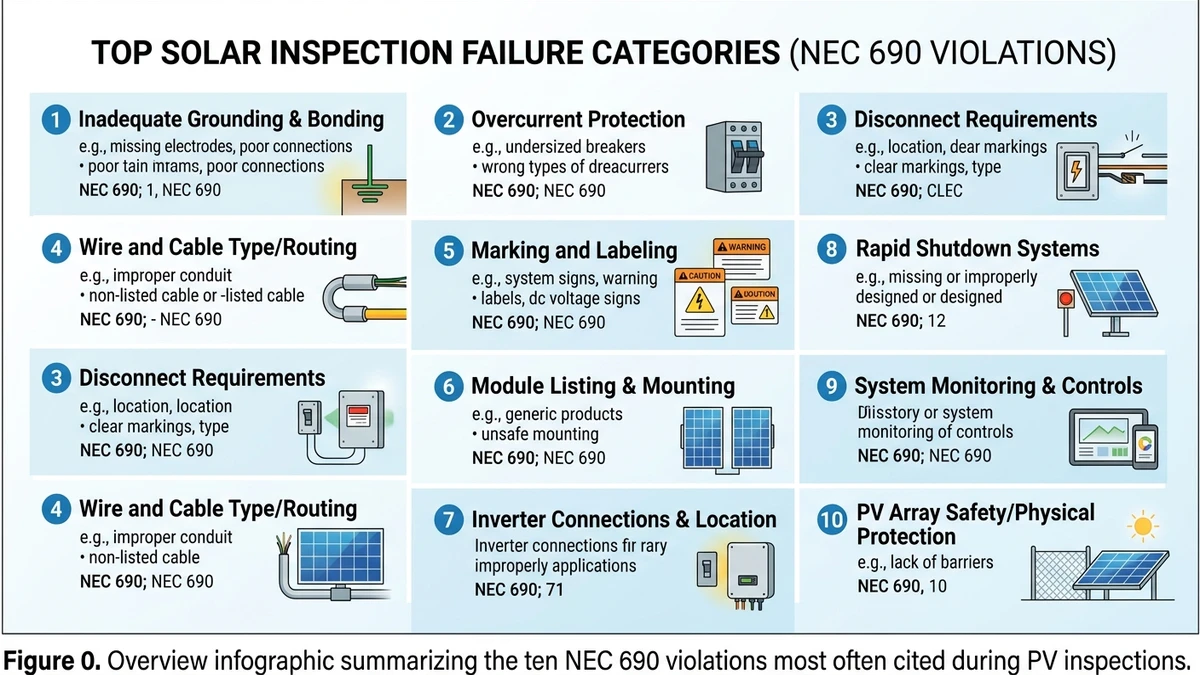
The NEC 690 violations that fail solar inspections most often include missing or undersized DC disconnects, improper string overcurrent protection, unlabeled conductors, inadequate working clearance, and missing arc-fault circuit interrupter (AFCI) protection. These ten code deficiencies account for the majority of failed PV inspections across residential and commercial installations in the U.S.
In a 2023 review of commercial rooftop PV projects across California and Arizona, inspectors flagged DC overcurrent protection sizing errors and disconnect labeling failures as the two most recurring NEC 690 deficiencies, appearing in roughly 60–70% of first-inspection failures.
Most NEC 690 failures trace back to installers applying AC protection logic to DC circuits. NEC 690.9 requires overcurrent protection devices to be rated for DC voltage and sized to handle a minimum of 156% of the module short-circuit current in the applicable calculation context. Using an AC-rated breaker on a 1000 VDC string circuit is both a code violation and a fire risk.
The ten violations in this article span four protection categories:
For installers troubleshooting a failed inspection, the DC disconnect switch compliance checklist and the PV combiner box wiring standards guide are practical starting points for the two most commonly cited deficiency categories.
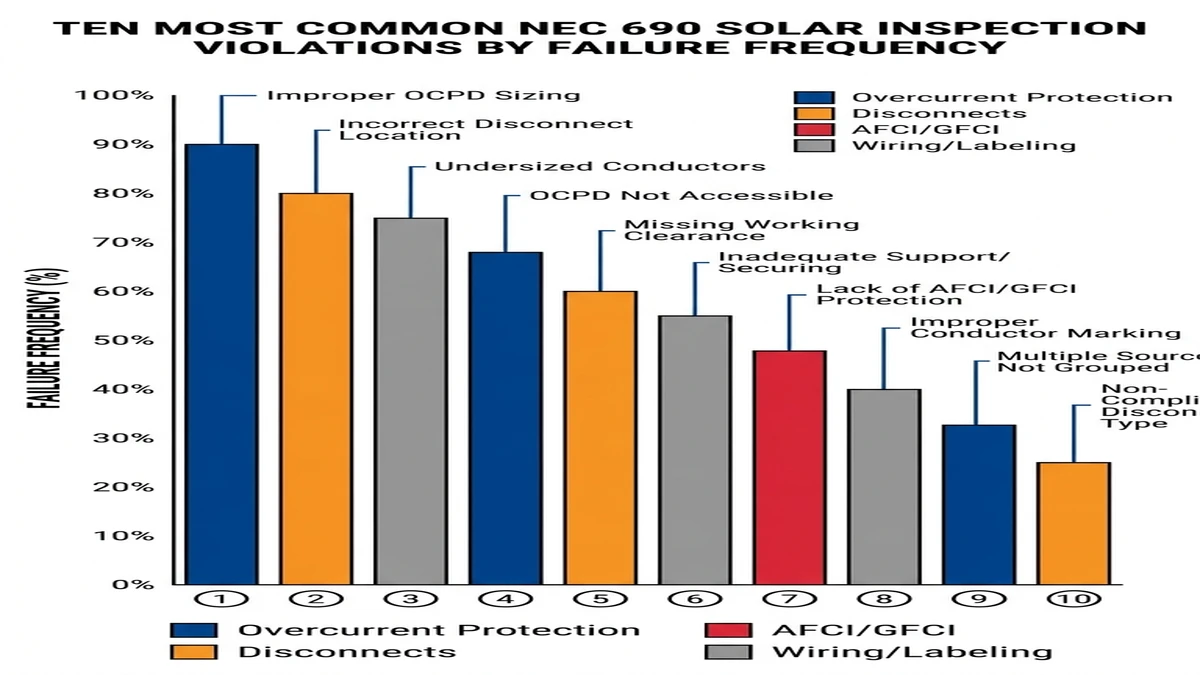
The most common failures usually appear inside the combiner or at the string protection level, where one wrong component choice can affect the whole array.
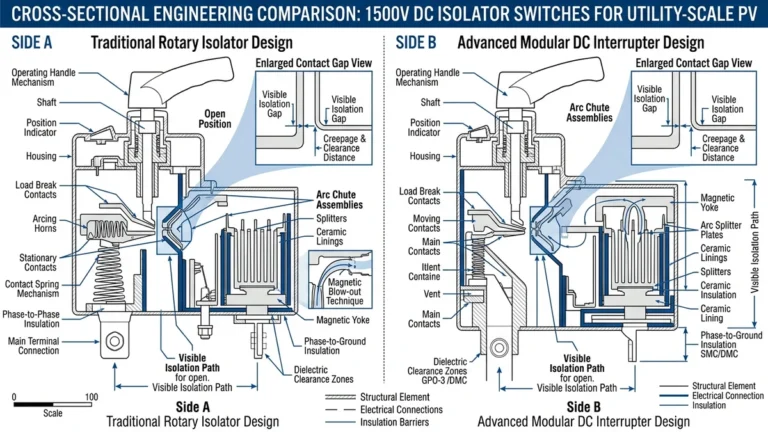
DC arcs are harder to extinguish than AC arcs because DC current has no natural zero crossing. In AC systems, current reverses polarity 100–120 times per second, giving the arc a self-extinguishing opportunity. In DC systems, the arc remains ionized until the interrupting device forces the current to zero.
In 1500 VDC string circuits, a fault arc can sustain extreme temperatures while drawing multiple times Isc before protection clears. A properly rated Fusible CC interrupts that energy through a current-limiting element designed for PV fault conditions. An undersized or incorrectly rated fuse may rupture, vent, or fail to clear the arc.
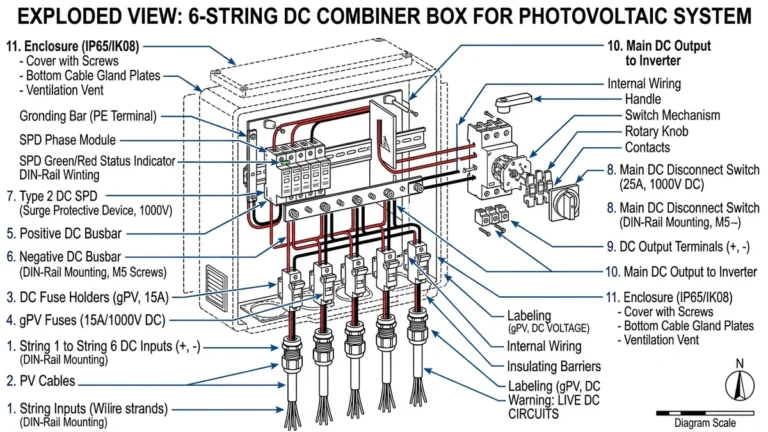
NEC 690.9 requires overcurrent devices to be listed for the application. Inspectors routinely find standard gG or gL industrial fuses installed in string combiner boxes instead of gPV-rated fuses. gPV fuses under IEC 60269-6 are intended for DC interruption at 1000–1500 VDC and for PV source circuits. A gG fuse rated for 400 VAC may not reliably interrupt a 1000 VDC fault.
Inspector red flag: fuse markings showing “AC 500V” or no DC voltage rating.
NEC 690.9(A) limits string overcurrent protection based on module short-circuit current. Inspectors frequently find 30 A or 40 A fuses protecting strings where module Isc is only 10–11 A. Oversized fuses allow damaging overcurrent to persist long enough to overheat wiring and stress module protection components.
In a 48 MW rooftop installation across commercial buildings in Jiangsu Province in 2024, replacing oversized string fuses with correctly rated gPV fuses reduced thermal anomalies identified in the next IR survey by roughly 60%.
Inspector red flag: fuse ampere rating clearly above the calculated maximum allowed for the string.
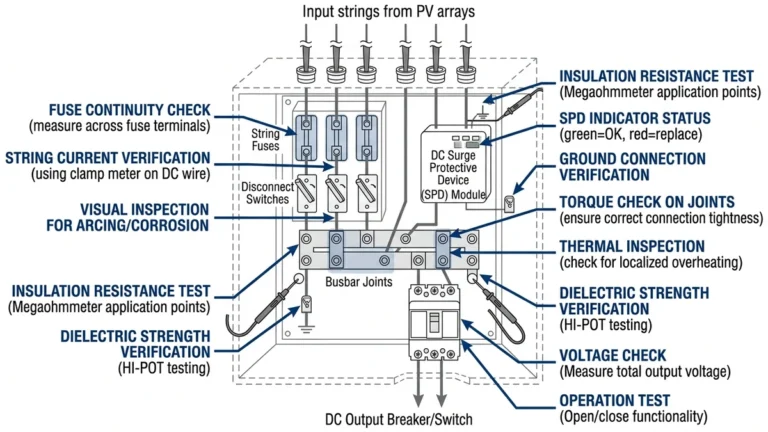
NEC 690.9(B) requires overcurrent protection where conductors can receive current from multiple sources, especially at combiner outputs and parallel string points. Inspectors find combiner boxes with empty fuse holders, removed fuse cartridges, or field-installed copper bridges used during “temporary” repairs.
That bypass leaves the DC trunk cable and inverter input exposed to the combined fault current of all parallel strings. In a 16-string combiner, that can place 160–200 A fault current onto a circuit designed for a fraction of that level.
Inspector red flag: empty fuse holders, discolored clips, or visible wire bridges inside the PV combiner box.
[Expert Insight]
– Pull one representative fuse from each combiner and verify both ampere class and DC voltage marking.
– If a fuse holder shows heat discoloration, inspect spring tension and clip damage before replacing the fuse alone.
– Compare as-built string schedules against combiner labeling.
Shutdown and isolation checks are where code compliance shifts from component selection to emergency operation under real site conditions.
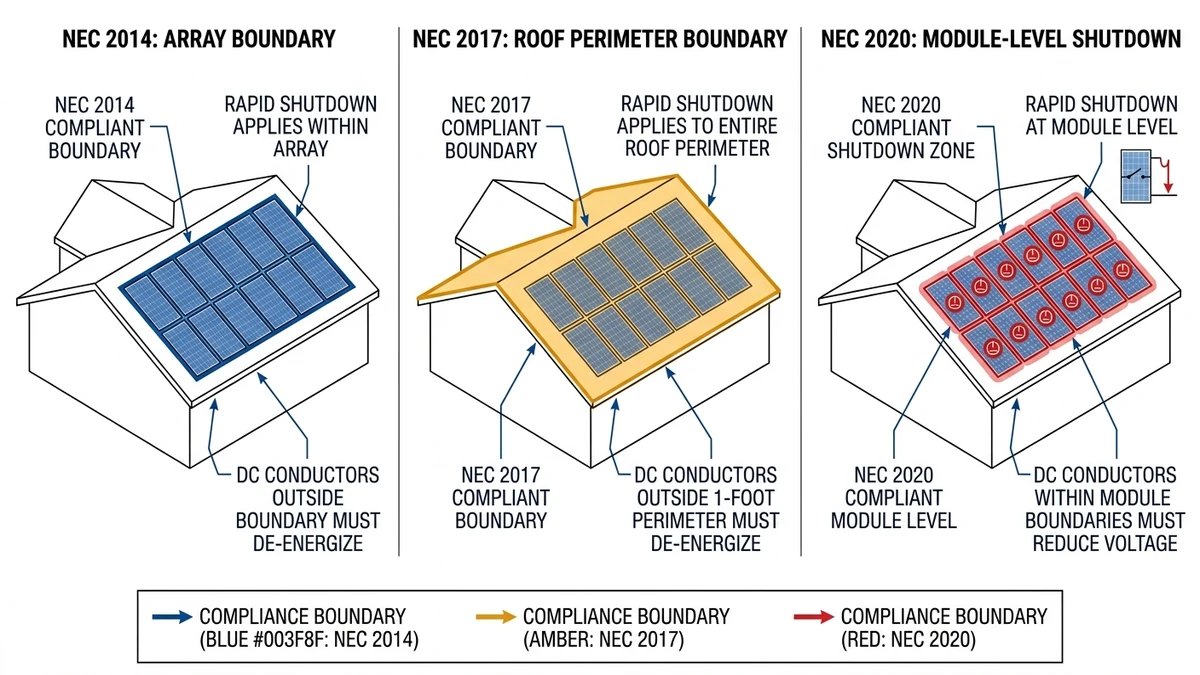
| Code Cycle | Rapid Shutdown Requirement | Controlled Boundary |
|---|---|---|
| NEC 2014 (690.12) | Reduce conductors to ≤ 30V within 10 seconds | Array boundary only |
| NEC 2017 (690.12) | Reduce to ≤ 30V within 30 seconds | Entire roof surface (1 ft perimeter) |
| NEC 2020 (690.12) | Module-level shutdown required; ≤ 80V within 30 seconds at module terminals | Module-level enforcement |
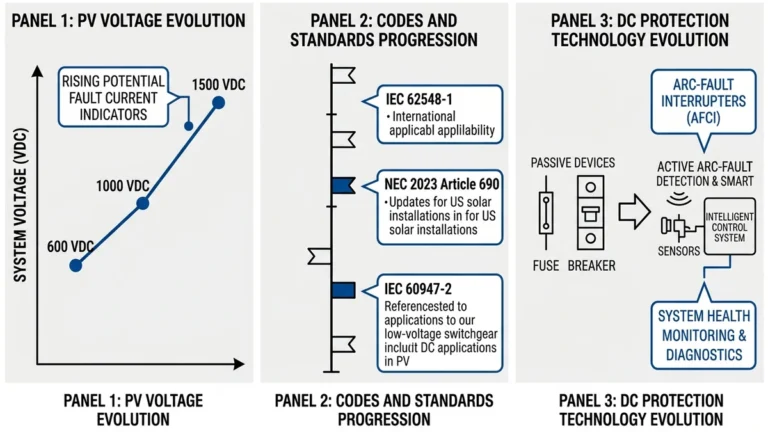
The 2017 revision moved the controlled boundary from the array edge to essentially the full roof working area. The 2020 edition pushed requirements further by making module-level shutdown the practical compliance path for most rooftop systems.
Inspectors regularly fail systems where the rapid shutdown initiator is missing, not listed for the installed equipment, or not labeled correctly at the service location. A system may have MLPE installed and still fail if the placarding or initiation hardware does not match the approved plan set.
Common red flags include:
NEC 690.13 and 690.15 require disconnecting means that are accessible, correctly located, and rated for DC interruption under the actual system voltage. Inspectors frequently find disconnects with inadequate voltage rating, poor labeling, or mounting locations that do not meet access expectations.
In a 3.2 MW commercial rooftop project in Zhejiang Province in 2023, retrofit inspections found that 40% of installed Interruptores-seccionadores de CC lacked the interrupting rating required for 1000 VDC string voltage under load.
For a deeper review, the NEC 690.13 compliance checklist covers disconnect sizing and labeling in detail.
[Expert Insight]
– Test rapid shutdown in front of the inspector only after confirming inverter firmware, MLPE pairing, and placards all match the current as-built configuration.
– On retrofit jobs, verify whether the AHJ is enforcing the original permit cycle or a newer adopted NEC edition before ordering replacement shutdown equipment.
– For DC disconnects, check horsepower and utilization ratings in addition to voltage.
Wiring and grounding deficiencies are common because they often develop at transitions: roof to raceway, array to combiner, or racking to grounding electrode system.
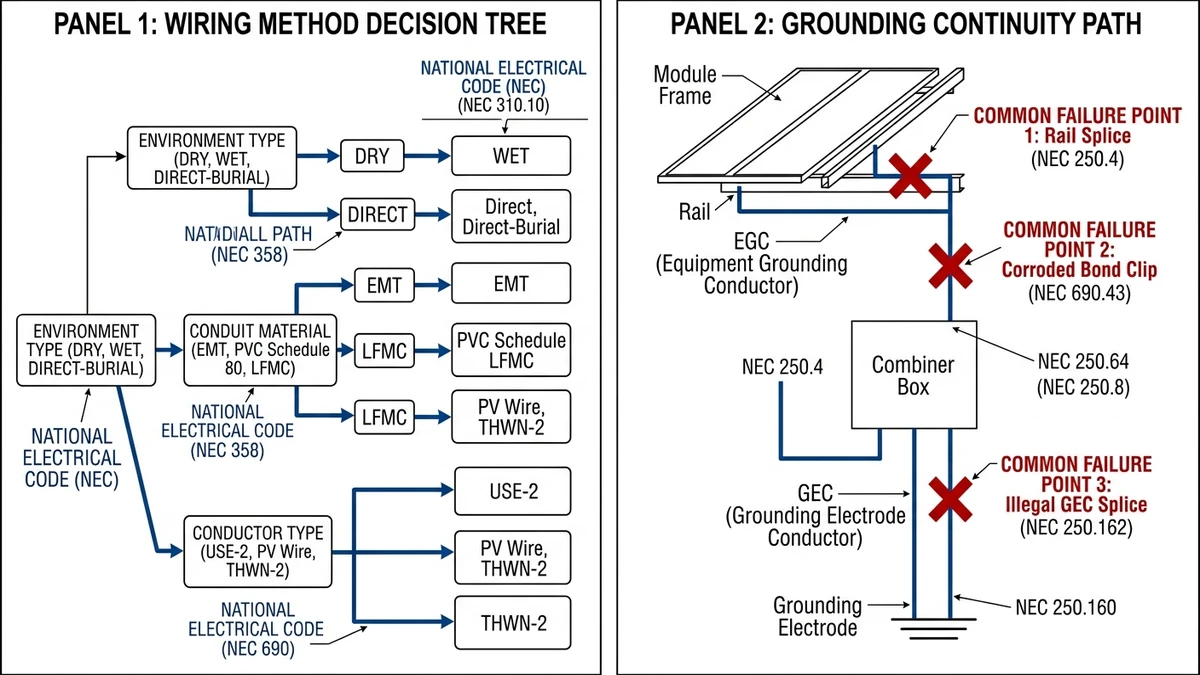
NEC 690.31 governs wiring methods for PV source and output circuits. Inspectors flag exposed conductors lacking proper raceway protection, incorrect conductor types for wet or UV-exposed locations, and transitions into buildings made with cable types not permitted for the environment.
A practical field sequence is:
A broken ground path can remain invisible until a real fault occurs. Inspectors focus on continuity, bond quality, and whether metallic module frames, rails, and associated equipment are tied into an effective grounding path.
Use this checklist during troubleshooting:
In a 6.5 MW commercial rooftop installation in Zhejiang Province in 2023, a corroded rack-to-rail bond joint measuring 2.3 Ω caused recurring GFDI trips for months before technicians traced the issue to the bond path.
The last group of high-frequency failures usually appears when the installed hardware technically fits the layout but not the code-required ratings.
NEC 690.4(B) requires PV equipment to be listed and identified for the application. Inspectors cite this when AC-rated breakers are used on DC strings, when combiner boxes lack PV-specific listing, or when field substitutions were made without updated submittals.
Verify that every Disyuntor de CC carries an explicit DC voltage rating at or above the system maximum open-circuit voltage.
Where surge protection is specified or required by project design, the SPD must match the DC system voltage and the equipment insulation limits. For a 1500 VDC system, an SPD with a 1000 V continuous operating rating is a mismatch that can fail prematurely or nuisance-trip connected equipment.
In a 35 MW ground-mount installation in Hebei Province in 2023, undersized SPDs on DC combiner circuits caused repeated inverter shutdowns before corrective inspection identified the rating mismatch. Properly rated surge protection devices solved the issue without broader equipment replacement.
For general surge-risk background, see the National Renewable Energy Laboratory guidance: https://www.nrel.gov
NEC 690.8 requires conductor ampacity calculations that account for current multipliers and derating factors such as ambient temperature and conduit fill. Inspectors routinely find wire selected from a nominal ampacity table without applying the actual rooftop conditions.
String Isc = 10 A → base requirement = 10 × 1.25 = 12.5 A
Ambient correction factor at 50°C (from NEC Table 310.15(B)(2)(a)) = 0.82
Conduit fill factor (4 conductors) = 0.80
Combined derating = 0.82 × 0.80 = 0.656
Required conductor ampacity = 12.5 ÷ 0.656 = 19.1 A minimum
A 14 AWG conductor rated at 15 A fails this check. Use 10 AWG (30 A rated) minimum.
A common result is 12 AWG installed where 10 AWG is required once temperature and fill corrections are applied.
| Violation | NEC Clause | Inspector Red Flag | Pass Condition |
|---|---|---|---|
| Missing or undersized DC disconnect | 690.13 | No accessible disconnect within 10 ft of inverter; unlabeled handle | Rated disconnect installed, labeled, accessible within reach per 690.13(B) |
| String overcurrent protection absent | 690.9 | Unprotected conductors at combiner box; no gPV fuse or string breaker | Each string fused or breakered at the required value per 690.9(A) |
| Incorrect wire ampacity | 690.8 | Conductor gauge undersized for calculated load and derating factors | Conductor ampacity satisfies calculated requirement at operating temperature |
| No rapid shutdown system | 690.12 | Array on roof with no RSD initiator or boundary labeling | RSD installed, tested, and labeled per 690.12(B)(2) |
| Improper grounding/bonding | 690.43 | Floating equipment ground; missing bonding jumper on racking | All metallic components bonded; grounding path verified |
| Surge protection device missing | 690.11 | No SPD on DC side where specified by design or site risk assessment | SPD correctly rated and installed at the appropriate DC location |
| Combiner box not rated for environment | 690.31 | NEMA 1 enclosure in outdoor/wet location | Enclosure rating matches installation environment |
| Backfeed protection missing | 690.15 | No means to isolate each source circuit at the combiner box | Isolation provided per source circuit and rated for DC interruption |
| Conductor routing through living space | 690.31(G) | PV source/output circuits routed through interior walls without required protection | Routing and raceway comply with occupied-space requirements |
| Missing system labeling | 690.53 / 690.54 | No maximum voltage, Isc, or operating current labels at disconnect | Required labels present, permanent, and legible |
In a 22 MW rooftop portfolio across 18 commercial buildings in Zhejiang Province in 2024, pre-inspection audits using a structured checklist reduced re-inspection rates by catching labeling and overcurrent deficiencies before the official site visit.
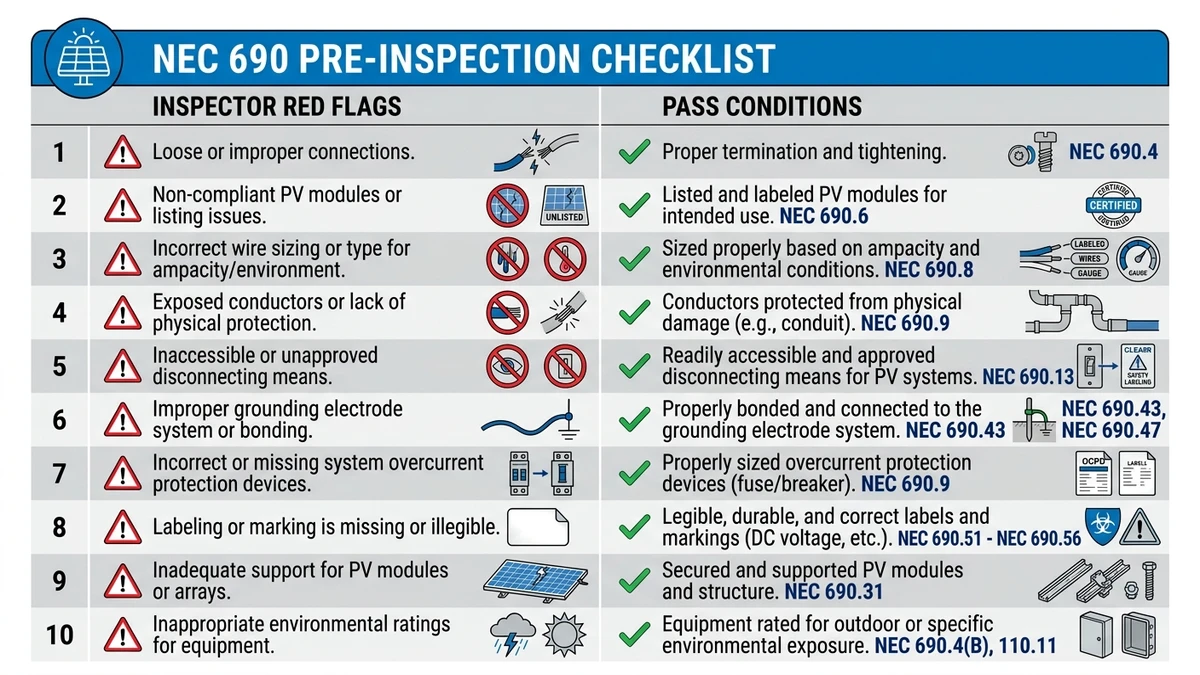
The inspection outcome is usually determined long before anyone opens a combiner box on-site.
Most NEC 690 violations begin at design and procurement, when voltage class, interrupt rating, conductor sizing, and listing details are assumed instead of verified. By the time an inspector flags an undersized DC disconnect or the wrong fuse class, the project has already absorbed delay and rework costs.
A more reliable method is to spec components against actual operating and fault conditions before drawings are submitted. Confirm interrupting capacity against prospective short-circuit current, verify gPV fuses carry the correct certification at system voltage, and make sure every protective device is listed for DC use rather than borrowed from an AC bill of materials.
Sinobreaker’s DC protection lineup covers string-level MCBs, combiner-box fusing, and surge protection devices rated up to 1500 VDC, all aligned with the standards commonly referenced during plan review. Whether the project is a 100 kW rooftop or a multi-MW ground mount, the workflow is the same: match voltage class, apply conductor and overcurrent calculations correctly, and document those selections in the submittal package.
Overcurrent protection and disconnect labeling issues are among the most frequently cited failures, especially on first inspections. They are easy for inspectors to spot and often trace back to incorrect component selection.
A breaker that is acceptable on AC may not safely interrupt a DC fault arc. Inspectors look for explicit DC ratings because DC current is harder to break under load.
Most rooftop systems do under the NEC editions commonly enforced today, but the exact requirement depends on the adopted code cycle and system configuration. The AHJ’s adopted edition determines the compliance path.
They compare installed wire size and type against calculated current, temperature correction, conduit fill, and installation conditions. If the installed conductor does not support the corrected ampacity requirement, it fails.
Common misses include rapid shutdown placards, disconnect identification, and PV system labels showing maximum voltage, current, and power values. Missing or illegible field-applied labels are a routine correction item.
No. The enclosure rating and the internal protection devices are separate compliance checks, and either one can fail the inspection.
Use a pre-inspection checklist that verifies ratings, labeling, grounding continuity, and shutdown operation before the AHJ visit. Most repeat failures are preventable with one disciplined field audit.