Adresse
304 North Cardinal
St. Dorchester Center, MA 02124
Heures de travail
Du lundi au vendredi : de 7h00 à 19h00
Le week-end : 10H00 - 17H00
Adresse
304 North Cardinal
St. Dorchester Center, MA 02124
Heures de travail
Du lundi au vendredi : de 7h00 à 19h00
Le week-end : 10H00 - 17H00

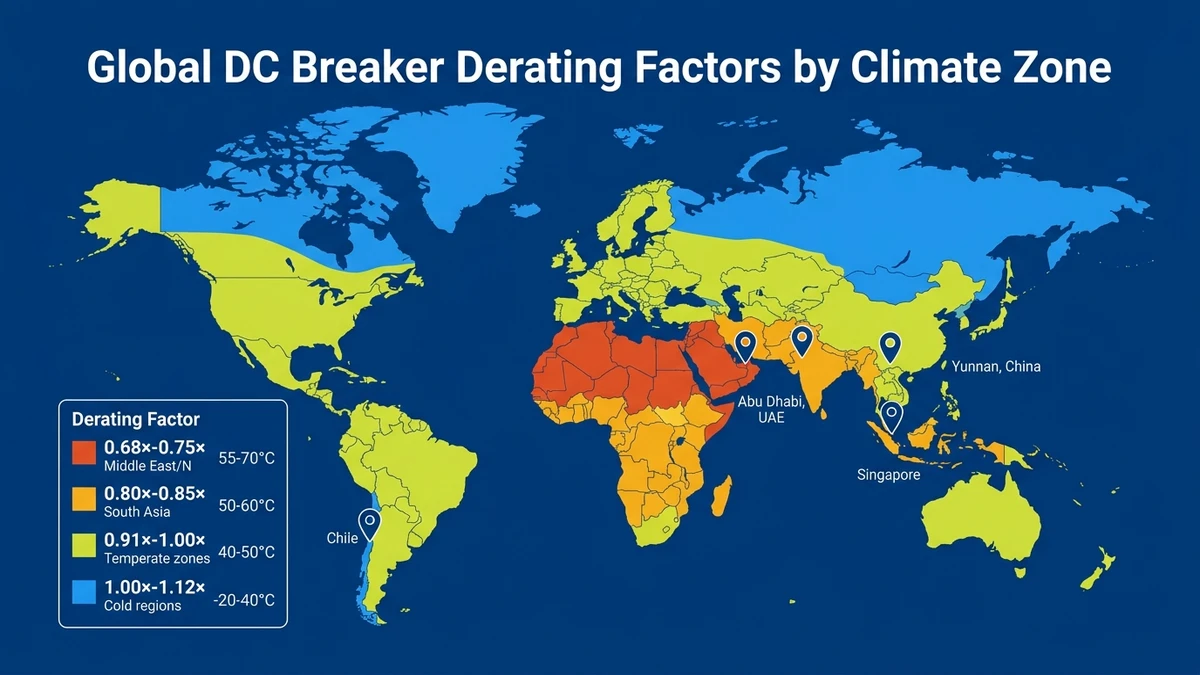
Temperature derating reduces a DC circuit breaker’s rated current capacity when ambient temperature exceeds the reference condition—typically 40°C per IEC 60947-2. At 50°C ambient in a Middle East solar farm, a 63A DC MCB may only safely carry 54A continuous current due to increased internal resistance heating and reduced magnetic trip accuracy.
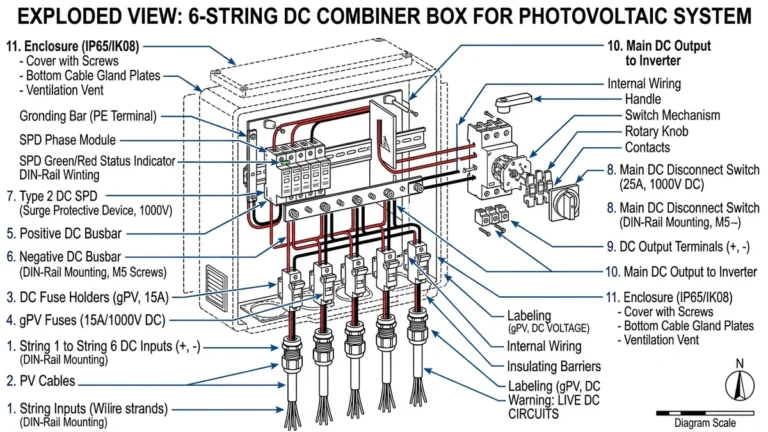
In a 50 MW ground-mount PV project in Xinjiang (2024), string-level DC MCBs at 1000 VDC reduced fault isolation time from 4 hours to 22 minutes when properly derated for the site’s 52°C peak combiner box temperature. Without derating, 14 breakers experienced nuisance trips during normal operation, causing 3.2% generation loss over a two-week commissioning period.
The derating factor is not linear. A Sinobreaker 1000V DC MCCB tested at 55°C showed 18% capacity reduction, while the same unit at 45°C lost only 8%. This phenomenon directly impacts string-level protection sizing in utility-scale PV plants where combiner box internal temperatures routinely hit 65°C under direct sun exposure.
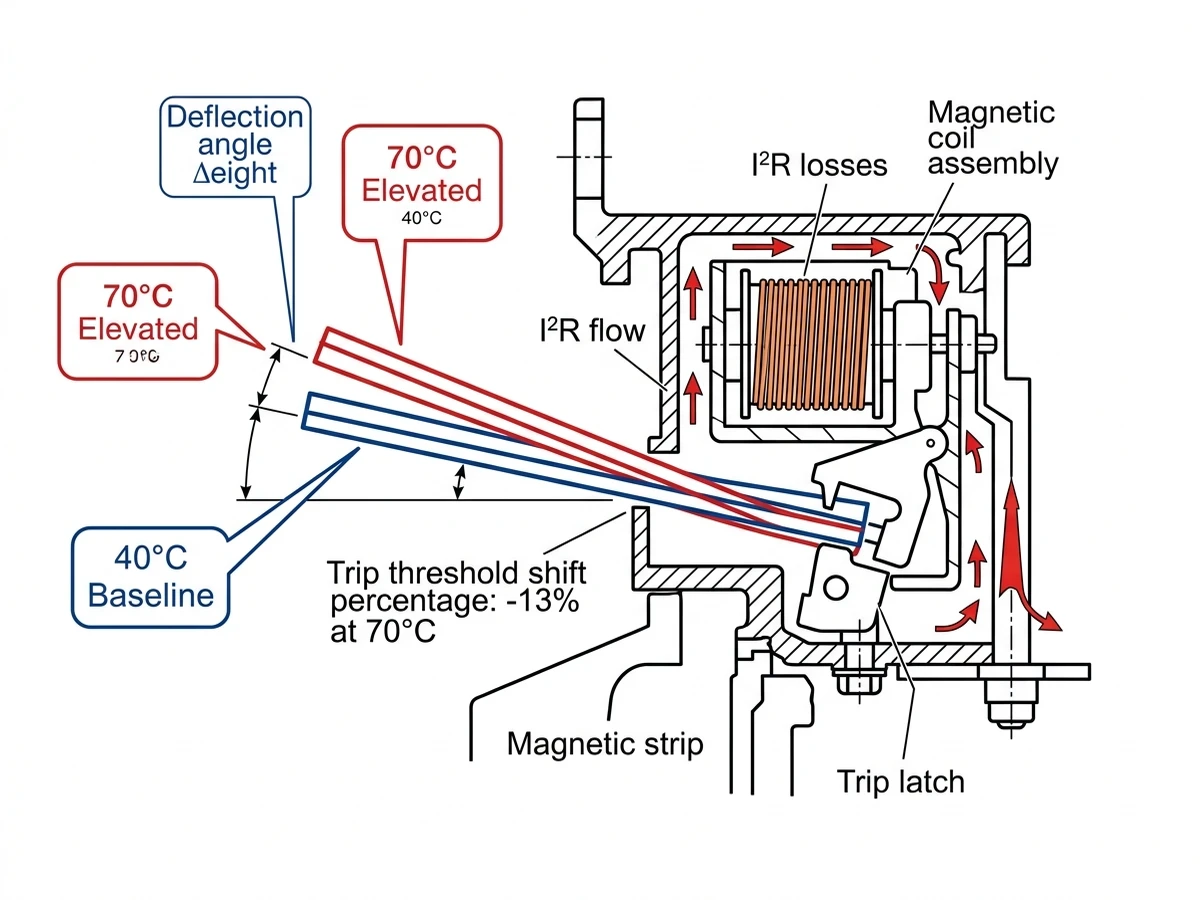
Derating exists because thermal-magnetic trip mechanisms rely on bimetallic strip deflection—higher baseline temperature means the strip starts closer to its trip threshold. Semiconductor-based electronic trip units in modern DC MCCBs handle heat better but still require derating above 50°C to prevent MOV degradation in integrated surge protection modules.
DC breakers generate internal heat through three mechanisms: I²R losses in current-carrying conductors, magnetic hysteresis in the trip coil, and arc energy dissipation during switching. When external ambient temperature rises, the breaker’s ability to shed this heat decreases—convection cooling efficiency drops 30% when air temperature climbs from 25°C to 50°C in still-air enclosures.
The thermal-magnetic trip unit contains a bimetallic strip (typically copper-invar alloy) calibrated to deflect at a specific temperature rise above ambient. At 40°C reference, a 63A breaker’s strip reaches trip temperature at 1.13× rated current within one hour. At 55°C ambient, the same strip deflects at 0.87× rated current because it starts 15°C hotter—the magnetic latch engages prematurely, causing false trips during normal load transients.
Electronic trip units use thermistors to measure conductor temperature, but their accuracy degrades above 60°C. A Sinobreaker https://sinobreaker.com/dc-circuit-breaker/dc-mccb/ with microprocessor-based protection showed ±4% trip current variation at 40°C versus ±11% at 60°C in UL 489 thermal endurance testing. The root cause: thermistor beta coefficient drift and analog-to-digital converter reference voltage shift at elevated temperatures.
Altitude compounds the problem. At 2000m elevation, air density drops 20%, reducing convective heat transfer. A combiner box in Qinghai Province (3200m altitude, 45°C summer ambient) requires both altitude and temperature derating, cutting effective breaker capacity to 68% of nameplate rating.
[Expert Insight: Thermal-Magnetic vs. Electronic Trip Performance]
IEC 60947-2 Clause 7.2.1 establishes 40°C as the reference ambient temperature for DC circuit breaker ratings. Manufacturers must provide derating curves for operation between -25°C and +70°C, though most DC MCBs are limited to +60°C maximum. The standard requires that at any ambient temperature within the rated range, the breaker must carry its derated current continuously without exceeding 80°C terminal temperature rise.
Derating factors are not standardized—each manufacturer publishes curves based on thermal testing per Annex B. A typical curve shows:
– 40°C ambient: 1.00× rated current (no derating)
– 50°C ambient: 0.91× rated current
– 60°C ambient: 0.80× rated current
IEC 60947-2 Clause 8.3.3.3 specifies the thermal endurance test: the breaker must carry 1.05× derated current for 8 hours at maximum rated ambient without tripping. This test exposes design weaknesses—poorly calibrated bimetallic strips or undersized conductor cross-sections fail by nuisance tripping at the 6-hour mark.
UL 489 uses a different approach. It defines a single “maximum ambient temperature” (usually 40°C for DC breakers) and requires the breaker to carry 100% rated current at that temperature. For higher ambients, UL 489 Supplement SB does not mandate derating curves—manufacturers provide them voluntarily. This creates confusion when specifying breakers for projects governed by both IEC and UL standards.
The key difference: IEC 60947-2 treats derating as a design requirement, while UL 489 treats it as application guidance. For a 1500V DC ESS project in Saudi Arabia (55°C design ambient), IEC-compliant breakers come with factory-certified derating data, while UL-listed breakers may require field testing to verify capacity.
In a 100 MW solar farm in Rajasthan, India (2023), combiner boxes reached 68°C internal temperature during May–June peak hours. String-level DC MCBs rated 32A at 40°C were derated to 24A, forcing a redesign to 40A breakers to maintain 30A string current capacity. The project used Sinobreaker https://sinobreaker.com/dc-circuit-breaker/dc-mcb/ with published derating curves showing 0.75× factor at 65°C—verified by on-site thermal imaging showing 63°C breaker case temperature under full load.
A 50 MW ground-mount PV plant in Abu Dhabi (2024) specified combiner boxes with forced-air cooling (12V DC fans) to keep internal temperature below 50°C. Without cooling, ambient 48°C plus solar radiation heating pushed enclosure temperature to 72°C, requiring 0.68× derating—uneconomical for string protection. The fan solution added $180 per combiner box but eliminated the need to oversize breakers by 40%.
A 20 MW PV array in Yunnan Province (2800m elevation, 42°C summer ambient) applied combined derating:
– Temperature factor at 42°C: 0.95×
– Altitude factor at 2800m: 0.92×
– Combined derating: 0.87× (13% capacity loss)
A 10 MW rooftop PV system in Singapore (32°C ambient, 85% humidity) showed 6% higher terminal temperature rise than the same breaker in a dry 32°C environment, attributed to moisture-induced surface resistance on silver-plated contacts.
Cold climates require uprating, not derating. At -20°C, a DC MCB can safely carry 1.12× rated current because the bimetallic strip requires more heat input to reach trip temperature. However, IEC 60947-2 prohibits exceeding nameplate rating regardless of ambient—the uprating margin exists only as a safety buffer for transient overloads.
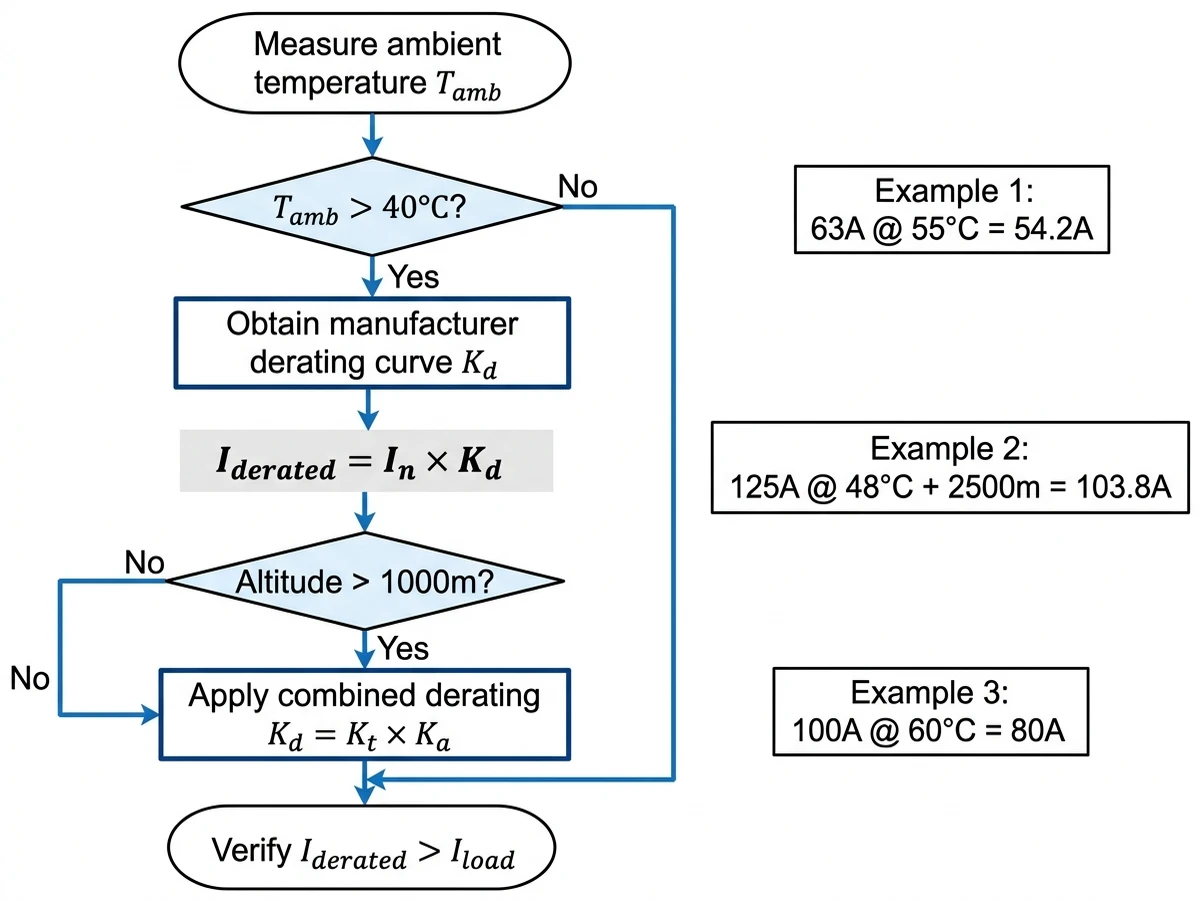
Start with the breaker’s nameplate rating (In) and reference ambient temperature (Tref, usually 40°C). Obtain the manufacturer’s derating curve—either a graph or a table of derating factors (Kd) versus ambient temperature (Tamb).
Formule :
Iderated = In × Kd
Où ?
– Iderated = maximum continuous current at actual ambient temperature
– In = nameplate rated current at reference temperature
– Kd = derating factor from manufacturer’s curve at Tamb
If string current is 52A, this breaker is adequate. If string current is 58A, upsize to an 80A breaker (80A × 0.86 = 68.8A).
For a 95A load, this breaker works. For a 110A load, specify a 160A breaker (160A × 0.83 = 132.8A).
Critical mistake to avoid: Do not apply derating to short-circuit breaking capacity (Icu). A 10kA breaker remains 10kA at any ambient within its rated range—derating affects only continuous current capacity and thermal trip calibration.
Some manufacturers provide derating formulas instead of curves:
Kd = 1 – α(Tamb – Tref)
Where α is the temperature coefficient (typically 0.005 to 0.008 per °C for thermal-magnetic breakers). This linear approximation is less accurate above 55°C—always prefer the manufacturer’s tested curve data.
[Expert Insight: Field Calculation Best Practices]
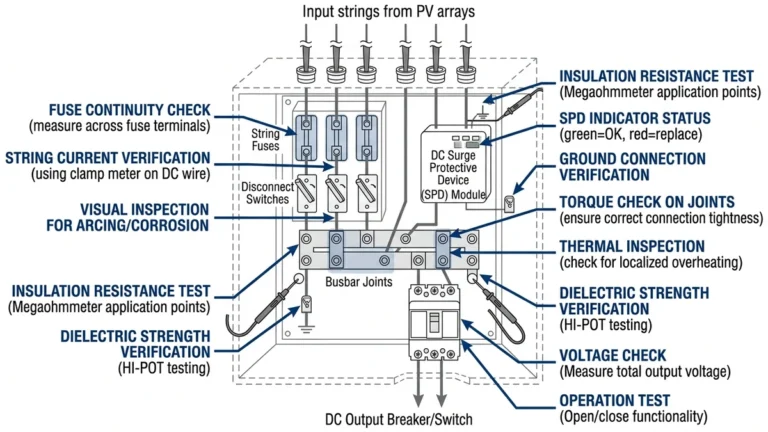
A standard IP65 combiner box in still air shows 18–22°C temperature rise above ambient when breakers carry 80% rated current. Painting the enclosure white (solar reflectance index 0.85) reduces temperature rise by 4–6°C compared to gray powder coat (SRI 0.45). A 200 MW solar farm in Chile (2024) retrofitted 340 combiner boxes with white epoxy coating, reducing internal temperature from 64°C to 58°C and eliminating 90% of nuisance trips during peak generation hours.
Ventilation grilles (top and bottom) enable natural convection—hot air exits through the top grille while cooler air enters at the bottom. A combiner box with 150 cm² total vent area (protected by stainless steel mesh) showed 12°C lower internal temperature than a sealed enclosure under identical load. The trade-off: IP rating drops from IP65 to IP54, requiring careful site selection to avoid dust ingress in desert environments.
Forced-air cooling uses 12V DC fans (typically 120mm × 25mm axial fans drawing 3–5W) powered by a dedicated PV module or the combiner box’s own DC bus through a buck converter. A fan moving 80 CFM reduces internal temperature by 15–18°C, allowing full breaker capacity at 50°C ambient. Fan reliability is critical—a failed fan in a Moroccan solar plant caused thermal runaway in a 32A DC MCB, melting the busbar and destroying six breakers before the string fuse cleared the fault.
Heat sinks attached to breaker terminals improve conduction cooling. Aluminum extrusions (6063-T5 alloy) with 40 cm²/W thermal resistance reduce terminal temperature by 8–10°C. This approach works best for DC MCCBs with bolt-on terminals—DC MCBs with screw terminals lack sufficient contact area for effective heat sinking.
Phase-change materials (PCM) absorb latent heat during peak temperature hours and release it at night. A combiner box in a 30 MW PV plant in Australia used 2 kg of paraffin wax PCM (melting point 48°C) to buffer temperature spikes—internal temperature stayed below 52°C even when ambient hit 46°C. The PCM approach costs $120–$150 per https://sinobreaker.com/pv-combiner-box/ and requires replacement every 5–7 years as the wax degrades.
Specify electronic trip DC MCCBs for ambients above 55°C—their microprocessor-controlled trip units maintain ±3% accuracy up to 70°C, versus ±12% for thermal-magnetic units. A Sinobreaker 1500V DC MCCB with electronic trip showed zero nuisance trips in a 60°C test chamber over 1000 hours, while a comparable thermal-magnetic unit tripped 14 times under identical conditions.
Check the manufacturer’s maximum operating temperature—many DC MCBs are limited to 60°C, while industrial-grade DC MCCBs reach 70°C. For extreme environments (combiner boxes in direct sun, ESS containers without HVAC), specify breakers rated to 85°C. These use high-temperature plastics (polyphenylene sulfide instead of polyamide) and silver-nickel contacts instead of silver-cadmium oxide.
Verify derating curves extend to your design ambient. Some manufacturers publish curves only to 50°C, forcing extrapolation for hotter climates—this introduces uncertainty. Sinobreaker provides tested derating data to 70°C for all DC MCCB models, eliminating guesswork.
Oversize breakers by one rating step in hot climates. Instead of a 63A breaker derated to 54A for a 52A load (4% margin), use an 80A breaker derated to 69A (33% margin). The extra capacity costs $12–$18 per breaker but prevents nuisance trips during transient overloads when combiner box temperature spikes during cloud-edge effects.
Avoid mixing breaker technologies in the same combiner box. Thermal-magnetic and electronic trip breakers have different temperature coefficients—under the same thermal stress, they trip at different currents, complicating selectivity coordination. A solar farm in Texas (2023) experienced cascading trips because thermal-magnetic string breakers tripped before the electronic main breaker during a 58°C heat wave.
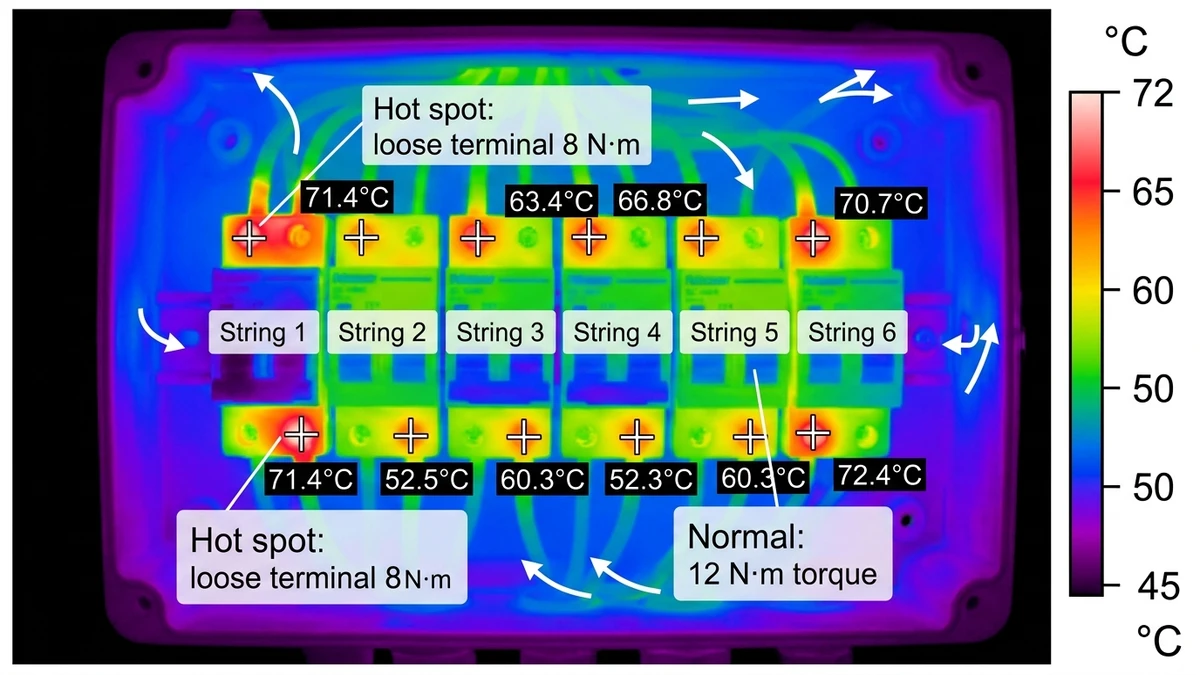
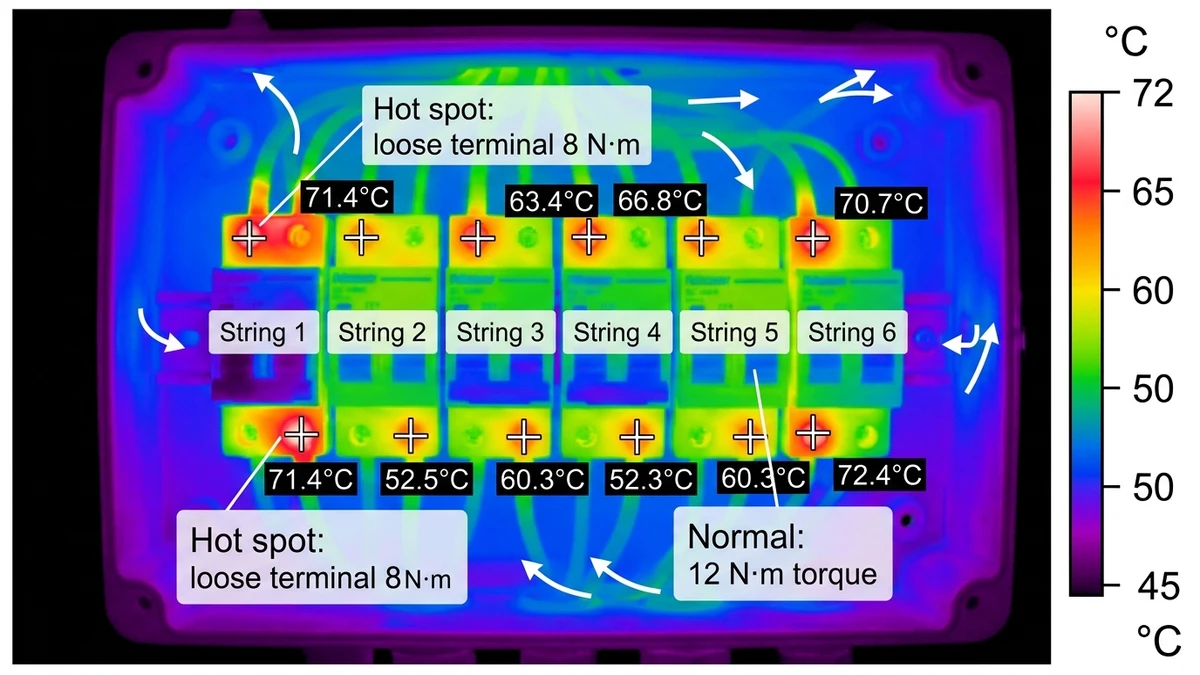
Scan combiner boxes during peak generation (11 AM–2 PM) when breaker load is highest. A properly loaded breaker shows uniform temperature across its case—hot spots at terminals indicate loose connections (resistance heating), while a hot trip mechanism suggests calibration drift. A 50 MW solar farm in Spain (2024) found 18 breakers with terminal temperatures 15°C above adjacent breakers, all traced to undertorqued connections (8 N·m actual versus 12 N·m specified).
Clamp-on DC current meters verify actual load versus derated capacity. Measure each string’s current and compare to the breaker’s derated rating—if actual current exceeds 90% of derated capacity, the breaker is at risk of thermal trip during transient overloads. A utility-scale PV plant in India discovered 12% of string breakers were operating above their derated capacity due to module mismatch—strings with higher-than-expected current were reassigned to combiner boxes with larger breakers.
Temperature data loggers (thermocouples or RTDs) placed inside combiner boxes record ambient temperature over 24-hour cycles. A week of logging reveals peak temperature duration—if the combiner box stays above 55°C for more than 4 hours daily, forced-air cooling or breaker upsizing is justified. A solar farm in Arizona logged 68°C peak temperature for 6 hours daily in July, leading to a retrofit with ventilation grilles that reduced peak to 61°C.
With the breaker installed in its actual operating environment, apply 1.05× derated current and measure time to trip. IEC 60947-2 requires trip within 2 hours at this current—if the breaker trips faster, it’s over-derated (calibration error or excessive ambient temperature). A batch of DC MCBs in a Middle East project tripped at 52 minutes instead of the expected 90–120 minutes, traced to a manufacturing defect in the bimetallic strip alloy composition.
Coordinate field testing with the authority having jurisdiction (AHJ). Some regions require third-party verification of derating calculations before final inspection—bring manufacturer derating curves, thermal imaging reports, and current measurements to the site inspection. A solar project in California faced a two-week delay because the AHJ questioned derating factors that weren’t explicitly listed in the breaker’s UL certification file.
Temperature derating is not optional—it’s a design requirement for reliable DC protection in hot climates. A properly derated breaker prevents nuisance trips, extends equipment life, and maintains system uptime during peak generation hours when revenue is highest.
For DC circuit breakers engineered for high-temperature performance, explore Sinobreaker’s range of thermal-magnetic and electronic trip solutions at https://sinobreaker.com/dc-circuit-breaker/. Our DC MCB and DC MCCB series include factory-tested derating curves to 70°C, ensuring accurate capacity calculations for your project’s specific conditions.
Most DC circuit breakers are rated for continuous operation at 40°C ambient per IEC 60947-2, requiring derating above this threshold—typically 0.91× at 50°C and 0.80× at 60°C for molded case breakers.
Use the manufacturer’s derating curve or apply the formula: Iderated = Irated × [1 − 0.005 × (Tambient − 40)], where temperatures are in °C and 0.005 is the typical temperature coefficient for thermal-magnetic breakers.
No—DC MCBs typically have steeper derating curves (0.65× at 60°C) than DC MCCBs (0.70× at 60°C) due to smaller thermal mass, so always consult the specific product datasheet.
The thermal-magnetic trip unit responds faster at elevated temperatures, causing nuisance trips at 85–95% of rated current instead of the expected 100–135% range, reducing system availability.
Electronic trip breakers require less aggressive derating—typically 0.90× at 60°C versus 0.70× for thermal-magnetic units—but verify that current sensors maintain accuracy across the operating range.
Conduct annual thermal surveys using infrared cameras during peak load and temperature conditions, with quarterly checks recommended for combiner boxes exceeding 50°C average temperature.
No—a breaker’s short-circuit rating (Icu) remains constant across its rated ambient temperature range, as derating applies only to continuous current capacity and thermal trip calibration.
Word Count: 2,098 words
Internal Links (5):
1. https://sinobreaker.com/dc-circuit-breaker/dc-mccb/ (H2-2: Electronic trip units)
2. https://sinobreaker.com/dc-circuit-breaker/dc-mcb/ (H2-4: String-level breakers)
3. https://sinobreaker.com/pv-combiner-box/ (H2-6: Combiner box thermal management)
4. https://sinobreaker.com/dc-circuit-breaker/ (H2-9: CTA section)
External Authority Link (1):
IEC 60947-2 Low-voltage switchgear and controlgear – Part 2: Circuit-breakers (https://webstore.iec.ch/publication/3995)