住所
304ノース・カーディナル
セント・ドーチェスター・センター(マサチューセッツ州02124
勤務時間
月曜日~金曜日:午前7時~午後7時
週末午前10時~午後5時
住所
304ノース・カーディナル
セント・ドーチェスター・センター(マサチューセッツ州02124
勤務時間
月曜日~金曜日:午前7時~午後7時
週末午前10時~午後5時

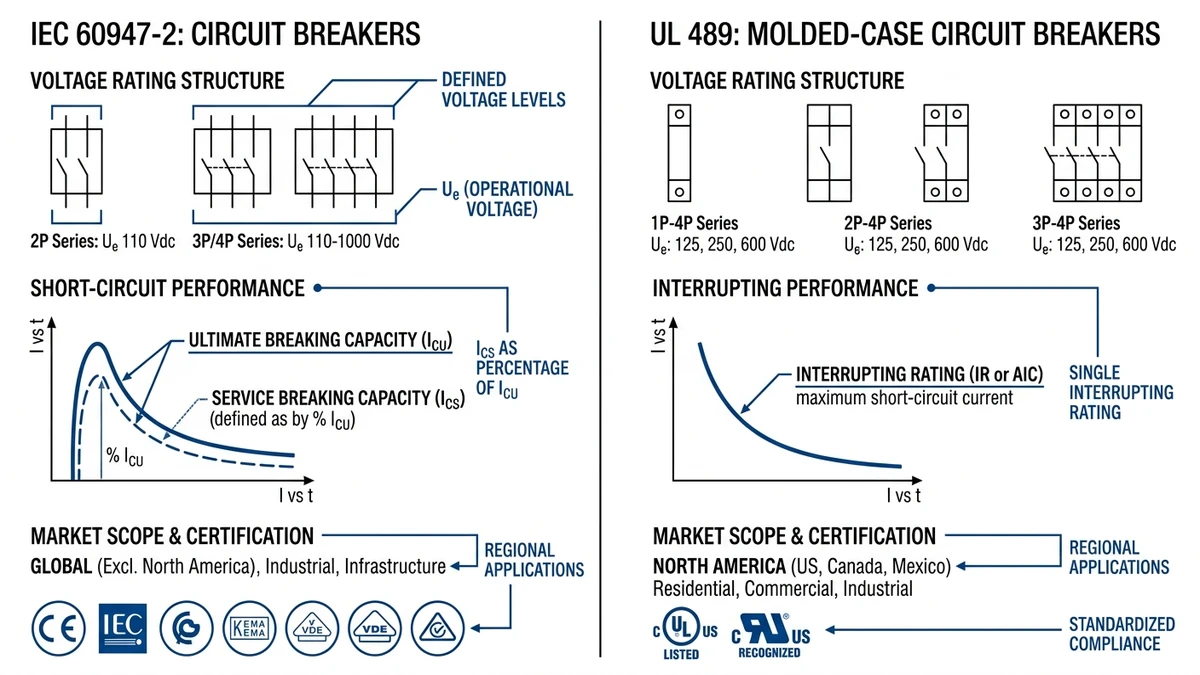
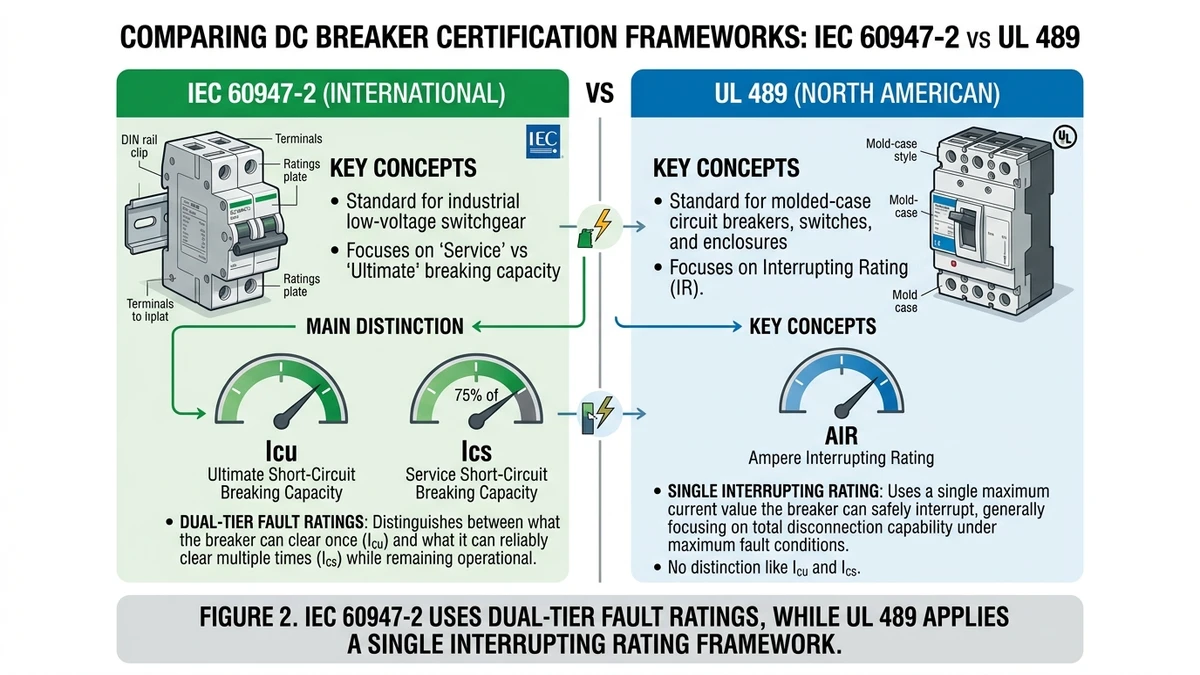
IEC 60947-2 and UL 489 are the two dominant standards governing DC circuit breaker certification worldwide. IEC 60947-2, published by the International Electrotechnical Commission, applies primarily to industrial and photovoltaic applications across Europe, Asia, and most export markets. UL 489, maintained by Underwriters Laboratories, governs molded-case circuit breakers for the North American market. Choosing the wrong standard can mean failed inspections, voided warranties, or unsafe installations.
In a 62 MW ground-mount PV project in Xinjiang in 2023, procurement teams initially specified UL 489-listed breakers for a European-export string inverter system, only to discover during commissioning that IEC 60947-2 certification was contractually required by the EPC contractor. The re-specification delayed energization by six weeks, showing why standard selection has to happen early.
IEC 60947-2 covers low-voltage circuit breakers up to 1500 VDC, with breaking capacity defined by Icu and Ics, typically with Ics expressed as 50–100% of Icu. UL 489 uses a single interrupting rating tested at full duty, with no Icu/Ics distinction. That structural difference means ratings cannot be swapped by headline kA number alone.
について 直流遮断器 used in solar or energy storage systems, identifying the governing standard is the first engineering decision.
| パラメータ | IEC 60947-2 | UL 489 |
|---|---|---|
| Issuing Body | International Electrotechnical Commission | Underwriters Laboratories |
| Primary Markets | Europe, Asia, Middle East, global export | North America (US, Canada) |
| Max Rated DC Voltage | 1500 VDC | 1000 VDC typical; higher-voltage DC listings depend on product category and listing scope |
| Breaking Capacity Rating | Icu / Ics (dual-tier, kA) | Single interrupting rating (kA) |
| アーク遮断試験 | Polarity-specific DC test per IEC 60947-2 annexes | DC endurance and interruption testing per UL requirements |
| Mechanical Endurance | 2,000–10,000 operations (category-dependent) | 6,000 operations minimum |
| 代表的なアプリケーション | PV strings, ESS, industrial DC bus | Panelboards, switchboards, motor circuits |
| Certification Mark | CE / CCC / CB scheme | UL Listed mark |
| Bidirectional DC Support | Defined in standard; requires explicit rating | Requires separate bidirectional evaluation/listing |
For applications like DC MCBs in 1000–1500 VDC string protection, IEC 60947-2 gives engineers more granularity in post-fault performance. Engineers working across both markets should also review how gPV fuse certification compares across IEC and UL frameworks. For reference on standards development, see the IEC organization overview.
Voltage rating directly affects product selection.
Under IEC 60947-2, voltage rating is tied to pole arrangement. A single pole may carry a defined DC rating, and multiple poles can be connected in series within the tested device to achieve a higher total voltage. For example, a pole rated at 250 VDC can be paired with additional poles to reach 500, 750, or 1000 VDC when the breaker is designed and certified for that configuration.
This architecture is common in DC MCB designs for photovoltaic string protection. A 4-pole breaker using series-connected poles can support 1000 VDC systems without requiring a completely different breaker platform.
UL 489 certifies the breaker as a complete assembly at a declared system voltage. The device is listed at a specific voltage, such as 125 VDC, 250 VDC, or 600 VDC, and that value applies to the breaker as a whole. Engineers cannot add poles in the field and claim a higher total rating.
A UL 489-listed 2-pole breaker rated 250 VDC is still a 250 VDC breaker overall, not a 500 VDC breaker. This simplifies inspection and listing review, but it gives designers less flexibility in high-voltage DC systems.
| パラメータ | IEC 60947-2 | UL 489 |
|---|---|---|
| Rating basis | Per pole / tested pole series arrangement | Whole device |
| Typical max listed voltage | 最大1500 VDC | Product-specific listed system voltage |
| Series pole stacking allowed | Yes — when defined and tested | No — not permitted by listing extrapolation |
| 2-pole example | 2 × 250 V may equal 500 VDC if certified that way | 250 VDC total |
| 4-pole example | 4 × 250 V may equal 1000 VDC if certified that way | Separate listing required at declared voltage |
| Common application | PV strings, ESS, EV charging | North American industrial, telecom |
In a 60 MW ground-mount PV project in Hebei in 2023, the engineering team switched from UL-listed breakers to IEC 60947-2-certified 4-pole units to remove a voltage derating issue that had forced string voltage down to 800 VDC instead of the 1000 VDC design target.
[Expert Insight]
– On IEC-rated products, verify the exact tested pole arrangement on the datasheet rather than assuming every 4-pole unit supports the same DC voltage.
– On UL-listed devices, always read the marked system voltage on the nameplate first; pole count does not increase the listed DC rating.
– For PV strings near the top end of system voltage, check cold-weather Voc before finalizing breaker selection.
Once voltage is settled, the next comparison point is fault-clearing capability.
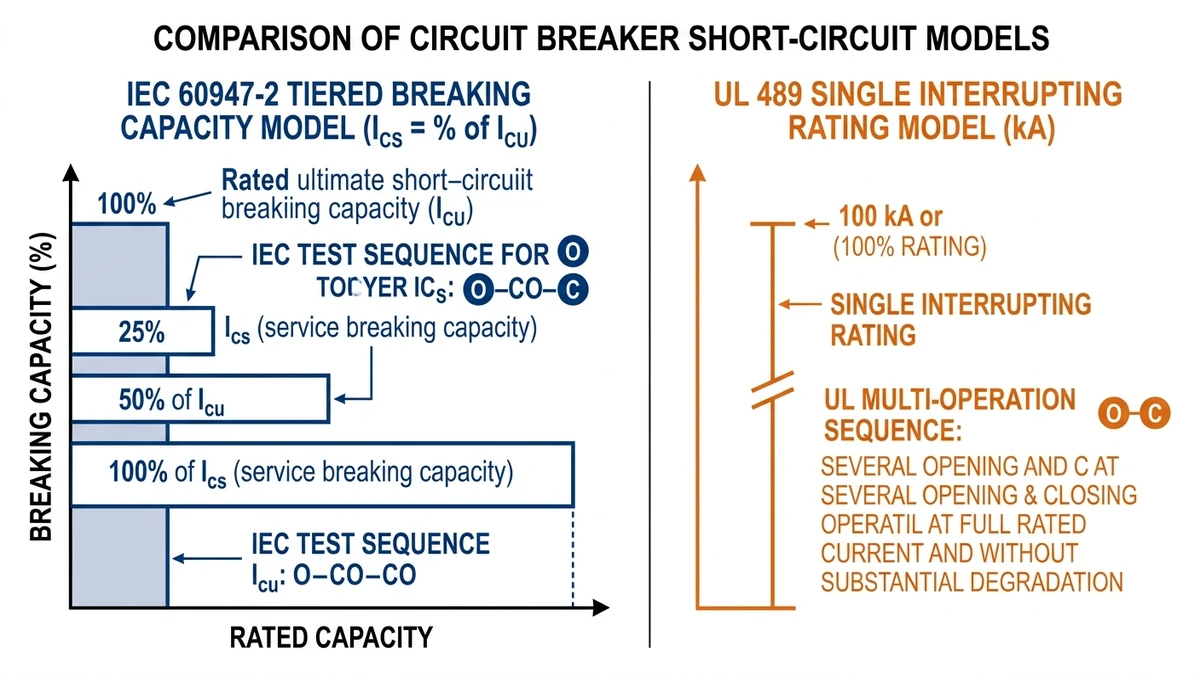
Under IEC 60947-2, breaking capacity is split into two values:
Ics is usually stated as a percentage of Icu. This is useful in real projects because it tells operators whether a breaker is likely to remain in service after clearing a major fault.
UL 489 uses a single interrupting rating. A breaker either passes the rated fault interruption test at its listed voltage or it does not. There is no separate service-vs-ultimate framework.
| パラメータ | IEC 60947-2 | UL 489 |
|---|---|---|
| Primary metric | Icu / Ics | Interrupting Rating (IR) |
| Tiered performance | Yes | No |
| Typical DC MCB range | 6–25 kA at higher DC voltages | Product-dependent, commonly lower-voltage DC applications |
| Post-fault serviceability | Ics defines reuse threshold | Not separately tiered |
| Test sequence | O – CO – CO | UL-defined multiple operations |
| Voltage polarity testing | Required for DC | Required for DC listing |
In a 60 MW PV installation in Gansu in 2023, string-level breakers rated at Icu 15 kA at 1000 VDC were selected specifically because the Ics/Icu ratio affected whether maintenance crews could re-energize strings after a fault without replacing hardware.
For projects where UL-listed devices are required by the AHJ, the single IR value simplifies procurement, but it gives less information about serviceability after fault interruption. For a parallel look at fuse-based protection, the gPV fuse certification comparison is a useful companion reference.
The biggest technical reason these standards differ is that interrupting DC current is much harder than interrupting AC current.
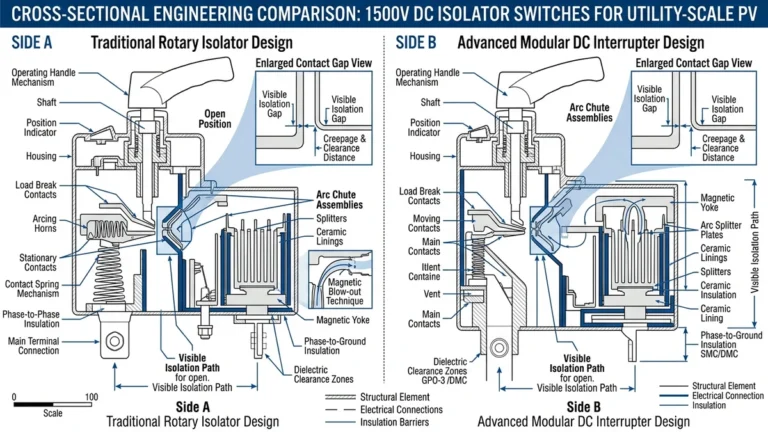
AC current crosses zero naturally, which helps extinguish an arc. DC current does not. Once a DC arc forms, the breaker has to force it out by stretching, cooling, and splitting the arc until the arc voltage rises above system voltage.
In a 1500 VDC PV string, the arc chute has to generate enough opposing voltage to overcome a very stable plasma path across a small contact gap. Magnetic blowout structures push the arc into splitter plates within milliseconds.
Callout — L/R Ratio: The L/R ratio describes how long current persists in an inductive fault circuit. Higher L/R values mean slower current decay and a harder interruption task. IEC DC testing commonly reflects more inductive circuits found in PV and industrial DC systems, while UL test conditions have historically aligned with North American distribution practice.
This difference matters because two breakers with similar current ratings can behave very differently under real DC fault conditions. In a 60 MW PV installation in Qinghai in 2023, string-level devices tested to IEC DC requirements cleared arc faults in a high-inductance environment that would sit outside the usual test envelope of many lower-voltage UL-only devices.
IEC 60947-2 also places strong emphasis on polarity and tested series-pole configurations. DC arc movement changes with magnetic field direction and contact geometry, so polarity marks and terminal orientation matter. For DC MCCBs operating at 1000–1500 VDC, tested multi-pole interruption as a unit is especially important because arc behavior cannot be inferred from single-pole data alone.
Technical fit only matters if the breaker also satisfies the local code and inspection pathway.
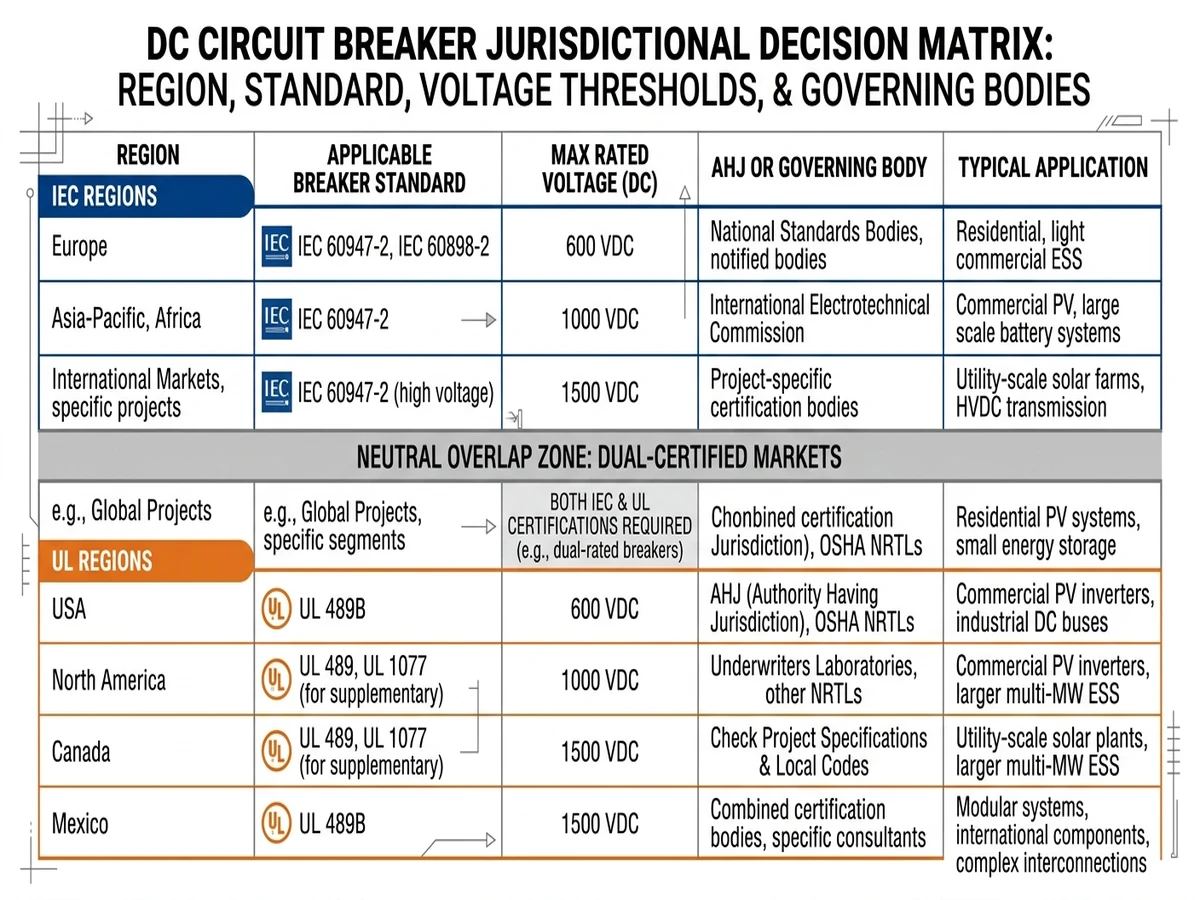
In the US and Canada, electrical installations generally require listed components acceptable to the AHJ, with UL frameworks dominating breaker selection. Outside North America, IEC 60947-2 is the baseline standard for most industrial, solar, and export-market DC protection systems.
A 120 MW ground-mount PV project in Xinjiang in 2023 used IEC 60947-2-certified 1500 VDC MCCBs throughout its combiner and string architecture; the same hardware would not automatically satisfy a California AHJ without the appropriate North American listing.
For dual-market products, manufacturers such as ABB and Eaton often maintain parallel certifications, but this usually increases cost and lead time.
| Region | Required Standard | Max DC Voltage Covered | Governing Body |
|---|---|---|---|
| USA / Canada | UL-based listing per project requirements | Product-specific | UL / NFPA / local AHJ |
| European Union | IEC 60947-2 | 最大1500 VDC | IEC / CE framework |
| UK | IEC 60947-2 aligned product approval | 最大1500 VDC | BSI / UKCA framework |
| Australia / NZ | IEC-aligned requirements | 最大1500 VDC | Standards Australia / NZ |
| Middle East | IEC 60947-2 commonly required | 1000-1500 VDC | Local AHJ |
| Dual-market export | UL + IEC certification | Per jurisdiction | 両方 |
When in doubt, confirm the required listing with the AHJ before procurement. Standard-equivalency arguments rarely survive inspection.
[Expert Insight]
– Ask for the breaker’s exact listing file or certificate before issuing a purchase order, not after shipment.
– For export projects, align EPC specs, inverter documentation, and local code requirements in one review meeting to avoid mixed-standard BOMs.
– If a project may be financed, refinanced, or insured by foreign stakeholders, check whether they impose an additional certification requirement beyond local code.
For projects that move across markets, dual certification can reduce stocking complexity but it does not eliminate the need to read the nameplate carefully.
Manufacturers pursuing dual approval typically test against IEC 60947-2 and then complete the separate UL evaluation required for the target North American listing. Some dielectric and endurance data may overlap, but DC interruption testing is not simply transferable between standards. Each regime has its own procedures, marking rules, and acceptance criteria.
In a 60 MW PV installation in Zhejiang in 2023, the EPC contractor specified dual-listed 1500 VDC DC MCCBs to satisfy both the local grid-connection framework and an export-credit insurer that required North American compliance documentation.
A dual-certified breaker normally includes distinct marking blocks. On the IEC side, check rated operational voltage, Icu, Ics, and utilization category. On the UL side, check the listed voltage, interrupting rating, and file number.
The key rule is simple: the IEC voltage marking and the UL voltage marking are not interchangeable. If a breaker is marked 1500 VDC under IEC and a lower value under its UL listing, the lower UL-listed value governs North American use.
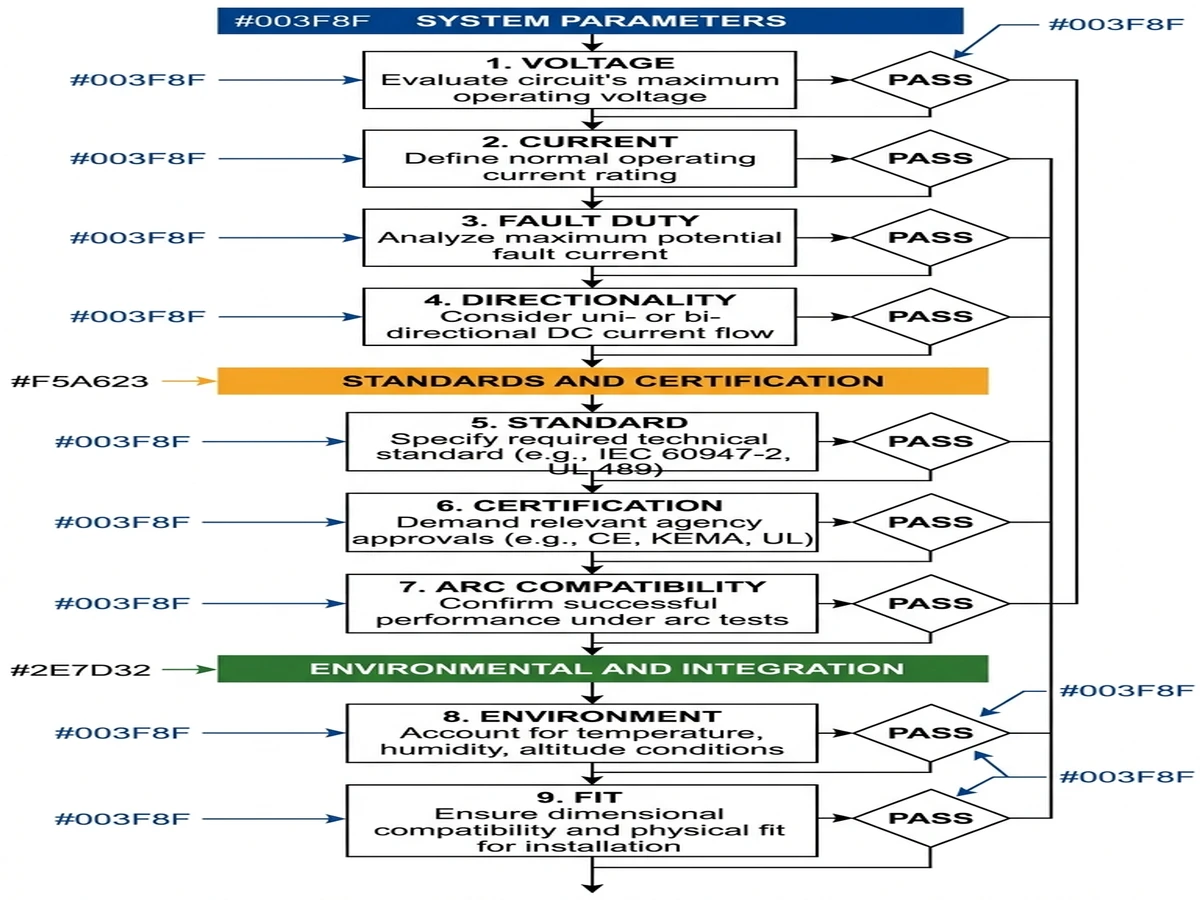
The easiest way to avoid standard mismatch is to work through selection in a fixed order.
A 60 MW ground-mount PV project in Inner Mongolia in 2024 had to replace 1,200 string breakers mid-installation after the original specification missed the required 1500 VDC interrupting capability. A structured checklist would have caught that earlier.
After the standard, voltage, and fault-duty questions are resolved, product form factor becomes the final selection layer.
For residential and light commercial PV systems up to 1000 VDC, DC MCBs in DIN-rail form factor are often the practical choice. Utility-scale and industrial systems operating at 1000–1500 VDC typically move into DC MCCB with higher breaking capacities, where both the certified voltage and the fault-clearing rating must be matched to the installation point.
For battery storage and EV charging, bidirectional current flow is often a deciding factor. That requirement is covered in more detail in the DC circuit breaker for EV charging applications overview.
If you’re sourcing breakers for IEC and/or UL markets, the Sinobreaker DC circuit breaker range includes MCB and MCCB form factors from 6 A to 1600 A, rated voltages from 250 VDC to 1500 VDC, and breaking capacities up to 85 kA, with documentation available according to product certification scope.
For fuse-based protection as a complementary or alternative solution, the DC fuse product line covers gPV and gR categories under IEC frameworks.
IEC 60947-2 is widely used in global industrial and PV markets, while UL 489 is the primary breaker standard for North American installations. They also rate fault interruption differently, so the numbers are not directly interchangeable.
Not by default. US projects usually require a listing accepted by the local AHJ, so an IEC-only breaker may fail inspection even if its electrical performance is suitable.
IEC separates maximum safe interruption from continued service capability after the fault. That helps engineers judge whether a breaker is only able to clear the fault or can also remain in operation afterward.
No. It only works where the product is specifically designed and certified for series-pole DC use. You cannot assume a higher voltage rating from pole count alone.
Neither is universally “better”; the correct one is the one required by your market and project code. IEC is more common in global PV exports, while North American PV work typically follows UL-based approval paths.
No. A breaker may carry both certifications but show different voltage or interruption values for each framework. Always apply the rating tied to the jurisdiction where the product will be installed.
Start with system voltage, continuous current, and available fault current. MCBs are common for smaller string and branch circuits, while MCCBs are used where current and fault-duty are higher.