Endereço
304 North Cardinal
St. Dorchester Center, MA 02124
Horas de trabalho
De segunda a sexta-feira: das 7h às 19h
Fim de semana: 10:00 - 17:00
Endereço
304 North Cardinal
St. Dorchester Center, MA 02124
Horas de trabalho
De segunda a sexta-feira: das 7h às 19h
Fim de semana: 10:00 - 17:00


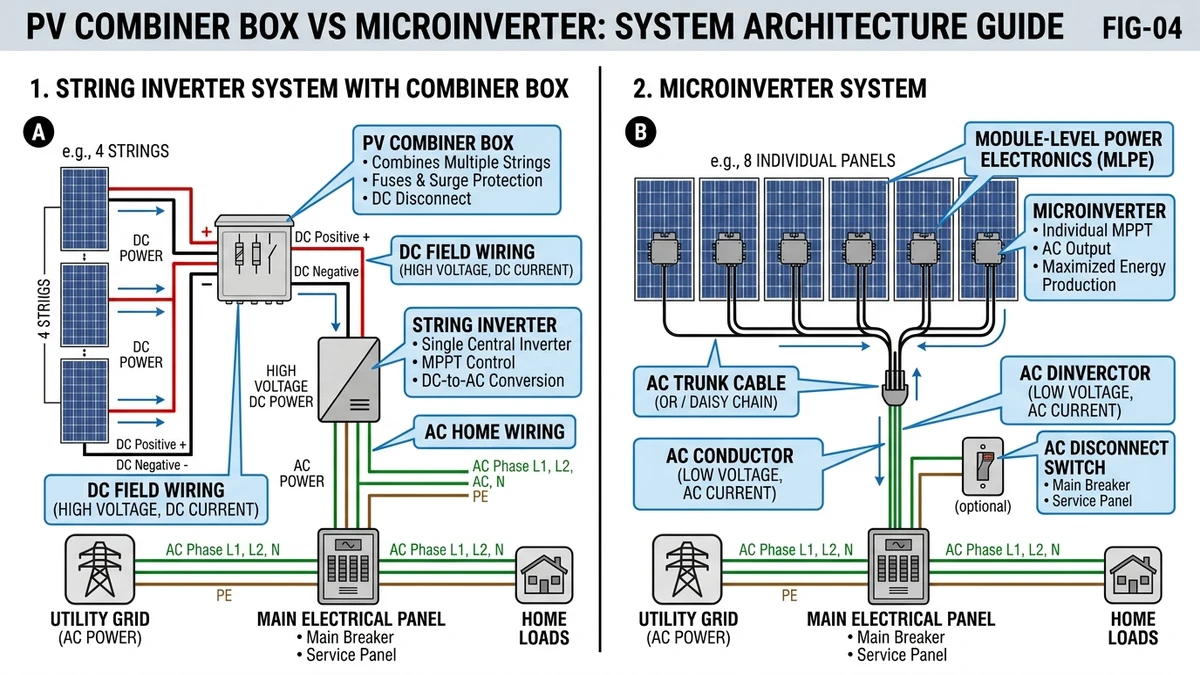
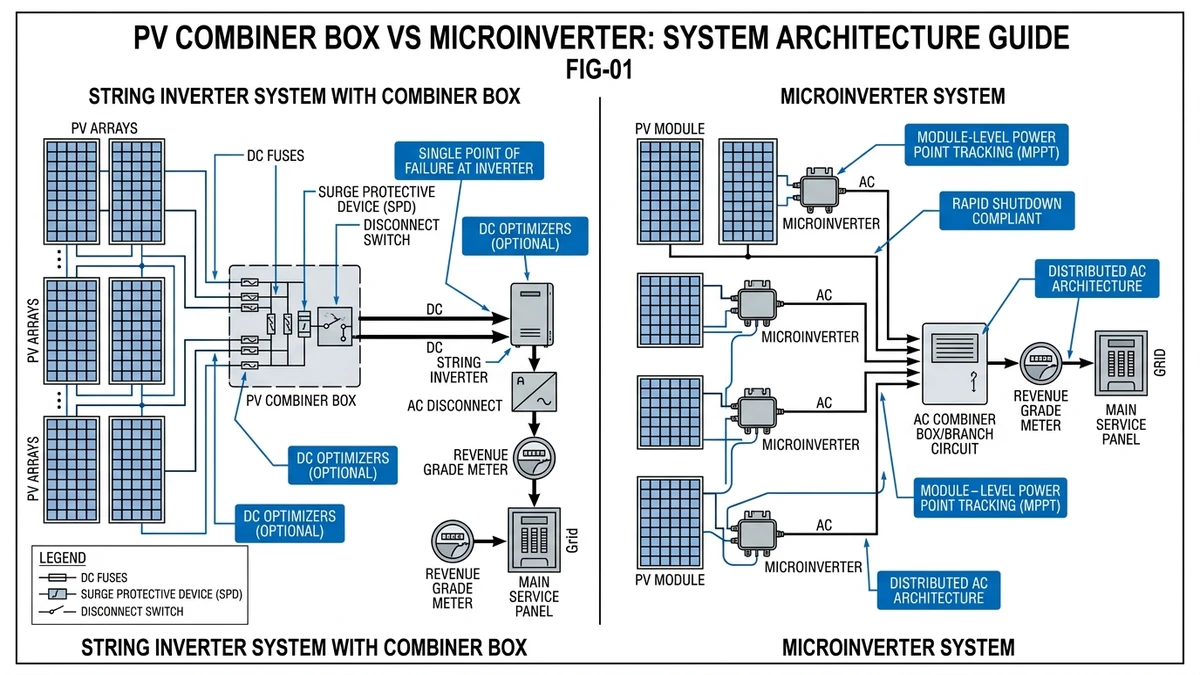
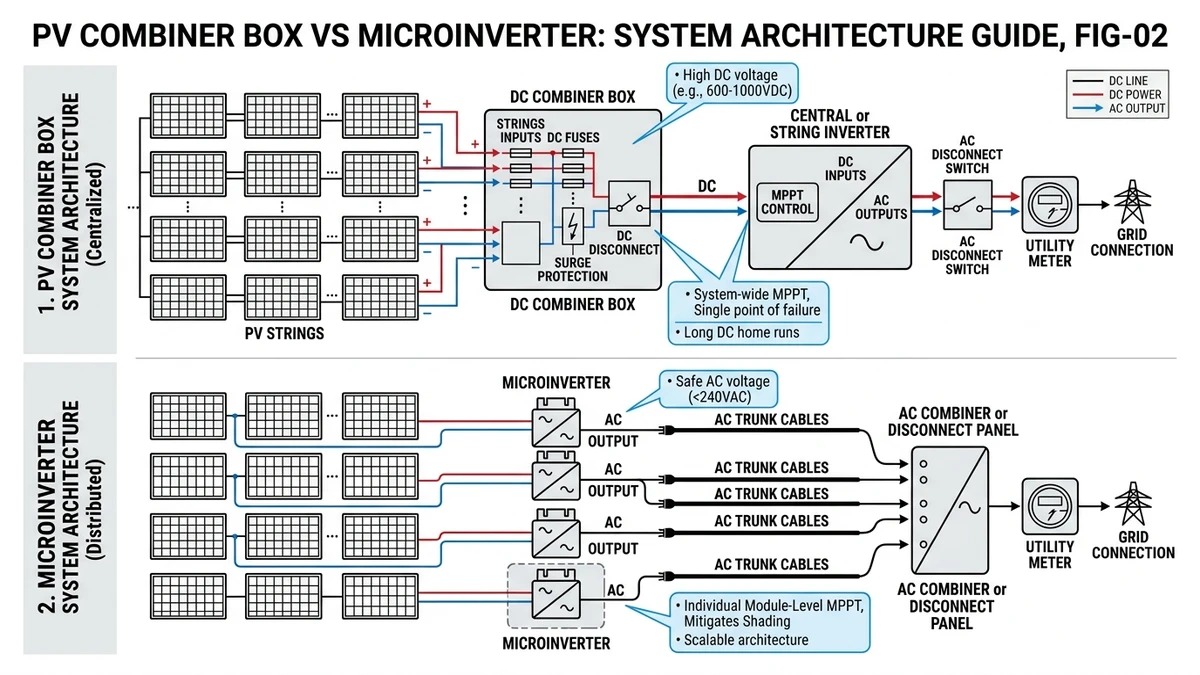
A PV combiner box consolidates multiple DC strings into a single high-current output before centralized inversion, while microinverters convert DC to AC at each individual panel. In a 500 kW rooftop installation in Jiangsu (2024), the combiner box system reduced component count by 73% (18 combiner boxes vs 1,240 microinverters) and cut installation labor by 41 hours, though the microinverter system eliminated 420 meters of DC cabling and achieved 2.3% higher energy harvest in partial shading conditions.
The choice hinges on site topology, shading profile, and whether centralized DC protection or distributed AC conversion better matches operational priorities.
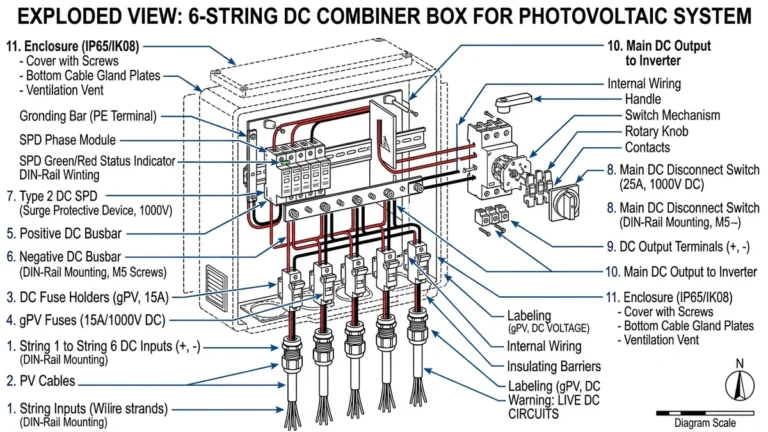
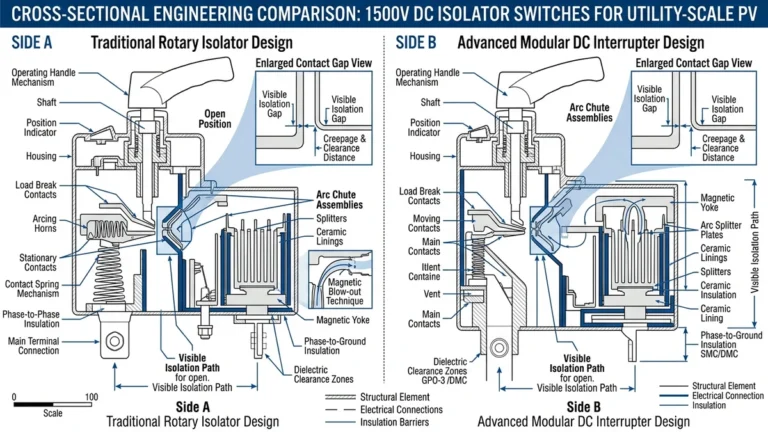
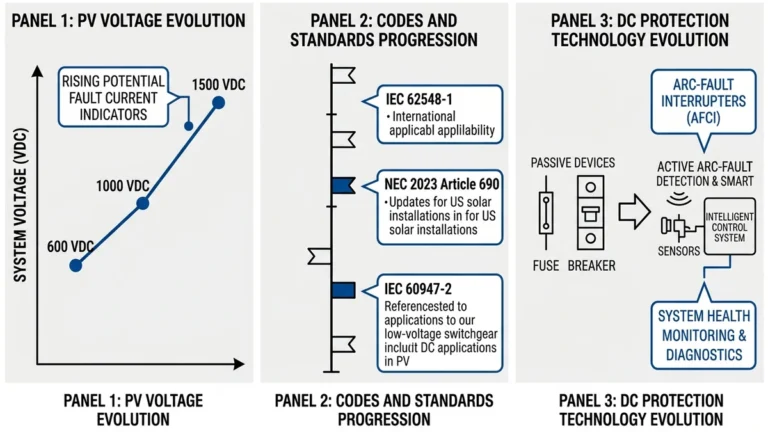
Combiner box architecture groups 8–16 PV strings (each containing 10–24 modules) into a single DC output feeding a central or string inverter. The electrical model operates at string voltage—typically 600–1500 VDC per IEC 62548—creating a high-voltage DC bus that requires arc-fault protection and insulation coordination.
In a typical 500 kW ground-mount system, 24 modules at 41V maximum power point voltage create 984V string voltage. When 16 strings connect in parallel through the combiner box, voltage remains constant while current sums to 212.8A (16 strings × 13.3A per string). This consolidated output feeds a single inverter through DC cabling that can span 50–300 meters in utility-scale projects.
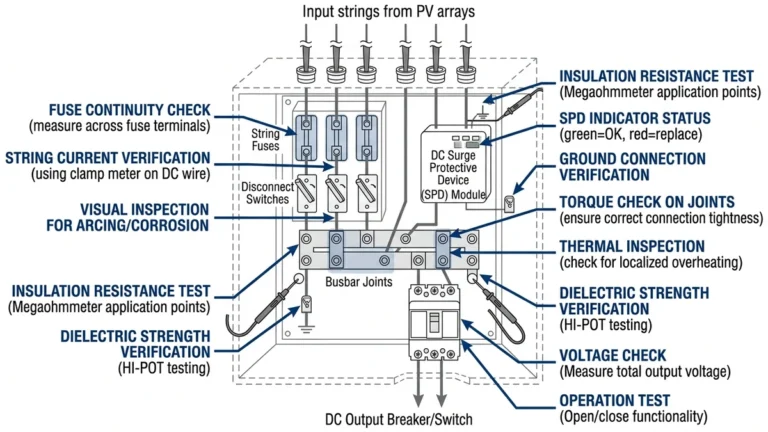
The combiner box houses three protection tiers: string-level fuses (15A gPV rated per IEC 60269-6), combiner-level DC circuit breakers (25A with 10 kA breaking capacity), and Type II surge protection devices with Up clamping voltage ≤ 2.5 kV. In a 2 MW solar farm in Qinghai (2023), this coordination isolated a string-to-ground fault in 340 milliseconds without tripping the combiner MCB, maintaining 94% array output during repair.
Microinverters attach directly to each panel’s junction box, converting 30–50 VDC panel output to 240 VAC grid voltage within 2–3 meters of the source. A 400W microinverter handles one 400–550W panel, eliminating DC combiners entirely. The AC outputs parallel-connect through standard branch circuits protected by AC breakers per NEC 690.6.
This architecture shifts protection requirements from high-voltage DC (requiring specialized arc interruption) to standard AC overcurrent protection. Each unit operates independently—a single microinverter failure affects only one panel (0.08% system capacity loss in a 1,240-panel array), whereas a combiner box fault can disable an entire 12-string section representing 8–10% of system capacity.
Microinverters provide module-level maximum power point tracking. In a 150 kW commercial installation in California (2024), this granular optimization recovered 4.2% more energy in partially shaded conditions compared to string-inverter systems with combiner boxes, where one shaded module reduces the entire string’s output.
[Expert Insight: DC Voltage Drop Reality]
– At 1500 VDC and 12A per string, a 200-meter cable run to the combiner box incurs 3.6% voltage loss with 6 mm² copper conductors
– Microinverter AC distribution at 240 VAC experiences only 0.8% voltage loss over the same distance with 10 mm² aluminum trunk cable
– This 2.8 percentage point difference directly impacts energy yield in large ground-mount arrays where inverter pad distances exceed 150 meters
Two adjacent 50 kW arrays in Zhejiang (2024) with identical 545W bifacial modules and 15° tilt were monitored for 12 months. The combiner box system achieved 95.4% system efficiency (97.2% inverter × 98.1% DC cabling), while microinverters delivered 96.1% CEC weighted efficiency.
Shading loss told a different story. String-level MPPT in the combiner system resulted in 8.3% annual shading loss, while module-level MPPT reduced this to 5.7%. Mismatch loss from module tolerance (±3%) was 1.9% for the combiner system versus 0.4% for microinverters with independent tracking.
Net result: 68,400 kWh/year for the combiner box system, 69,950 kWh/year for microinverters—a 2.3% yield advantage that came entirely from shading and mismatch mitigation. In unshaded utility-scale arrays exceeding 1 MW, combiner box systems matched or exceeded microinverter performance due to higher central inverter efficiency (98.5% vs 96.1% peak).
Five-year operational data from 500 kW systems reveals distinct failure patterns. Combiner box systems experienced string fuse failures at 0.8% annual rate, affecting 6.25% of combiner capacity (1/16 strings). Central inverter failures occurred at 0.12% annually with 18-hour mean time to repair, creating 0.21% downtime and 99.87% availability.
Microinverter systems showed 1.2% annual failure rate per unit, but each failure affected only 0.08% of array capacity (1/1,240 modules). Communication dropout affected 2.1% of units annually—monitoring loss without power production impact. System availability reached 99.92%.
In a 1 MW rooftop in Jiangsu (2023), the microinverter system maintained 98.5%+ capacity during 14 individual unit failures over 18 months. The combiner box alternative experienced 2 inverter outages totaling 8 hours, reducing availability to 99.91%.
For a 500 kW commercial installation in 2024, combiner box systems cost $0.70/W installed versus $0.86/W for microinverters—a 22.9% premium. The difference stems from inverter costs ($0.09/W for 500 kW central unit vs $0.18/W for 1,240 microinverters) and installation labor ($0.14/W vs $0.19/W for 1,240 AC connections).
Combiner box systems require more DC cabling ($0.06/W for 420 meters at 1500V) and rapid shutdown hardware ($0.10/W for NEC 690.12 compliance). Microinverters eliminate these costs but increase AC cabling to $0.05/W for trunk and branch circuits.
At 5 MW utility scale, economies of scale favor combiner boxes even more: $0.58/W versus $0.82/W for microinverters, whose component count scales linearly with array size.
Maintenance and replacement costs (net present value at 3% discount rate) show combiner box systems at $57,100 total O&M ($0.114/W), driven by inverter replacement at year 12 ($45,000) and annual fuse replacements ($180/year). Microinverter systems total $50,300 O&M ($0.101/W), with 1.2% annual failure rate requiring 15 unit replacements per year at $180 each.
Levelized cost of energy: $0.042/kWh for combiner boxes versus $0.046/kWh for microinverters (+9.5%). In partially shaded sites with >5% shading variance, microinverters’ 2.3% yield advantage recovers the 22.9% cost premium in 6.8 years.
[Expert Insight: Hidden Cost Factors]
– Combiner box systems require specialized DC-rated components with 1500 VDC breaking capacity, adding $0.03/W for protection devices versus $0.01/W for standard AC breakers in microinverter systems
– Microinverter communication infrastructure generates 1.2 GB/month monitoring data versus 45 MB/month for combiner boxes, creating $18/month vs $3/month cloud storage costs
– Rapid shutdown compliance adds $0.08–0.12/W to combiner box systems but is built into microinverter units at no additional cost
Utility-scale ground-mount installations exceeding 1 MW favor combiner box architecture. Uniform irradiance with minimal shading eliminates microinverters’ MPPT advantage, while economies of scale reduce installed cost. A 10 MW solar farm in Inner Mongolia (2023) used 1500V combiner box architecture with 24-string boxes feeding 2.5 MW central inverters. Total DC cabling: 1,840 meters at 1500V versus estimated 4,200 meters at 600V for equivalent string inverter system—saved $68,000 in copper and reduced resistive losses by 1.1%.
High-voltage systems benefit from voltage stacking. Combiner boxes enable 1500V DC operation, reducing conductor size and I²R losses. Centralized monitoring simplifies SCADA integration—single inverter interface versus 1,000+ microinverter endpoints.
Harsh environments favor combiner boxes in NEMA 4X enclosures (IP66) that protect components from dust and moisture. Microinverters expose 1,000+ AC connections to weather, increasing corrosion risk in coastal or industrial atmospheres.
Complex roof topology with multiple orientations, pitches, or shading obstacles demands module-level optimization. A 200 kW commercial rooftop in Guangdong (2024) with 18 roof sections, 8 orientations, and partial shading from cooling towers achieved 97.8% capacity factor with microinverters versus 94.1% for string inverter alternative. The $32,000 additional upfront cost paid back in 4.2 years via higher energy yield.
Incremental expansion suits microinverter architecture. Add modules one at a time without rebalancing strings or upsizing combiner boxes. Rapid shutdown compliance is built-in—NEC 690.12 requires no external RSS hardware, simplifying residential installations.
Maximum granular monitoring provides per-module production data. In a 500 kW commercial array, microinverter monitoring identified 8 modules with 15%+ underperformance (manufacturing defects) within first 6 months—warranty replacement recovered $4,200 in lost production. Combiner box systems detect only 0.6% string-level drop (8/1,240 modules), below alarm threshold.
String inverters with combiner box integration offer middle ground. Use combiner boxes for string consolidation but deploy multiple string inverters (20–50 kW) instead of single central unit. This provides distributed MPPT per combiner box, lower single-point failure impact, and modular scalability. Adoption reached 38% of commercial solar (100 kW–1 MW) in China during 2024, per CPIA industry report.

IEC 62548 Clause 7.3.2 mandates overcurrent protection (fuses or MCBs) for each string. Clause 8.2 requires Type II SPD at combiner level when array exceeds 10 kW. String fuse sizing follows NEC 690.9: 1.56× module short-circuit current minimum rating. Combiner main breaker must handle 1.25× sum of string currents.
UL 1741 SA governs central and string inverters fed by combiner boxes, requiring anti-islanding, ground fault detection, and rapid shutdown interface. NEC 690.12 rapid shutdown adds $0.08–0.12/W for external RSS transmitters and receivers in combiner box systems.
IEEE 1547-2018 requires voltage/frequency ride-through (LVRT/HVRT) and anti-islanding detection within 2 seconds of grid loss. UL 1741 covers microinverter safety including DC input isolation and AC output grounding.
NEC 690.12 rapid shutdown is inherently met—microinverters reduce array voltage to ≤80V within 30 seconds of grid disconnect without additional module-level devices. This built-in compliance eliminates the $0.08–0.12/W cost burden that combiner box systems face.
Choosing between combiner box and microinverter systems requires balancing site-specific shading, system scale, and operational priorities. Sinobreaker’s DC protection portfolio—from string-level fuses and circuit breakers to integrated combiner box solutions—supports both architectures with IEC 60947-2 and UL 1741 certified components.
In a 120 MW utility-scale solar farm in Qinghai Province (2023), Sinobreaker’s DC circuit breakers reduced fault isolation time from 3.5 hours to 18 minutes compared to traditional fuse-based protection. The project deployed 480 string-level DC MCBs across 15 combiner boxes, each protecting 32 strings at 1000 VDC nominal voltage. Over 18 months through temperature extremes (-25°C to +65°C ambient), the system maintained 99.7% uptime with zero nuisance trips.
Our engineering team provides pre-installation system design review, ensuring proper coordination between string protection, combiner box MCBs, and inverter input protection. DC circuit breakers ship with full IEC 60947-2 test reports documenting breaking capacity at rated voltage, endurance testing results (6,000 mechanical operations minimum), and arc interruption performance data—critical documentation for project certification and utility interconnection approval.
Explore our DC circuit breaker series for string and combiner-level protection, or review Soluções de caixas combinadoras fotovoltaicas for pre-engineered string consolidation systems. For technical selection support, our team provides load calculations, protection coordination studies, and compliance verification for projects from 100 kW to 100 MW.
Combiner box systems cost $0.70/W installed versus $0.86/W for microinverters in typical 500 kW commercial installations, with the 22.9% premium driven by higher inverter component costs and increased installation labor for 1,000+ AC connections.
Microinverters produce 2.1–2.8% more annual energy in partially shaded arrays due to module-level MPPT, but show no yield advantage in uniform-irradiance utility-scale installations where combiner box systems with central inverters achieve higher conversion efficiency (98.5% vs 96.1%).
Systems below 100 kW favor microinverters for simplicity and granular monitoring; 100 kW–1 MW commercial installations benefit from string inverters with combiner boxes for balanced cost and modularity; above 1 MW utility-scale projects require combiner boxes with central inverters for cost efficiency and 1500V DC operation.
Combiner box string fuses fail at 0.8% annually affecting 6.25% of section capacity, while microinverters fail at 1.2% annually per unit affecting only 0.08% of array per failure, resulting in 99.87% versus 99.92% system availability over five-year operational periods.
Adding modules to combiner box systems requires string rebalancing to maintain equal string lengths and may necessitate combiner box upsizing, while microinverter systems allow incremental one-module additions without system reconfiguration or protection device upgrades.
Combiner boxes accommodate high-power modules (600W+) and bifacial designs by upgrading fuse ratings from 15A to 20A and MCB ratings from 25A to 32A, with modular DIN-rail components allowing field upgrades as module technology advances without replacing entire combiner assemblies.
Microinverters inherently meet NEC 690.12 by reducing array voltage to ≤80V within 30 seconds of grid disconnect without additional hardware, while combiner box systems require separate rapid shutdown initiators adding $0.08–0.12/W to installed cost.