Endereço
304 North Cardinal
St. Dorchester Center, MA 02124
Horas de trabalho
De segunda a sexta-feira: das 7h às 19h
Fim de semana: 10:00 - 17:00
Endereço
304 North Cardinal
St. Dorchester Center, MA 02124
Horas de trabalho
De segunda a sexta-feira: das 7h às 19h
Fim de semana: 10:00 - 17:00


A escolha dos interruptores isoladores CC corretos requer o conhecimento da capacidade de interrupção, do mecanismo de isolamento e do ambiente de instalação. O isolamento CC difere fundamentalmente dos arcos CA-CC que não se extinguem automaticamente no cruzamento zero, exigindo um projeto de contato especializado. A seleção errada do isolador pode falhar catastroficamente sob condições de arco CC, criando riscos de incêndio.
Este guia compara os tipos de interruptor rotativo, de lâmina de faca e de fusível, abrangendo Artigo 690 do NEC.13, classificação IEC 60947-3 e cálculos de dimensionamento. Você aprenderá a evitar o erro comum de selecionar isoladores apenas pela classificação de corrente, sem considerar o estresse da tensão CC e a capacidade de interrupção de arco.
💡 Fato crítico de especificação: Uma chave de faca de 100 A com classificação CA pode falhar de forma catastrófica ao interromper apenas 20 A de corrente CC a 600 V devido à formação contínua de arco. Sempre verifique as classificações específicas de CC e a capacidade de interrupção.
Os interruptores do isolador CC criam espaços de ar visíveis para isolamento de manutenção por NEC 690.13(B)(1). Diferentemente dos disjuntores que interrompem as correntes de falha, os isoladores são projetados para desconexão sem carga ou com carga mínima com alças operáveis externamente.
Com classificação DC: Contatos especializados e calhas de arco projetadas para extinguir arcos de CC que não se autoextinguem como os de CA.
Quebra visível: Indicação externa da separação de contatos exigida pela NEC 690.13(B)(1) para verificação da segurança do pessoal.
Funções primárias(1) Isolamento de manutenção com verificação visível, (2) Capacidade de desligamento de emergência, (3) Isolamento de seção de falha de arco, (4) Acesso para teste e comissionamento.
Analogia: Pense em um isolador CC como um cadeado físico em circuitos de alta tensão - você pode ver se ele está desconectado, verificar a abertura e impedir fisicamente a reconexão durante a manutenção.
DC-21 (sem ruptura de carga): Isoladores básicos apenas para isolamento de manutenção. Capacidade de interrupção: 0,1 × corrente nominal.
DC-22 (quebra de carga): Chaves seccionadoras de carga padrão para operações normais. Capacidade de interrupção: 1,0 × corrente nominal na tensão nominal. Mais comum em aplicações solares.
DC-23 (carga indutiva): Chaves para serviço pesado para cargas indutivas. Capacidade de interrupção: 2,0 × corrente nominal.
- Pode ser operado externamente sem expor o operador a partes energizadas (690.13(B)(1))
- Indicar claramente a posição ON/OFF (690.13(B)(2))
- Abertura simultânea de todos os condutores não aterrados (690.13(B)(3))
- Capacidade de interrupção ≥ corrente de falha máxima disponível (690.13(B)(4))
A norma UL 98 verifica o estresse da tensão CC, a capacidade de interrupção de arco e o aumento da temperatura sob corrente contínua. Sempre verifique a marcação de certificação UL na placa de identificação do interruptor.
Design: Eixos de contato giratórios com mecanismos de quebra rápida acionados por came, alça giratória montada na frente com alcance de 90° e indicação visível em vermelho/verde.
Vantagens:
- Tamanho compacto, capacidade de vedação IP65-IP66
- Sem partes vivas expostas, adequado para comutação frequente
- Melhor para aplicações externas
Desvantagens:
- Custo mais alto ($85-$200 para 100A)
- Limitado a 630A no máximo
- Pode engessar em ambientes de alta corrosão
Melhor para: Desconexões de cordas, telhados residenciais/comerciais, instalações externas
Design: Contatos de lâmina giratória com design de dupla quebra, tampa frontal transparente que mostra a posição da lâmina e calhas de arco para supressão de arco CC.
Vantagens:
- Verificação de contato visual direto
- Alta capacidade (até 3.000 A)
- Menor custo ($45-$120 para 100A)
Desvantagens:
- Necessário um gabinete maior
- Classificação IP limitada a IP54 (projetos padrão)
- Lâmina exposta requer intertravamentos
Melhor para: Caixa combinadora de redes, desconexões em escala de serviços públicos, acesso controlado interno
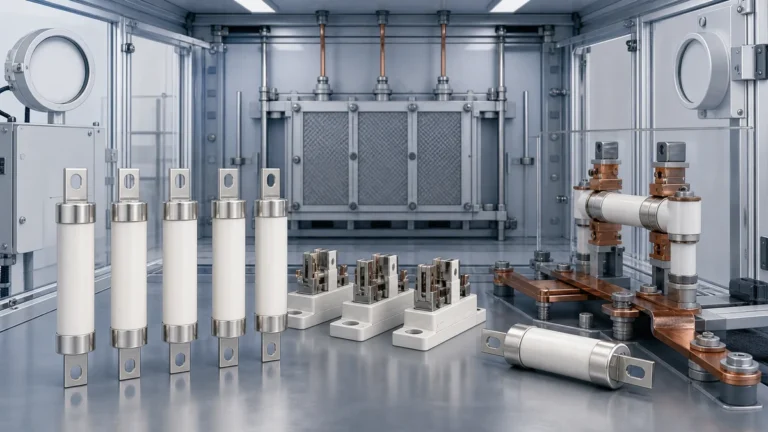
Design: Porta-fusíveis integrados com isolamento de lâmina de faca, proporcionando proteção e isolamento combinados em um único dispositivo.
Vantagens:
- Proteção combinada contra sobrecorrente e isolamento
- Limitação inerente da corrente de falha
- Fiação simplificada
Desvantagens:
- Custos de substituição de fusíveis
- Maiores exigências de manutenção
- Não é possível verificar o isolamento sem a remoção do fusível
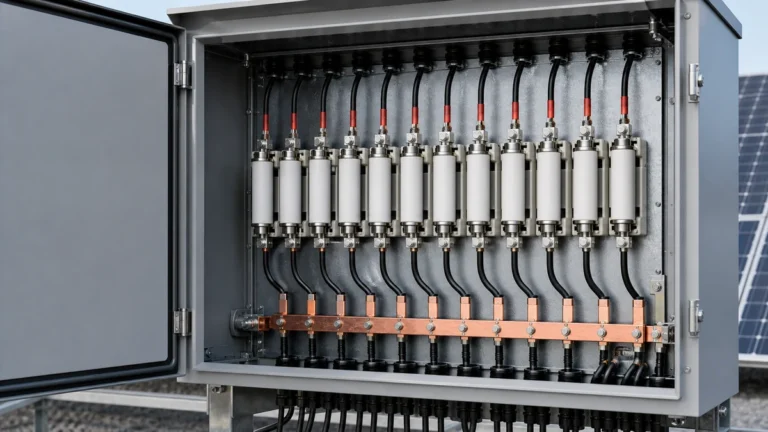
Melhor para: Combinadores multi-string, sistemas comerciais pequenos (50-150kW), aplicações de retrofit


| Parâmetro de especificação | Isolador rotativo | Lâmina de faca | Chave fusível |
|---|---|---|---|
| Faixa de corrente contínua | 16-630A | 32-3000A | 32-630A |
| Classificação de tensão CC | Até 1500V | Até 1500V | Até 1000V |
| Capacidade de ruptura | DC-21: 0,1× In DC-22: 1,0× em | DC-21: 0,1× In DC-22: 1,0× em | Limitado por fusível Até 20kA SCCR |
| Classificação IP (típica) | IP65-IP66 | IP54 (IP65 especial) | IP54-IP65 |
| Vida mecânica | 10.000 operações | 5.000 operações | 3.000 operações (lâmina) Substituição do fusível |
| Quebra visível | Posição da alça (indicação externa) | Visualização direta da lâmina (capa transparente) | Posição da lâmina + status do fusível |
| Custo típico (100A) | $85-$200 | $45-$120 | $120-$280 (inclui fusíveis) |
| Conformidade com os padrões | IEC 60947-3 UL 98 | IEC 60947-3 UL 98 | IEC 60947-3 UL 98B |
⚠️ Aviso de especificação crítica: As classificações de tensão e corrente CC devem ser verificadas AMBAS. Uma chave classificada como 1000 V CC a 200 A pode suportar apenas 600 V CC a 400 A. Sempre verifique as curvas de redução do fabricante para seu ponto de operação específico.
Selecione isoladores classificados para a tensão máxima de circuito aberto da matriz na temperatura mais fria esperada, de acordo com a NEC 690.7:
Vdc necessário ≥ VOC(STC) × [1 + β(Tmin - 25°C)]

Exemplo (Canadian Solar CS6K-300MS, 22 módulos):
- VOC(STC) = 44,8V × 22 = 985,6V a 25°C
- β = -0,0033/°C, Tmin = -20°C
- Correção: 1 + [-0.0033 × (-45)] = 1.149
- Necessário: 985,6V × 1,149 = 1.132V → Selecione 1500V nominal
Aplique os fatores de segurança NEC 690.8(A)(1):
In(rated) ≥ Isc(module) × Nparallel × 1,25 × 1,25

Exemplo (10 cadeias de caracteres, Isc = 9,5 A):
Necessário: 9,5A × 10 × 1,5625 = 148,4A → Selecione 200A nominal
🎯 Dica profissional: Selecione 40-50% acima da classificação calculada para expansão futura. A diferença de custo é mínima ($30-60) em comparação com a mão de obra de substituição ($400-800).
A SCCR deve exceder a corrente máxima de falha de acordo com a NEC 110.9:
Isc(máx) = Isc(módulo) × Nparalelo × 1,25
Exemplo: 9,5A × 10 × 1,25 = 118,75A (selecione SCCR mínimo de 10kA)

| Localização | Classificação IP mínima | Tipo preferido |
|---|---|---|
| Controlado em ambientes internos | IP20 | Lâmina de faca |
| Abrigado ao ar livre | IP54 | Rotativo |
| Exposto ao ar livre | IP65 | Rotary necessário |
| Costeiro/Marinho | IP66 | Rotativo + 316SS |
- NEMA 1 ≈ IP20 (geral para ambientes internos)
- NEMA 3R ≈ IP54 (resistente à chuva)
- NEMA 4 ≈ IP65 (à prova d'água)
- NEMA 4X ≈ IP66 (resistente à corrosão)
⚠️ Importante: As classificações NEMA e IP NÃO são equivalentes diretas. A NEMA 4X inclui testes de corrosão não cobertos pela IP66.
Faixa padrão: -25°C a +70°C. Para extremos:
- Alta temperatura (>55°C): Diminua 2,5% por °C, use contatos banhados a prata
- Baixa temperatura (<-25°C): Lubrificantes sintéticos, molas com classificação a frio
- Alto UV: Gabinetes resistentes a UV, cores claras reduzem o calor em 8-12°C
1. Facilmente acessível: Acessível sem escalada ou ferramentas
2. À vista: Visível a partir do equipamento ou com trava de acordo com 110.25
3. Exterior Operável: Alça acessível sem expor partes energizadas
4. Altura: 4-6,5 pés acima da superfície de trabalho de acordo com 404.8(A)
Dimensionamento do condutor:
Tamanho ≥ 1,25 × Isc × 1,25 (NEC 690.8(B)(1))
Exemplo: 148,4A → 185,5A de ampacidade → cobre 4/0 AWG
Torque terminal:
- Cobre: 250-350 pol-lb para 4/0 AWG
- Alumínio: 300-400 pol-lb (use um composto antioxidante)
- Aterramento: Mínimo de cobre 6 AWG de acordo com NEC 690.43
- Tensão do sistema na temperatura mais baixa
- Corrente máxima de curto-circuito (com fator de 1,25×)
- Aviso de “PERIGO - ALTA TENSÃO CC
- Aviso de arco elétrico se a corrente de falha for >240VA
- Desenhos de correspondência de identificação de circuitos
Problema: Usar chaves DC-21 (sem interrupção de carga) onde a DC-22 (interrupção de carga) é necessária, ou aplicar chaves classificadas como AC em circuitos DC.
Correção: Verifique se a categoria de utilização IEC 60947-3 corresponde à aplicação. Os seccionadores de cordas exigem a classificação DC-22 (1,0 × corrente nominal de interrupção). Sempre verifique a folha de dados do fabricante quanto à “capacidade de produção” e “capacidade de interrupção” específicas de CC. As chaves CA falham catastroficamente sob condições de arco CC.
Referência de código: O NEC 690.13(B)(4) exige capacidade de interrupção ≥ corrente máxima de falha.
Problema: Uso de chaves classificadas para a tensão STC sem correção de temperatura, o que leva a falhas de sobretensão em climas frios.
Correção: Calcule VOC(max) = VOC(STC) × [1 + β(Tmin - 25)]. Selecione o interruptor classificado como ≥125% do resultado. Exemplo: uma matriz de 985 V com -20 °C no mínimo requer 1.132 V no máximo → especifique o interruptor com classificação de 1.500 V.
Referência de código: O NEC 690.7(A) exige o cálculo da tensão CC na temperatura mais baixa esperada.
Problema: Terminais com torque insuficiente causam conexões de alta resistência e fuga térmica, ou terminais com torque excessivo danificam os terminais.
Correção:
- Use uma chave de torque calibrada de acordo com as especificações do fabricante (250-350 pol-lb em cobre, 300-400 pol-lb em alumínio)
- Aplique um composto antioxidante nos condutores de alumínio
- Agende uma nova inspeção de torque após o primeiro ano
- Realize imagens térmicas anuais para detectar conexões soltas
Referência de código: NEC 110.3(B) e 110.14(D) exigem terminação de acordo com as instruções do fabricante.
Problema: Isoladores sem as etiquetas de tensão, corrente e advertência do sistema NEC 690.56 que desbotam ou caem.
Correção:
- Use etiquetas gravadas ou impressas na subsuperfície resistentes a UV (não adesivas)
- Inclui: tensão máxima do sistema, corrente de curto-circuito com fator de 1,25 ×, aviso de “PERIGO - ALTA TENSÃO CC”, identificação do circuito
- Adicionar aviso de arco elétrico se a corrente de falha for >240VA
- Verificar a adesão do rótulo semestralmente
Referência de código: NEC 690.56 e 110.16 (aviso de arco elétrico)

- Inspeção visual (classificações, torque, aterramento, etiquetas)
- Teste de continuidade: <0,1Ω por polo para ≤200A, <0.05Ω for >200A
- Operação mecânica: 10 ciclos, operação suave verificada
- Imagem térmica após 24 horas energizado (terminais <50°C acima da temperatura ambiente)
Imagens térmicas: Durante o pico de produção, investigue se o aumento for >40°C, ação imediata se for >60°C
Resistência de contato (A cada 2 ou 3 anos):
- Novo: 0,02-0,08Ω típico
- 3 anos: Deve permanecer <0.15Ω
- 5 years: Replace if >0.20Ω
Inspeção mecânica:
- A força operacional não deve aumentar >20%
- Verifique se há erosão ou corrosão nos contatos
- Verificar a condição da gaxeta anualmente
- Confirme o torque do hardware de montagem
Premium (escala de utilidade pública): ABB, Eaton, Siemens - capacidade de 1500 V, certificação TÜV/UL
Nível intermediário (Comercial): Schneider Electric, Socomec, LS Electric - confiabilidade econômica
Orçamento (Residencial): TAYEE, Chint, Kraus & Naimer - aplicações sensíveis ao preço
- ✅ UL 98 (América do Norte) + IEC 60947-3 (Internacional)
- ✅ UL 1741 (suplemento específico para PV)
- Mínimo de contatos de liga de prata, preferencialmente calhas de arco de cerâmica
- Relatórios de teste de classificação IP de um laboratório credenciado
- Residencial: 1-2 anos de peças (taxa de falha anual de 1-2%)
- Comercial: 2-3 anos de peças/trabalho (taxa de falha de 0,3-0,5%)
- Premium: 5-10 anos abrangente (Taxa de falha <0,1%)
💡 Análise de valor: Os switches premium custam de 2 a 3 vezes mais, mas duram de 3 a 5 vezes mais. Para instalações comerciais/utilitárias, o custo do ciclo de vida favorece os premium, apesar do investimento inicial mais alto.
Recomendação: Interruptores rotativos IP65
- Material: $95 vs $50 (lâmina da faca)
- Instalação: 4 horas vs 6 horas
- Total instalado: $680 vs $650 rotativo (a instalação mais rápida compensa)
Recomendação: IP66 rotativo para combinadores de rede
- Ciclo de vida de 10 anos: $740 (rotativo) vs $795 (lâmina de faca)
- Menores requisitos de manutenção
- Melhor desempenho em ambientes externos
Recomendação: Lâmina de faca para desconexões centrais
- Ciclo de vida de 20 anos: $4.760 vs. $10.340 (motorizado)
- Operação manual aceitável para comutações pouco frequentes
- Instalação interna adequada do painel de distribuição
Os isoladores CC criam espaços de ar visíveis para manutenção, mas têm capacidade de interrupção limitada (0,1-1,0 × corrente nominal). Eles servem para desconexão sem carga. Os disjuntores CC interrompem correntes de falha de até 10-20kA usando calhas de arco e sopro magnético, fornecendo proteção contra sobrecorrente de acordo com a norma NEC 690.9. A maioria dos sistemas solares precisa de ambos: disjuntores para proteção e isoladores para isolamento de manutenção.
Não. As chaves CA são incompatíveis com CC porque a corrente CA cruza naturalmente o zero 100 a 120 vezes por segundo, extinguindo os arcos. A corrente contínua mantém a polaridade constante, criando arcos contínuos que corroem os contatos e causam risco de incêndio. Os interruptores com classificação CC incluem calhas de arco especializadas, maiores lacunas de contato e bobinas de descarga. O uso de chaves CA para CC viola a norma NEC 110.3(B), anula a listagem UL e cria sérios riscos.
Calcule com base no tamanho máximo planejado da matriz dentro de 5 anos. Aplique os fatores NEC 690.8(A)(1) (1,5625 total) à corrente de curto-circuito futura e, em seguida, selecione a próxima classificação padrão. Exemplo: Corrente 100A, planejada 140A → 140A × 1,5625 = 219A → selecione 250A ou 315A. A diferença de custo é mínima ($60-100) em relação ao trabalho de substituição futura ($400-800). Verifique se a ampacidade do condutor também suporta expansão.
Interrupção visível significa que é possível verificar fisicamente o espaço de ar entre os contatos abertos, seja por meio de janelas transparentes ou pela indicação externa da posição da alavanca. A norma NEC 690.13(B)(2) exige que as seccionadoras “indiquem claramente se estão na posição aberta ou fechada” para segurança da manutenção.
Para chaves de lâmina de faca, as tampas transparentes mostram diretamente a posição da lâmina. Para chaves rotativas, a posição da alavanca (vertical = OFF, horizontal = ON com indicadores vermelho/verde) fornece confirmação visível. Isso evita a energização acidental durante a manutenção - um recurso de segurança essencial, pois os painéis fotovoltaicos não podem ser desligados como a energia da rede elétrica.
Em geral, os isoladores CC duram de 15 a 25 anos em instalações com boa manutenção. Substitua quando a resistência de contato exceder 0,25Ω, aparecer corrosão visível no contato, a força operacional aumentar >20% ou a classificação IP se degradar. Aplicações de alto ciclo (comutação diária) podem precisar de substituição após 7 a 10 anos. Realize testes anuais de imagem térmica e de resistência de contato.
Os isoladores rotativos são preferidos em ambientes externos devido à vedação superior (IP65-IP66 em gabinetes compactos individuais). Os interruptores de lâmina de faca normalmente atingem o máximo em projetos padrão IP54. Para ambientes costeiros ou de alta umidade, as chaves rotativas com hardware inoxidável oferecem uma vida útil significativamente mais longa. O prêmio de custo do 40-60% é justificado pela redução da frequência de manutenção e substituição.
Sim, as seccionadoras com fusíveis servem como proteção contra sobrecorrente e isolamento de acordo com NEC 690.13 e 690.9, se atenderem aos requisitos de interrupção visível e às classificações de capacidade de interrupção de CC. Ideal para combinadores de 2 a 8 strings (100-250A). Para sistemas maiores ou acesso frequente para manutenção, o disjuntor e o isolador separados oferecem mais flexibilidade operacional. Considere as implicações de manutenção - a substituição do fusível requer a abertura do circuito.
#
Palavra-chave de foco: chaves isoladoras dc
URL Slug: Guia de seleção de interruptores dc-isoladores
Meta Título: Interruptores de isolador CC: Guia de seleção de lâminas rotativas versus lâminas de faca 2025
Meta Descrição: Guia completo de seleção de chaves isoladoras CC comparando tipos de chaves rotativas, de lâmina de faca e de fusíveis. Especificações técnicas, conformidade com a NEC e metodologia de dimensionamento para sistemas solares fotovoltaicos.
Nível de conteúdo: Nível 3 (Conteúdo de apoio)
Funil de conversão: Topo do funil (conscientização)
Contagem de palavras-alvo: 2800-4000 palavras
Diagramas da sereia-alvo: 3
Configure-os nas definições do Rank Math e, em seguida, exclua esta caixa antes de publicar.
Os isoladores CC criam espaços de ar visíveis para a segurança da manutenção, mas têm capacidade limitada de interrupção de corrente (normalmente 0,1-1,0 × corrente nominal). Os disjuntores CC interrompem ativamente as correntes de falha até a sua classificação de interrupção (geralmente de 10 a 20kA) usando calhas de arco e sopro magnético. Eles fornecem proteção contra sobrecorrente de acordo com a NEC 690.9 e podem interromper a corrente de carga total com segurança. A maioria dos sistemas solares exige ambos: disjuntores para proteção e isoladores para isolamento de manutenção.
Não. As chaves CA são fundamentalmente incompatíveis com CC devido às diferenças de extinção de arco. Os interruptores classificados como CC incluem calhas de arco especializadas, distâncias maiores entre os contatos e bobinas de sopro para deflexão de arco magnético. O uso de chaves CA para aplicações CC viola a norma NEC 110.3(B) e anula a listagem UL, criando riscos de incêndio e choque. Sempre verifique a classificação de CC na placa de identificação do interruptor.
Calcule a classificação do isolador com base no tamanho máximo planejado da matriz dentro de 5 anos. Aplique os fatores NEC 690.8(A)(1) (1,25 × 1,25 = 1,5625) à futura corrente de curto-circuito. Selecione a próxima classificação padrão acima desse valor. A diferença de custo entre as classificações adjacentes geralmente é mínima em comparação com os custos futuros de mão de obra de substituição.
Interrupção visível significa que é possível verificar fisicamente o espaço de ar entre os contatos abertos por meio de janelas transparentes ou indicação externa da alça. A norma NEC 690.13(B)(2) exige que as seccionadoras indiquem claramente se estão na posição aberta ou fechada para segurança da manutenção. Isso evita a energização acidental durante a manutenção.
Em geral, os isoladores CC duram de 15 a 25 anos em instalações com boa manutenção. Os gatilhos de substituição incluem resistência de contato >0,25Ω, corrosão visível do contato, aumento da força operacional >20% da linha de base ou degradação da classificação IP. As aplicações de alto ciclo podem exigir a substituição após 7 a 10 anos. Realize testes anuais de imagem térmica e de resistência de contato.
Os isoladores rotativos são preferidos para instalações externas devido à capacidade superior de vedação, alcançando as classificações IP65-IP66. As chaves tipo lâmina de faca normalmente atingem o máximo de IP54 em projetos padrão. Para ambientes costeiros ou de alta umidade, as chaves rotativas com hardware de aço inoxidável oferecem vida útil significativamente mais longa, apesar do custo inicial mais alto.
Sim, as seccionadoras com fusíveis podem servir como proteção contra sobrecorrente e isolamento de acordo com NEC 690.13 e 690.9, desde que atendam aos requisitos de interrupção visível e às classificações de capacidade de interrupção de CC. Elas funcionam melhor para combinadores de 2 a 8 strings (faixa de 100 a 250 A). Para sistemas maiores, o disjuntor e o isolador separados oferecem mais flexibilidade operacional.