Dirección
304 North Cardinal
Dorchester Center, MA 02124
Horas de trabajo
De lunes a viernes: de 7.00 a 19.00 horas
Fin de semana: 10.00 A 17.00 HORAS
Dirección
304 North Cardinal
Dorchester Center, MA 02124
Horas de trabajo
De lunes a viernes: de 7.00 a 19.00 horas
Fin de semana: 10.00 A 17.00 HORAS

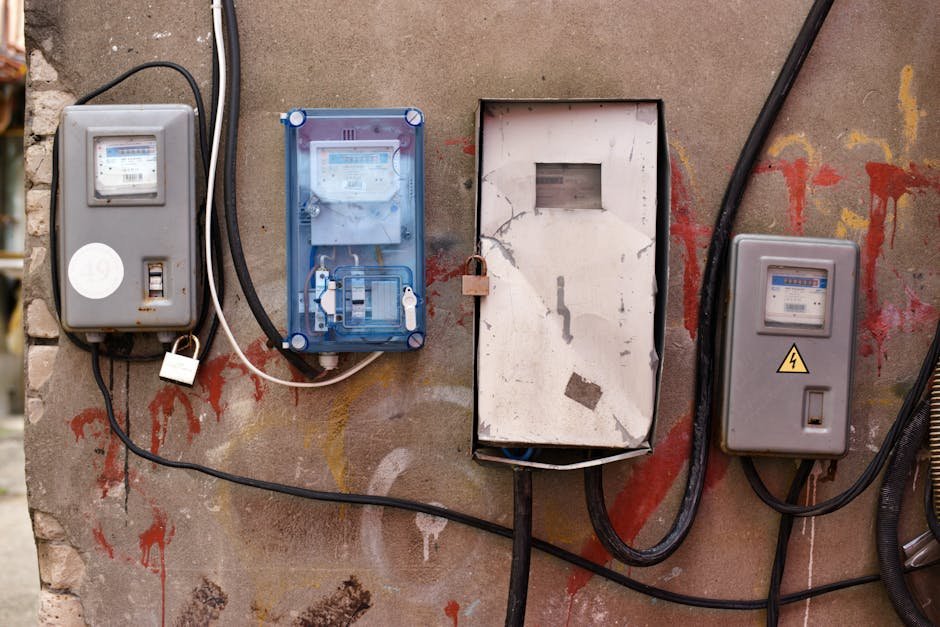
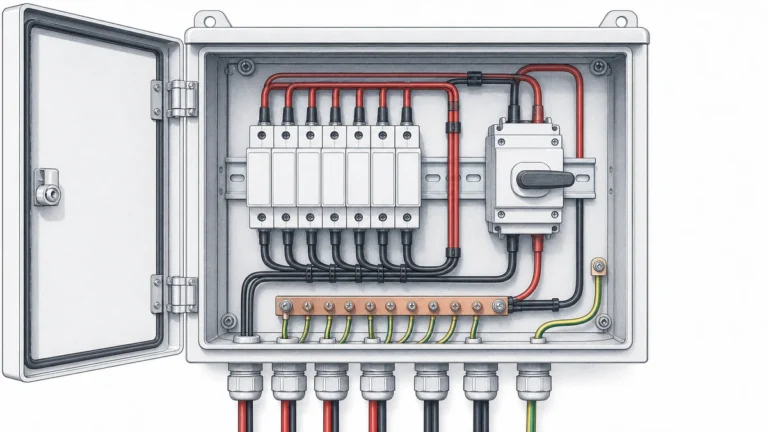
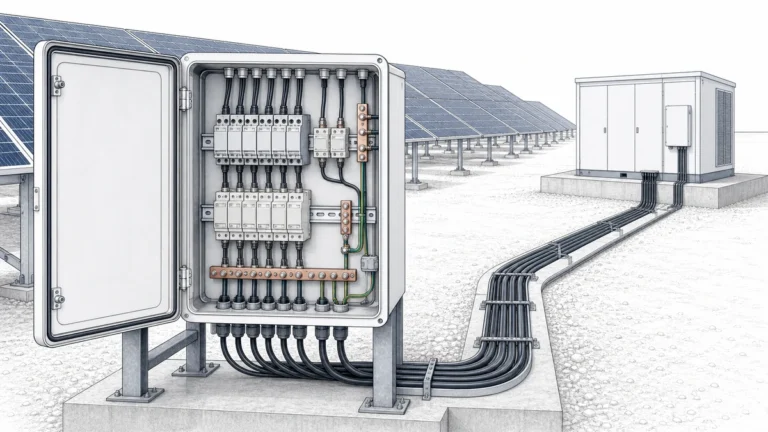
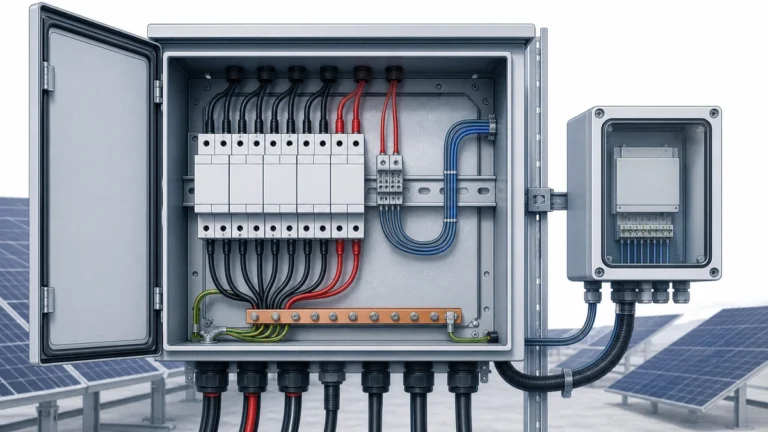
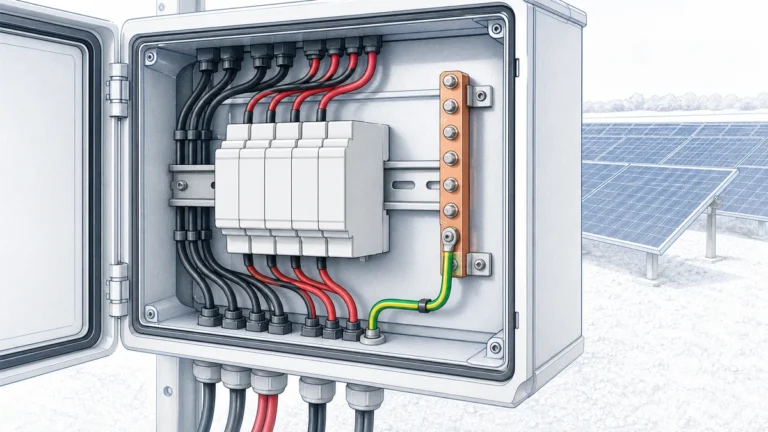
PV combiner box wiring diagrams provide essential visual documentation of string connections, grounding architecture, and bonding conductor routing required for safe and code-compliant photovoltaic installations. Understanding proper wiring topology, conductor sizing methodology, and grounding system integration enables installers to execute reliable connections that maintain protection integrity throughout the system lifecycle.
Moderno Caja combinadora FV wiring encompasses multiple critical elements: positive and negative string conductor routing, equipment grounding conductor (EGC) connections, bonding jumper installation, overcurrent protection device integration, and proper termination techniques. Each wiring element must comply with Artículo 690 de NEC requirements while accommodating site-specific conditions including conduit routing constraints, environmental exposure, and maintenance accessibility.
This comprehensive technical guide presents standardized wiring diagrams for common combiner box configurations, explains grounding and bonding design principles per NEC requirements, demonstrates proper conductor sizing calculations, and provides troubleshooting guidance for installation issues. You’ll learn systematic wiring methodology, verification procedures, and best practices ensuring first-time-right installations that pass inspection and provide long-term reliability.
💡 Wiring Principle: Proper pv combiner box wiring diagram implementation requires understanding that grounding provides fault current path while bonding establishes equipotential plane—these separate functions use distinct conductors with different sizing requirements.
String connection topology defines how individual PV strings connect to combiner box busbars through overcurrent protection devices. Standardized topologies ensure consistent installation quality and facilitate troubleshooting.
The most common topology connects each series string (typically 8-24 modules in series) to a dedicated combiner box input position through a Fusible CC or miniature circuit breaker. The positive conductor from each string connects to the line side of the overcurrent device, with the load side connecting to the positive busbar. Negative conductors connect directly to the negative busbar without fusing per NEC 690.9(B).
Connection sequence: String positive conductor → overcurrent device line terminal → device load terminal → positive busbar. String negative conductor → negative busbar terminal. This topology isolates each string through individual protection, enabling selective disconnection for maintenance or fault isolation.
Trazado de conductores: Install string positive and negative conductors in the same conduit or cable tray to minimize electromagnetic coupling and voltage drop imbalance. Maintain consistent polarity throughout the installation using color-coded conductors (red/white positive, black negative) or cable markers every 3 meters.
Some combiner designs accommodate parallel string connection without individual overcurrent protection when total system fault current remains below safe levels. NEC 690.9(C) permits unprotected parallel connections when maximum available fault current does not exceed string conductor ampacity and downstream equipment ratings.
Ampacity verification: Verify that parallel string fault current I_sc × N_parallel × 1.56 remains below minimum conductor ampacity and combiner busbar rating. A system with 12A string I_sc and 4 parallel unprotected strings: 12A × 4 × 1.56 = 74.9A, requiring minimum 75A conductor and busbar rating at elevated temperature.
Application limitations: Unprotected parallel connection suits small residential systems (≤4 strings) with short combiner-to-inverter cable runs (<30m) where conductor ampacity significantly exceeds parallel fault current. Larger systems require individual string protection per NEC 690.9(A).
Combined DC output from all parallel strings exits the combiner through main positive and negative terminals, typically located on the enclosure bottom or side panel. Output conductors must carry the sum of all string currents: I_output = N_strings × I_string_max, where I_string_max = I_sc × 1.56 per NEC 690.8(A)(1).
Terminal lug sizing: Main output terminals accommodate conductor sizes from 6 AWG to 1/0 AWG depending on total current. Large utility-scale combiners may require 2/0 or 4/0 AWG output conductors. Verify terminal lug conductor range matches selected wire size to ensure proper compression connection.
Strain relief requirements: Install strain relief fittings on all output conductors preventing mechanical stress transmission to terminal connections. Cable glands or cord grips maintain enclosure NEMA/IP rating while securing conductors. Improperly supported cables create loosening from thermal cycling and vibration.
🎯 Consejo profesional: Label each string input position with corresponding array location (e.g., “String 1: Roof Section A, Rows 1-3”) inside the combiner lid—this documentation dramatically reduces troubleshooting time when investigating performance issues years after installation.
PV combiner box grounding architecture implements NEC Article 690 Subpart E requirements establishing equipment grounding conductor paths and supplementary grounding electrode connections. Proper grounding design ensures fault current safely returns to source while maintaining ground fault detection functionality.
Equipment grounding conductors provide the primary fault current path from combiner box metallic enclosure to system grounding point at the inverter or service entrance. NEC 690.43(A) requires EGC to run with circuit conductors and connect to all exposed non-current-carrying metal parts.
EGC conductor sizing: Size equipment grounding conductor per NEC Table 250.122 based on overcurrent device rating protecting the circuit. For combiner boxes with 30A string fuses, minimum EGC size = 10 AWG copper (or 8 AWG aluminum). For 60A main combiner output protection, minimum EGC = 10 AWG copper. These represent minimums—increase sizes for long runs or to match circuit conductor gauge.
Connection points: EGC must connect to: (1) combiner box enclosure grounding lug, (2) bonding busbar if present, (3) array frame grounding system, and (4) system grounding point at inverter or main service. Use listed compression connectors or exothermic welds for all EGC connections—never rely on device mounting screws for grounding continuity.
Large PV systems require supplementary grounding electrode system per NEC 690.47(B) connecting array frame and combiner box to earth ground. The grounding electrode conductor routes from combiner box to ground rods or other electrodes meeting NEC 250.50 requirements.
GEC sizing methodology: NEC 690.47(B)(1) references Table 250.166 for grounding electrode conductor sizing based on largest conductor supplying the system. For systems with 1/0 AWG output conductors, minimum GEC = 6 AWG copper. If largest conductor exceeds 1100 kcmil copper, GEC = 3/0 AWG copper maximum per table.
Electrode connection: Connect GEC to ground rods driven minimum 8 feet (2.4m) into earth, spaced at least twice rod length apart when using multiple rods. Use listed ground rod clamps (acorn clamps) or exothermic connections—ensure connection remains accessible for testing and inspection per NEC 250.68(A).
Modern inverters employ ground fault detection monitoring insulation resistance between DC conductors and ground. Combiner box grounding must not interfere with this detection by creating unintended ground paths that mask legitimate faults.
Insulation resistance preservation: All wiring inside combiner box must maintain >100kΩ insulation resistance to ground under normal operation. This requires proper conductor insulation, careful routing avoiding sharp edges, and use of insulated terminal blocks where conductors could contact enclosure walls.
Testing verification: After installation, verify insulation resistance from DC+ and DC- busbars to combiner enclosure with all circuits connected but inverter disconnected. Measured resistance should exceed 1MΩ—lower values indicate insulation damage or improper terminations requiring correction before energization.
| Grounding Conductor Type | Función | Sizing Reference | Tamaño típico | Connection Point |
|---|---|---|---|---|
| Equipment Grounding Conductor (EGC) | Fault current path | NEC Table 250.122 | 10 AWG Cu | Enclosure ground lug |
| Grounding Electrode Conductor (GEC) | Earth ground connection | NEC Table 250.166 | 6 AWG Cu | Ground rod clamp |
| Bonding Jumper (Main) | Equipment bonding | NEC 250.102(C) | Same as EGC | Busbar to enclosure |
| Array Frame Ground | Module frame bonding | NEC 690.43(D) | 6-10 AWG Cu | Combiner ground bus |

Bonding establishes equipotential connections between all metallic components preventing voltage differences during fault conditions. NEC Article 690.43 mandates specific bonding practices for PV systems.
Main bonding jumper connects the grounding busbar to combiner box metallic enclosure, ensuring all exposed metal surfaces reach same electrical potential. This connection must use conductor sized per NEC 250.102(C) based on largest ungrounded conductor supplying the equipment.
Bonding jumper installation: Install listed bonding jumper from grounding busbar terminal to threaded enclosure ground stud or lug. Use star washer under connection nut to penetrate paint or anodizing, ensuring metal-to-metal contact. Torque to manufacturer specification (typically 10-15 N·m for M6 hardware).
Non-metallic enclosure consideration: Fiberglass or polycarbonate combiner boxes require internal metallic grounding busbar bonded to all metallic components (busbars, mounting hardware). External grounding lug penetrates enclosure via insulated bushing bonding to internal ground bus.
PV module frames require grounding per NEC 690.43(C) through equipment grounding conductor connecting frame mounting rails to combiner box ground system. This conductor provides lightning discharge path and ensures fault current return during ground faults.
Frame grounding conductor routing: Route bare or insulated 6-10 AWG copper conductor from array mounting rails to combiner box grounding busbar. Use listed grounding lugs or lay-in lugs at module frame connections—drilling frames voids UL listing unless using manufacturer-approved attachment points.
Connection methodology: String combiner locations often serve as array frame ground collection points, consolidating individual frame ground conductors from multiple array sections. Install compression lugs on each frame ground wire, securing all lugs to common grounding busbar terminal with sufficient contact area.
When combiner box includes separate positive and negative busbars not inherently bonded through common mounting, verify bonding integrity through low-resistance measurement. While DC busbars don’t require bonding to each other (as they carry different polarities), mounting hardware and structural components require bonding to grounding system.
Mounting hardware bonding: Busbar mounting insulators (standoffs) must provide electrical isolation while mounting bolts bond insulator metal bases to enclosure. Install toothed lock washers under mounting bolt heads, penetrating paint to establish low-resistance connection.
All bonding connections require proper torque ensuring adequate contact pressure without damaging hardware. Under-torquing creates high-resistance connections that overheat under fault current. Over-torquing damages threads or crushes conductors.
Recommended torque values:
– M6 grounding hardware: 8-10 N·m (70-88 lb-in)
– M8 grounding hardware: 15-18 N·m (133-159 lb-in)
– Grounding lug terminations: Per manufacturer specification (typically 10-20 N·m)
– Ground rod clamps: 20-25 N·m (177-221 lb-in)
Verification procedure: Use calibrated torque screwdriver or torque wrench for all grounding connections. Mark torqued connections with paint pen or witness mark allowing visual verification of proper installation. Document torque values on installation checklist for inspection records.
⚠️ Critical Safety: Never use thread-forming screws or sheet metal screws for bonding connections—these create insufficient contact area and vibration loosening. Use only machine screws with lock washers into tapped holes or captive nuts.

Proper conductor sizing ensures adequate ampacity for continuous current while maintaining acceptable voltage drop. NEC Article 690 provides specific calculation methods for PV systems.
String input conductors from array to combiner box must handle maximum string current with appropriate safety factors and temperature derating. NEC 690.8(B)(1) defines calculation methodology.
Base current calculation: String maximum current = Module I_sc × 1.56. For modules with 12A short-circuit current: I_string = 12A × 1.56 = 18.72A. This represents maximum continuous current under fault conditions.
Temperature correction: Apply temperature correction factor from NEC Table 310.15(B)(2)(a) based on ambient temperature and conductor insulation rating. For 40°C ambient with 90°C insulation (THWN-2): correction factor = 0.91. Required conductor ampacity at elevated temperature: 18.72A / 0.91 = 20.6A.
Conductor selection: From NEC Table 310.16, 12 AWG copper with 90°C insulation (THWN-2) provides 30A ampacity at 30°C, exceeding required 20.6A. Verify conduit fill and bundling adjustment factors don’t reduce ampacity below required minimum.
Voltage drop verification: Calculate voltage drop using: V_drop = 2 × I × L × R, where I = string current, L = one-way distance, R = conductor resistance (0.002 ohms/ft for 12 AWG). For 100-foot run: V_drop = 2 × 18.72A × 100ft × 0.002 Ω/ft = 7.49V. At 400V string voltage, this represents 1.87% voltage drop, within NEC 690.7(D) recommended 3% maximum.
Combiner box output conductors must handle combined current from all parallel strings with appropriate safety factors.
Combined current calculation: Total output current = N_strings × I_string_max. For 8-string combiner: I_output = 8 × 18.72A = 149.76A continuous. Apply 125% safety factor per NEC 690.8(B)(1): Required ampacity = 149.76A × 1.25 = 187.2A.
Reducción de la temperatura: At 40°C ambient with 90°C conductor: Correction factor = 0.91. Required conductor ampacity at temperature: 187.2A / 0.91 = 205.7A. From NEC Table 310.16, 4/0 AWG copper (90°C) provides 260A, meeting requirement.
Conduit fill adjustment: If multiple current-carrying conductors share conduit, apply adjustment factors from NEC Table 310.15(B)(3)(a). For 4-6 conductors: adjustment = 0.80. Verify derated ampacity still exceeds requirement: 260A × 0.80 = 208A > 205.7A required.
Equipment grounding conductor sizing follows NEC Table 250.122 based on overcurrent protection device rating.
Sizing method: For combiner with 60A main output overcurrent protection, Table 250.122 specifies minimum 10 AWG copper EGC. This represents absolute minimum—many installations use larger conductors matching circuit conductor gauge for mechanical strength and future expansion.
Oversizing benefits: Installing EGC same size as circuit conductors (e.g., 4 AWG when using 4 AWG ungrounded conductors) provides: (1) lower impedance fault current path enabling faster protection operation, (2) better mechanical durability for field service, (3) accommodation of future uprating without rewiring.
Aluminum considerations: When using aluminum circuit conductors, NEC 250.122(A) requires increasing EGC size per table equivalence. For 60A protection requiring 10 AWG copper, aluminum EGC must be 8 AWG minimum.
| Circuit Type | Current Calculation | Safety Factor | Typical Conductor | Min EGC Size |
|---|---|---|---|---|
| String Input (18A string) | I_sc × 1.56 | Included in 1.56 | 12 AWG Cu (30A) | 10 AWG Cu |
| Combiner Output (8 strings) | Sum all strings | ×1.25 | 4/0 AWG Cu (260A) | 10 AWG Cu |
| Grounding Electrode Conductor | Per Table 250.166 | N/A | 6 AWG Cu min | N/A (is ground) |
| Bonding Jumper | Per 250.102(C) | N/A | Same as EGC | 10 AWG Cu |

Proper installation technique ensures long-term connection reliability and facilitates future maintenance. Following standardized practices creates consistent quality across installations.
Strip length verification: Strip conductor insulation to expose copper matching terminal depth—typically 10-12mm for screw terminals, 8-10mm for spring-clamp terminals. Excessive stripped length creates exposed copper increasing shock hazard. Insufficient strip length prevents adequate terminal contact.
Wire stripping tools: Use quality wire strippers with depth gauge stops preventing conductor nicking. Damaged conductor strands create high-resistance hot spots and mechanical weak points. Inspect stripped conductors—if any strand damage visible, re-cut and re-strip conductor.
Strand twisting: For stranded conductors without ferrules, twist exposed strands clockwise (matching terminal screw direction) before insertion. This prevents strand spreading during tightening. For critical connections, install wire ferrules on stranded conductors ensuring all strands engage terminal contact area.
Torque control: Use torque-limiting screwdrivers or torque wrenches for all terminations. Terminal manufacturers specify torque values (typically 1.5-2.5 N·m for string terminals, 10-15 N·m for main output lugs). Insufficient torque creates high-resistance connections. Excessive torque damages terminals or crushes conductors.
Compression lug installation: For output conductors using compression lugs, select proper lug die matching conductor size. Crimp lug in single operation avoiding multiple partial crimps weakening connection. Verify crimped barrel no longer allows conductor withdrawal—pull test at 50 pounds force for AWG sizes, 200+ pounds for larger conductors.
Terminal block orientation: Orient terminal blocks allowing conductor entry from bottom when possible—this prevents water intrusion if gland seal fails. Where top entry necessary, install drip loops in conductors before entry allowing water to drain before reaching terminals.
Bend radius compliance: Maintain minimum bend radius of 6× conductor diameter for single-conductor wires, 8× for multi-conductor cables. Tight bends damage conductor insulation and create stress concentration points. Use strain relief bushings at enclosure entry points distributing bending stress.
Strain relief methods: Install cable glands, cord grips, or strain relief connectors on all conductors entering combiner box. These fittings clamp on conductor jacket (not copper strands) preventing mechanical pulling force transmission to terminals. Adjust gland compression avoiding over-tightening damaging conductor insulation.
Internal cable management: Route conductors inside combiner box avoiding sharp enclosure edges and maintaining clearance from busbars. Use cable tie mounts securing conductors every 150-200mm. Leave slight service loop at terminals allowing component replacement without conductor removal. Avoid crossing positive and negative conductors—maintain parallel routing where possible.
Terminal identification: Label each string input terminal position inside combiner lid using weather-resistant labels. Include string number and corresponding array location. This documentation proves invaluable during troubleshooting when trying to identify which physical string connects to which combiner position.
Conductor color coding: Maintain consistent color scheme throughout installation. NEC 690.31(B) requires identified conductors (positive, negative, grounded) using marking at termination points minimum every 3 meters. Standard practice: Red or red-striped for positive ungrounded, white or gray for negative ungrounded, bare or green for grounding.
Wiring diagram posting: Affix laminated wiring diagram inside combiner lid showing actual as-built configuration. Include string count, conductor sizes, protection device ratings, and date of installation. Update diagram when system modifications occur.
🎯 Consejo profesional: Photograph completed wiring before closing combiner lid—upload images to cloud storage or email to yourself creating permanent accessible record. These photos dramatically simplify troubleshooting years later when original installation crew unavailable.
Problema: Installing undersized equipment grounding conductors violates NEC 250.122 and creates inadequate fault current path preventing proper overcurrent protection operation. During ground faults, excessive voltage drop across undersized EGC delays fault clearing, extending equipment damage duration.
Escenarios comunes: Using 14 AWG EGC with 12 AWG circuit conductors (requires minimum 12 AWG EGC per continuous conductor rule), selecting EGC based on string fuse rating instead of main combiner output protection, failing to upsize aluminum EGC per table requirements.
Corrección: Size EGC per NEC Table 250.122 based on largest overcurrent device protecting the circuit. For 30A string protection, minimum 10 AWG copper EGC. For 60A combiner output protection, minimum 10 AWG copper. Consider upsizing EGC to match circuit conductor gauge providing better fault current path and mechanical strength.
Problema: Directly connecting copper and aluminum conductors without proper transition connectors creates galvanic corrosion destroying connections within 5-10 years. Dissimilar metal contact in presence of moisture accelerates electrochemical degradation.
Escenarios comunes: Terminating copper string conductors and aluminum output conductors to same busbar terminal, using aluminum array frame ground connecting to copper combiner grounding busbar, installing steel hardware contacting aluminum conductors without anti-oxidation compound.
Corrección: Use listed bimetallic transition connectors rated for Cu-Al connection when joining dissimilar metals. Apply anti-oxidation compound (zinc or petroleum-based) to all aluminum conductor surfaces before termination. Alternatively, specify all-copper conductor system eliminating dissimilar metal issues. Verify all hardware materials compatible with conductor material per ASTM G82 galvanic series.
Problema: Routing positive and negative conductors in separate conduits or routing DC conductors with AC conductors creates electromagnetic coupling inducing circulating currents and increasing system losses. AC-DC conductor mixing violates NEC 690.31(B) separation requirements.
Escenarios comunes: Installing DC positive conductors in one conduit run and DC negative in separate parallel conduit “for organization,” mixing combiner output DC conductors with AC supply wiring in common junction box, separating EGC from circuit conductors.
Corrección: Install positive and negative conductors of each circuit in same raceway per NEC 690.31(B). Run EGC with associated circuit conductors. Never mix AC and DC conductors in same raceway unless specifically rated for such installation. This maintains electromagnetic balance and complies with code separation requirements.
Problema: Failing to provide proper conductor strain relief at enclosure entry points allows mechanical stress transmission to terminal connections. Thermal cycling and vibration cause connection loosening, creating high-resistance joints that overheat and fail.
Escenarios comunes: Threading conductors through knockouts without cable glands or bushings, over-tightening cable glands crushing conductor insulation, using plastic cable ties as strain relief allowing conductor movement, insufficient service loop inside enclosure creating tension on terminals.
Corrección: Install listed cable glands, cord grips, or strain relief connectors at all enclosure penetrations. Adjust gland compression to secure conductors without crushing jacket insulation—typically 60-70% compression of jacket diameter. Provide minimum 150mm service loop inside enclosure allowing terminal access without conductor removal. Verify installed strain relief maintains enclosure NEMA/IP rating per manufacturer specifications.
⚠️ Critical Error: Never bond DC- negative conductor to ground inside combiner box unless explicitly required by system design (rare in transformerless inverter systems)—this creates ground fault current path interfering with ground fault detection and potentially damaging inverter isolation.
String input conductor sizing requires calculating maximum string current: I_string = module I_sc × 1.56 per NEC 690.8(B)(1). For typical modules with 12A short-circuit current, required conductor ampacity = 18.72A before temperature derating. At 40°C ambient with 90°C insulation (THWN-2), apply 0.91 correction factor requiring 20.6A conductor capacity—12 AWG copper (30A rating) satisfies this requirement. Main output conductors must handle combined current from all strings: I_output = N_strings × I_string × 1.25 safety factor. For 8-string combiner, required ampacity = 8 × 18.72A × 1.25 = 187.2A, with temperature correction requiring 205.7A minimum—4/0 AWG copper (260A rating) meets this specification. Verify voltage drop remains under 3% using V_drop = 2 × I × L × R formula. Equipment grounding conductor size follows NEC Table 250.122 based on overcurrent device rating—minimum 10 AWG copper for typical string fuses up to 30A.
Proper grounding and bonding involves three distinct conductor systems with separate functions. Equipment grounding conductor (EGC) sized per NEC Table 250.122 connects combiner enclosure to system grounding point at inverter, typically requiring minimum 10 AWG copper based on 30A string protection. This provides fault current return path enabling overcurrent protection operation. Main bonding jumper sized per NEC 250.102(C) connects internal grounding busbar to combiner enclosure, establishing equipotential bonding of all metallic components. Grounding electrode conductor (GEC) sized per NEC Table 250.166 connects combiner box to supplementary grounding electrode system (ground rods), typically requiring 6 AWG copper minimum for residential systems. Array frame grounding conductors (6-10 AWG bare copper) collect module frame grounds routing to combiner grounding busbar. All connections require listed compression connectors or exothermic welds with proper torque specifications—never rely on device mounting screws for grounding continuity. Verify final installation maintains >100kΩ insulation resistance from DC conductors to ground preserving ground fault detection functionality.
Equipment grounding conductor (EGC) and grounding electrode conductor (GEC) serve fundamentally different functions requiring distinct installation methods. EGC sized per NEC 250.122 provides intentional fault current path from equipment enclosure back to system source, enabling overcurrent protection devices to clear faults rapidly. EGC must run with circuit conductors maintaining low-impedance path—typical size 10 AWG copper for residential systems. This conductor carries potentially high fault currents (100+ amps) during ground faults requiring adequate ampacity. Grounding electrode conductor sized per NEC Table 250.166 connects equipment to earth ground through driven ground rods or other electrodes, providing lightning surge dissipation path and voltage reference. GEC routes independently from circuit conductors to grounding electrodes—typical size 6 AWG copper minimum. This conductor carries minimal normal current but must withstand lightning surge energy. Critical distinction: EGC enables protection device operation through current path, while GEC establishes earth potential reference and lightning protection. Both conductors required for compliant PV combiner box installation per NEC 690.43 and 690.47.
Never route DC positive and negative conductors in separate conduits as this violates NEC 690.31(B) and creates electromagnetic induction issues degrading system performance. When DC current flows through spatially separated conductors, the magnetic fields don’t cancel creating net field that induces voltages in nearby conductors and metallic structures. This induction increases system losses, creates electromagnetic interference affecting monitoring equipment, and potentially induces circulating currents in parallel conductor runs. NEC 690.31(B) explicitly requires circuit conductors of each photovoltaic output circuit to occupy same raceway. Proper installation routes positive, negative, and equipment grounding conductors together through single conduit run. This maintains electromagnetic balance as opposing DC currents create canceling magnetic fields. Only exception: some large utility-scale systems use DC+ and DC- busbars in separate raceways but these require engineering analysis verifying induction effects remain acceptable. For standard combiner box installations, always group circuit conductors together per code requirements maintaining electrical and electromagnetic integrity.
Pre-energization verification follows systematic testing sequence preventing equipment damage from wiring errors. First, perform visual inspection: verify all conductors properly terminated with specified torque, confirm polarity consistency (positive to positive busbar, negative to negative busbar), check strain relief installed at all penetrations, ensure labeling complete identifying all terminals. Second, measure insulation resistance using megohmmeter at 1000V DC test voltage from DC+ busbar to ground and DC- busbar to ground with all strings connected but inverter disconnected—require minimum 1MΩ reading indicating proper insulation integrity. Third, verify polarity using multimeter measuring voltage between positive and negative busbars ensuring correct polarity throughout installation. Fourth, measure ground resistance from combiner enclosure to ground electrode system using fall-of-potential tester requiring <25Ω per NEC 250.53 (target <5Ω for optimal surge protection). Fifth, verify bonding continuity measuring resistance from enclosure ground lug to grounding busbar requiring <0.1Ω indicating adequate bonding jumper connection. Document all measurements creating commissioning record. Only after passing all tests proceed to energization under supervision verifying string voltages and currents match expected values.
NEC 690.31(B) requires identified conductors using color coding or marking throughout PV systems. Standard practice for ungrounded DC systems (most common with transformerless inverters): use red or red-striped conductors for positive ungrounded DC+, white or gray conductors for negative ungrounded DC-, and bare copper or green/green-yellow for equipment grounding conductors. While NEC doesn’t mandate specific colors for ungrounded DC circuits, consistent color scheme across installation simplifies troubleshooting and prevents connection errors. Apply permanent labels at termination points and every 3 meters along conductor runs clearly identifying polarity. For grounded DC systems (rare in modern residential solar): the grounded conductor (typically DC-) must use white or gray per NEC 200.6, while ungrounded conductor (DC+) uses any color except white, gray, or green. Equipment grounding conductors always use bare copper, green, or green-yellow regardless of system grounding type. Document color coding scheme on wiring diagram posted inside combiner enclosure. During installation, verify all technicians understand color conventions preventing polarity reversal which damages inverter input stages. Consider using pre-terminated cable assemblies with factory color coding ensuring consistency across entire installation.
Grounding electrode conductor (GEC) sizing for supplementary PV system grounding follows NEC Table 250.166 based on largest conductor supplying the system. Determine combiner box main output conductor size (e.g., 1/0 AWG copper for systems with 150-200A output current). Reference Table 250.166 finding GEC requirement for corresponding conductor size—1/0 AWG supply conductor requires minimum 6 AWG copper or 4 AWG aluminum GEC. This represents absolute minimum per code. Consider upsizing GEC to 4 AWG copper for systems in high-lightning regions providing lower impedance surge dissipation path. Maximum GEC size per Table 250.166 = 3/0 AWG copper regardless of supply conductor size (even for systems with 4/0 AWG or larger output conductors). Verify GEC installs in continuous run from combiner box grounding busbar to ground electrode without splices—use listed connectors if unavoidable splice necessary. Protect exposed GEC from physical damage using conduit or raceway where subject to mechanical injury per NEC 250.64(B). Connect GEC to ground electrodes using listed ground rod clamps or exothermic welds—mechanical connection must remain accessible for testing per NEC 250.68(A). For systems with multiple grounding electrodes, verify all electrodes bonded together per NEC 250.50 creating single grounding electrode system.
Proper pv combiner box wiring diagram implementation requires systematic attention to string connection topology, grounding system architecture, bonding requirements, conductor sizing methodology, and installation best practices. Understanding these technical elements ensures safe, reliable, code-compliant installations that provide long-term performance while facilitating future maintenance and troubleshooting.
Principales conclusiones:
1. String connection topology follows standardized patterns with individual fused inputs to common busbars, maintaining polarity consistency and enabling selective string isolation for maintenance.
2. Grounding architecture implements distinct conductor systems—equipment grounding conductor for fault current path, grounding electrode conductor for earth connection, and bonding jumpers for equipotential bonding.
3. Conductor sizing requires calculating string maximum current (I_sc × 1.56), applying temperature derating factors, and verifying voltage drop remains within acceptable limits per NEC 690.7(D).
4. Bonding requirements mandate low-resistance connections between enclosure, busbars, and grounding system using properly torqued hardware and appropriate conductor sizes per NEC 250.102(C).
5. Installation verification through insulation resistance testing, ground resistance measurement, polarity confirmation, and torque documentation ensures system integrity before energization.
Recursos relacionados:
- PV Combiner Box Selection Guide
- DC Fuse Specifications and Ratings
- DC Circuit Breaker Integration
Ready to implement compliant PV combiner box wiring for your installation? Contact SYNODE’s technical team for application-specific wiring diagrams, conductor sizing calculations, and grounding system design assistance. We provide detailed installation documentation, NEC compliance verification, and on-site commissioning support ensuring proper wiring implementation for residential, commercial, and utility-scale photovoltaic projects worldwide.
Última actualización: Octubre de 2025
Autor: Equipo técnico de SYNODE
Revisado por: Departamento de Ingeniería Eléctrica