Dirección
304 North Cardinal
Dorchester Center, MA 02124
Horas de trabajo
De lunes a viernes: de 7.00 a 19.00 horas
Fin de semana: 10.00 A 17.00 HORAS
Dirección
304 North Cardinal
Dorchester Center, MA 02124
Horas de trabajo
De lunes a viernes: de 7.00 a 19.00 horas
Fin de semana: 10.00 A 17.00 HORAS


Purchasing the right solar surge protector involves more than comparing voltage ratings and prices. Understanding warranty coverage, failure indicator reliability, certification requirements, and total cost of ownership ensures long-term protection for your photovoltaic investment. A $200 SPD with comprehensive warranty coverage and proven failure detection provides better value than a $100 unit requiring professional testing for status verification.
The solar surge protector market offers products ranging from basic residential units to sophisticated utility-scale protection systems with remote monitoring. Navigating manufacturer specifications, understanding what warranties actually cover, and identifying quality indicators separates reliable protection from premature failures. This buying guide equips you with the knowledge to make informed procurement decisions that balance upfront costs against long-term performance and maintenance requirements.
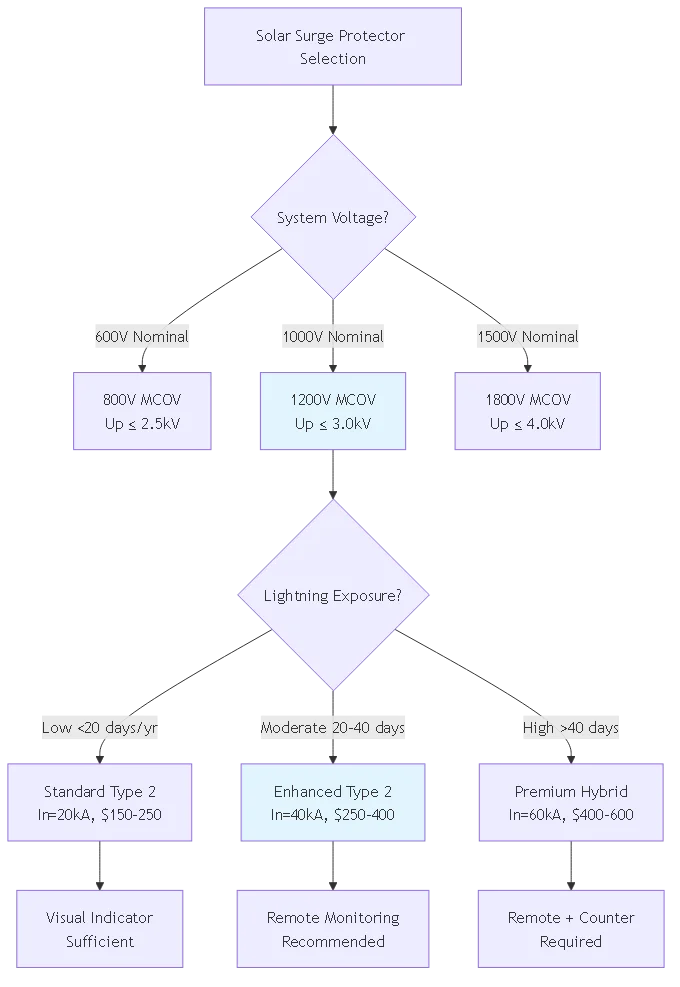
Maximum Continuous Operating Voltage (MCOV or Uc) represents the most critical specification when purchasing solar surge protectors. This value must exceed your system’s maximum open-circuit voltage including temperature effects. A 1000V nominal system operating in cold climates may reach 1150-1200V, requiring an SPD with 1200-1300V MCOV minimum. Under-specified MCOV leads to premature degradation and thermal runaway failures.
Voltage Protection Level (Up) defines the maximum voltage appearing at protected equipment during surge events. Lower Up values provide better protection but cost more due to tighter manufacturing tolerances. For inverter protection, select Up values providing at least 20% margin below the inverter’s maximum input voltage rating. A 1000V inverter needs an SPD with Up ≤ 3.0 kV, while 1500V systems require Up ≤ 4.0 kV.
Nominal discharge current (In) and maximum discharge current (Imax) indicate surge energy handling capacity. Type 2 SPDs for combiner box installation typically specify In=20 kA with Imax=40 kA. Higher ratings cost more but provide greater protection in severe lightning environments. Areas with isokeraunic levels exceeding 40 thunderstorm days per year benefit from enhanced Imax ratings of 50-60 kA.
Follow current interruption capability distinguishes quality DC SPDs from inadequate designs. This specification, often listed as “If” or “Ifi,” indicates the SPD’s ability to extinguish DC arcs after surge events. Look for If ratings of 1-3 kA minimum, demonstrating proper DC arc quenching design. Units without specified If ratings may sustain arcs, creating fire hazards.
Información clave: Don’t assume higher voltage or current ratings always mean better protection. An SPD with 1500V MCOV in a 1000V system offers no advantage over a properly sized 1200V unit, and may cost 30-50% more without improved protection.
| Tipo de SPD | Typical Price Range | Características principales | Mejor aplicación |
|---|---|---|---|
| Basic MOV (600V) | $100-150 | Visual indicator, In=15kA | Residential 600V systems, low lightning areas |
| Standard Type 2 (1000V) | $150-300 | Thermal disconnect, In=20kA, remote contact | Commercial 1000V, moderate exposure |
| Premium Hybrid (1000V) | $300-500 | MOV+SAD, surge counter, In=40kA | High-value commercial, high lightning |
| Utility-Scale (1500V) | $500-1200 | Multi-stage, monitoring, In=60kA | Utility-scale >500kW, critical protection |
Standard solar surge protector warranties range from 2-10 years, with significant variation in coverage terms. Basic warranties cover only manufacturing defects, excluding damage from surge events—the very purpose SPDs exist to handle. Premium manufacturers offer surge event coverage, replacing SPDs that fail due to lightning strikes within warranty period. This coverage typically requires installation documentation and may include maximum surge count limitations.
Limited warranties often contain exclusions that effectively void protection for common failure scenarios. Terms like “improper installation” or “excessive surge exposure” give manufacturers wide latitude to deny claims. Look for warranties specifying objective failure criteria: “Covers replacement if visual indicator shows failure within warranty period” provides clearer coverage than vague “manufacturing defect” language.
Warranty claim processes vary dramatically between manufacturers. Some require only a photo of the failed indicator and proof of purchase, shipping replacement units within days. Others demand return of the failed unit, professional electrical test results, and installation documentation, with claim processing taking weeks or months. Factor this reality into total cost of ownership calculations.
Extended warranty options add 10-25% to purchase price but may prove cost-effective for critical installations. A $200 SPD with $40 extended warranty providing 10-year coverage costs $24/year for protection. If the SPD requires replacement every 5-7 years at $200 each, the extended warranty saves money while eliminating replacement procurement effort.
⚠️ Importante: Warranty coverage only matters if the manufacturer remains in business. Purchasing from established companies with 10+ year market presence and robust financial stability provides greater assurance of warranty fulfillment than startups offering aggressive coverage terms.
Visual indicator windows provide the simplest failure detection, using colored tabs visible through the SPD housing. Green indicates normal operation, red signals failure requiring replacement. This passive technology costs little and requires no power, but demands manual inspection. Residential systems with quarterly maintenance visits work well with visual indicators alone.
LED indicator systems require auxiliary power, typically 12-24 VDC from a monitoring system or auxiliary power supply. Green LED illumination confirms operational status, extinction signals failure. Some designs flash patterns indicating degraded but still functional status. LED systems enable remote viewing from distances up to 50 feet, facilitating inspection without opening enclosures.
Remote contact outputs provide dry-contact or relay closure signals for SCADA integration. Normal operation keeps contacts closed; failure opens the circuit, triggering alarms. This technology enables immediate failure notification in utility-scale installations where inspection delays risk expensive downtime. Remote monitoring adds $50-100 to SPD cost but eliminates manual inspection requirements.
Surge counter modules track cumulative surge events, providing predictive maintenance data. After 20-30 surge operations, the SPD may retain functionality but exhibit degraded performance. Counters alert maintenance before complete failure occurs. This premium feature costs $100-200 additional but optimizes replacement timing, preventing both premature disposal of functional units and risk of undetected failures.
| Indicator Type | Additional Cost | Ventajas | Desventajas |
|---|---|---|---|
| Visual Window | $0 (included) | No power required, simple, reliable | Manual inspection needed, close viewing required |
| LED Indicator | +$20-40 | Visible from distance, degradation status | Requires auxiliary power, LED can fail |
| Remote Contact | +$50-100 | SCADA integration, immediate alerts | Wiring required, contact can stick |
| Surge Counter | +$100-200 | Predictive maintenance, event logging | Most expensive, requires data retrieval |
UL 1449 Edition 4 provides the primary certification standard for surge protective devices in North America. This standard requires separate DC voltage testing and rating, addressing unique DC arc interruption challenges. Verify that product literature specifically states “UL 1449 Ed.4 DC Listed” rather than just “UL Listed.” Generic listings may cover only AC applications, creating code violations and voiding warranties.
IEC 61643-31 governs international SPD standards, specifying test methods and performance requirements. European and Asian markets typically require IEC certification. For multinational projects or equipment potentially deployed across regions, dual UL/IEC certification provides flexibility. Premium manufacturers obtain both certifications, demonstrating commitment to quality and global market access.
Artículo 690 de NEC.35 mandates that SPDs be “listed for use” in the specific application. This requirement means more than just having a UL listing—the SPD must be rated for DC voltage, appropriate circuit configuration, and installation location. Installing a 600V SPD in a 1000V system violates code regardless of UL certification, as does using AC-only devices in DC circuits.
TÜV certification specifically for photovoltaic applications provides additional assurance for solar installations. TÜV 2 PfG 2144/08.2007 addresses PV-specific requirements including follow current interruption and behavior with varying DC sources. While not legally required in most jurisdictions, TÜV PV certification indicates manufacturers invested in specialized testing beyond minimum standards.

Metal Oxide Varistor (MOV) technology dominates the solar SPD market due to favorable cost-performance balance. MOV-based SPDs handle 15-40 kA surge currents reliably at price points from $100-300 for residential/commercial systems. MOV degradation occurs gradually, with visual indicators providing clear end-of-life signals. Expect 5-7 year service life in typical applications, longer in low-lightning environments.
Hybrid designs combine MOVs with Silicon Avalanche Diodes (SADs) or Gas Discharge Tubes (GDTs) for enhanced protection. The GDT or high-energy MOV stage handles bulk surge current, while precision SADs clamp final voltage. This two-stage approach achieves lower voltage protection levels (Up) and longer service life but costs 50-100% more than MOV-only designs.
Silicon Avalanche Diode technology offers tightest voltage clamping and longest life but handles lower surge currents. SAD-based SPDs work well for final equipment protection (Type 3) applications at inverter inputs where upstream Type 2 devices absorb most surge energy. All-SAD designs cost $400-600 for residential units, limiting market penetration despite superior performance.
Spark gap technology using Gas Discharge Tubes handles extreme surge currents exceeding 100 kA but exhibits higher clamping voltages and slower response than MOV designs. GDT-based SPDs suit Type 1 applications at service entrance with external lightning protection systems. The gap extinguishes naturally after surge events, providing reliable arc interruption in DC circuits.
Consejo profesional: For most residential and small commercial solar installations, quality MOV-based Type 2 SPDs provide optimal value. Reserve expensive hybrid designs for high-value utility-scale installations where premium protection justifies 2-3× cost.
Established electrical equipment manufacturers with decades of experience bring proven engineering to SPD designs. Companies like ABB, Schneider Electric, Phoenix Contact, and DEHN have extensive surge protection portfolios with documented field performance across millions of installations. Their products cost 10-30% more than lesser-known brands but come with confidence in warranty fulfillment and product availability.
Specialized surge protection manufacturers focus exclusively on SPD technology, often leading innovation in new protection features and materials. Companies like Citel, Raycap, and Mersen dedicate engineering resources specifically to surge protection, resulting in advanced features like adaptive MCOV, temperature-compensated clamping, and sophisticated monitoring. Premium pricing reflects specialized expertise.
PV-specific manufacturers design SPDs exclusively for solar applications, understanding unique requirements like varying source impedance, extended outdoor exposure, and wide temperature ranges. SYNODE, SolarEdge, and SMA produce SPDs optimized for their respective inverter platforms, ensuring compatibility and simplified procurement. Integrated warranty coverage across multiple system components provides additional value.
Generic import brands offer attractive pricing 40-60% below established manufacturers but introduce risk. Warranty claim processes may prove difficult, replacement parts unavailable, and performance specifications questionable. For critical commercial installations, the $100-200 savings on an SPD purchase represents poor risk management when protecting $10,000-50,000 inverters.
Residential systems (3-10 kW) typically require single-phase SPD protection at the combiner box or inverter input. Budget $150-250 for quality Type 2 protection with visual indicators and 5-year warranty. Consider upgrading to remote monitoring ($50-75 additional) if the installation includes existing SCADA or monitoring systems. Avoid over-specifying—1500V SPDs in 600V systems waste money without improving protection.
Small commercial systems (25-100 kW) benefit from enhanced SPD protection given higher equipment values and revenue impact of downtime. Specify remote contact outputs enabling alarm integration even if immediate SCADA doesn’t exist—future system upgrades become simpler. Budget $300-500 per combiner location, with multiple combiners requiring 2-4 SPDs. Hybrid designs make economic sense for high-lightning regions.
Large commercial installations (250-500 kW) should implement coordinated multi-stage protection: Type 2 at combiner boxes and Type 3 at inverter inputs. Specify remote monitoring as standard, integrating SPD status into O&M protocols. Consider spare SPD procurement with initial order, securing pricing and ensuring availability. Budget $2,000-5,000 total for comprehensive surge protection across 5-10 combiner locations.
Utility-scale projects (>1 MW) require engineering-grade surge protection with comprehensive monitoring, surge counters, and predictive maintenance features. Implement Type 1 protection at service entrance, Type 2 throughout combiner networks, and Type 3 at inverter stations. Budget $50,000-150,000 for complete system protection, representing 0.5-1.0% of total project cost. Specify spare SPD inventory equal to 10% of installed base.

DIN rail mounting provides the most versatile SPD installation method, fitting standard 35mm rail in combiner boxes and disconnect enclosures. This mounting style enables quick replacement without rewiring—simply disconnect, unclip from rail, snap new unit in place, and reconnect. DIN rail SPDs cost $20-40 more than panel-mount versions but save 30-45 minutes labor during replacement.
Panel-mount SPDs using screw terminals or bolt connections integrate into custom combiner designs or retrofit installations lacking DIN rail. These units mount directly to backplates or busbar assemblies. While less convenient for replacement, panel-mount designs handle higher current ratings and provide robust connections in high-vibration environments. Budget additional labor time for installation and replacement.
Integrated combiner box SPDs come pre-installed by the combiner manufacturer, offering simplified procurement and guaranteed compatibility. Factory installation ensures optimal grounding lead lengths and proper conductor sizing. Integrated designs cost 10-15% less than adding aftermarket SPDs but reduce flexibility for future upgrades or different SPD specifications.
External SPD enclosures suit retrofit installations where combiner boxes lack space for additional components. These NEMA 3R or 4X housings mount adjacent to combiners with short connection leads. External mounting provides easy inspection access and replacement without opening energized combiner boxes. Factor $75-150 additional cost for quality enclosure and mounting hardware.
Problema: Choosing the cheapest SPD without evaluating warranty, failure indicators, and total cost of ownership leads to higher long-term costs.
Escenarios comunes:
– Purchasing $80 SPDs that fail in 2 years versus $200 units lasting 7+ years
– No failure indicators requiring expensive testing to verify operation
– Generic import brands with impossible warranty claims processes
Corrección: Calculate 5-10 year total cost of ownership including replacement frequency, inspection labor, and downtime risk. Premium SPDs costing 2-3× more often provide lower TCO through extended life and simplified maintenance.
Problema: Selecting SPD with inadequate MCOV for system voltage leads to continuous degradation and premature failure.
Escenarios comunes:
– Using 1000V MCOV SPD in 1000V nominal system (which reaches 1150V cold)
– Ignoring temperature coefficient of PV module voltage
– Relying on installer’s verbal assurance rather than datasheet verification
Corrección: Calculate maximum expected Voc at minimum site temperature using module datasheet temperature coefficient. Select SPD MCOV at least 1.15× maximum Voc. For 1000V STC systems in cold climates, specify 1200V MCOV minimum.
Problema: Purchasing SPDs lacking proper UL 1449 Ed.4 DC certification creates code violations and liability issues.
Escenarios comunes:
– Using AC-rated SPDs in DC applications
– Installing SPDs marked “Pending UL Approval”
– Accepting “equivalent” certifications that don’t satisfy NEC requirements
Corrección: Verify UL 1449 Edition 4 DC certification on product label and literature before purchase. Request certification documentation for project closeout packages. Only purchase from authorized distributors preventing counterfeit devices.
Problema: Failing to stock spare SPDs results in extended downtime when lightning damage occurs, losing revenue while waiting for replacement delivery.
Escenarios comunes:
– Waiting 4-6 weeks for specialized SPD shipping after failure
– Emergency expedited shipping costs exceeding spare unit price
– Installing wrong SPD specification due to urgency
Corrección: Purchase spare SPDs equal to 10% of installed base (minimum 1 spare for systems with 1-5 SPDs). Store in climate-controlled environment with documentation. Update spare inventory after each replacement deployment.
For residential systems, budget $200-350 per SPD including equipment and installation labor. Small commercial systems require $300-500 per combiner location, while large commercial installations need $2,000-5,000 total for multiple protection points. Utility-scale projects allocate $50,000-150,000 for comprehensive surge protection. Installation labor adds $100-200 per SPD for new construction, $150-300 for retrofits requiring panel modifications. These costs represent 0.3-1.0% of total system cost—far less than replacing surge-damaged inverters.
Minimum acceptable warranty is 5 years covering both manufacturing defects and surge event failures. Premium SPDs offer 7-10 year warranties with unlimited surge event coverage and advance replacement shipping. Avoid warranties covering only “manufacturing defects” which manufacturers often interpret narrowly to exclude surge-related failures. For commercial installations, pay the 15-25% premium for extended warranties—the cost difference is negligible compared to replacement procurement effort and installation downtime.
Visual indicators prove sufficient for most residential installations with quarterly or annual maintenance schedules. Remote monitoring adds $50-100 cost but provides immediate failure notification, valuable for remote properties or homeowners tracking system performance through monitoring apps. If your installation already includes SCADA or monitoring systems, specify remote contacts—the marginal cost is minor and enables comprehensive system monitoring. For off-grid systems, remote monitoring justifies cost through prevention of undetected failures.
For most residential and small commercial systems, quality MOV-based SPDs provide optimal value at $150-300. Hybrid designs costing $300-600 make sense for high-lightning regions (>40 thunderstorm days/year), high-value installations where downtime costs exceed $500/day, or systems with previous surge damage history. Utility-scale installations should specify hybrid SPDs as standard given the small percentage of total project cost and significant equipment protection value.
Check the product label and datasheet for “UL 1449 Edition 4 DC” certification with a UL file number (format: E123456). Visit UL Product iQ database (ul.com/database) to verify the certification using manufacturer name and model number. Request IEC 61643-31 test reports for international installations. Avoid products stating “meets UL 1449” or “pending certification”—only purchase devices with active certifications. For large procurements, request factory test reports and witness testing if possible.
Inverter manufacturer SPDs offer simplified warranty coverage, guaranteed compatibility, and single-source procurement convenience. Premium brands like SMA and SolarEdge provide high-quality SPDs at competitive pricing. Third-party SPDs from established manufacturers (ABB, Phoenix Contact, DEHN) often provide more features, better specifications, or lower cost. For residential systems, inverter manufacturer SPDs simplify logistics. For commercial installations, evaluate specifications independently—the inverter manufacturer may source SPDs from third parties and rebrand them with markup.
Visual indicator windows provide most reliable long-term performance, requiring no power and having no electronic components to fail. LED indicators add visibility from distance but require auxiliary power and have potential LED failure modes. Remote contacts enable SCADA integration but mechanical relays can stick or fail. For critical installations, specify dual indicators: visual window plus remote contact, providing redundant failure detection. Surge counters offer predictive maintenance benefits but cost $100-200 additional—worth it for utility-scale, typically unnecessary for residential.
Ready to specify the right solar surge protectors for your installation with confidence in warranty coverage and long-term reliability? Contact SYNODE’s technical team for application-specific recommendations matching your system voltage, lightning exposure, and monitoring requirements. We provide detailed specification guidance, warranty comparison, and total cost of ownership analysis ensuring optimal protection investment for your photovoltaic system.
Artículos relacionados:
- What is DC SPD? Complete Technology Overview
- DC SPD Type 2 Specifications and Applications
- PV System Surge Protection Design Strategies
Palabra clave: – **Primary Focus Keyword**: `solar surge protector`
URL Slug:
Meta Título: Comprar protectores solares contra sobretensiones: Garantía e indicadores de fallo
Meta Descripción: Solar surge protector buying guide: warranty terms, failure indicator types, MOV vs hybrid technology, certification requirements, and cost analysis for PV surge protection.
Nivel de contenido: Nivel 3 (Contenidos de apoyo)
Embudo de conversión: Parte superior del embudo (concienciación)
Número de palabras objetivo: 2800-4000 palabras
Objetivo Diagramas de sirena: 3
Por favor, configúrelos en los ajustes de Rank Math, luego borre esta casilla antes de publicar.
For residential systems, budget $200-350 per SPD including equipment and installation labor. Small commercial systems require $300-500 per combiner location, while large commercial installations need $2,000-5,000 total for multiple protection points. Utility-scale projects allocate $50,000-150,000 for comprehensive surge protection. These costs represent 0.3-1.0% of total system cost.
Minimum acceptable warranty is 5 years covering both manufacturing defects and surge event failures. Premium SPDs offer 7-10 year warranties with unlimited surge event coverage and advance replacement shipping. Avoid warranties covering only manufacturing defects which manufacturers often interpret narrowly to exclude surge-related failures.
Visual indicators prove sufficient for most residential installations with quarterly or annual maintenance schedules. Remote monitoring adds $50-100 cost but provides immediate failure notification. If your installation already includes SCADA or monitoring systems, specify remote contacts—the marginal cost is minor and enables comprehensive system monitoring.
For most residential and small commercial systems, quality MOV-based SPDs provide optimal value at $150-300. Hybrid designs costing $300-600 make sense for high-lightning regions exceeding 40 thunderstorm days per year, high-value installations where downtime costs exceed $500/day, or systems with previous surge damage history.
Check the product label and datasheet for UL 1449 Edition 4 DC certification with a UL file number. Visit UL Product iQ database to verify the certification using manufacturer name and model number. Avoid products stating meets UL 1449 or pending certification—only purchase devices with active certifications.
Inverter manufacturer SPDs offer simplified warranty coverage, guaranteed compatibility, and single-source procurement convenience. Third-party SPDs from established manufacturers often provide more features, better specifications, or lower cost. For residential systems, inverter manufacturer SPDs simplify logistics. For commercial installations, evaluate specifications independently.
Visual indicator windows provide most reliable long-term performance, requiring no power and having no electronic components to fail. LED indicators add visibility from distance but require auxiliary power. Remote contacts enable SCADA integration but mechanical relays can fail. For critical installations, specify dual indicators for redundant failure detection.