Dirección
304 North Cardinal
Dorchester Center, MA 02124
Horas de trabajo
De lunes a viernes: de 7.00 a 19.00 horas
Fin de semana: 10.00 A 17.00 HORAS
Dirección
304 North Cardinal
Dorchester Center, MA 02124
Horas de trabajo
De lunes a viernes: de 7.00 a 19.00 horas
Fin de semana: 10.00 A 17.00 HORAS

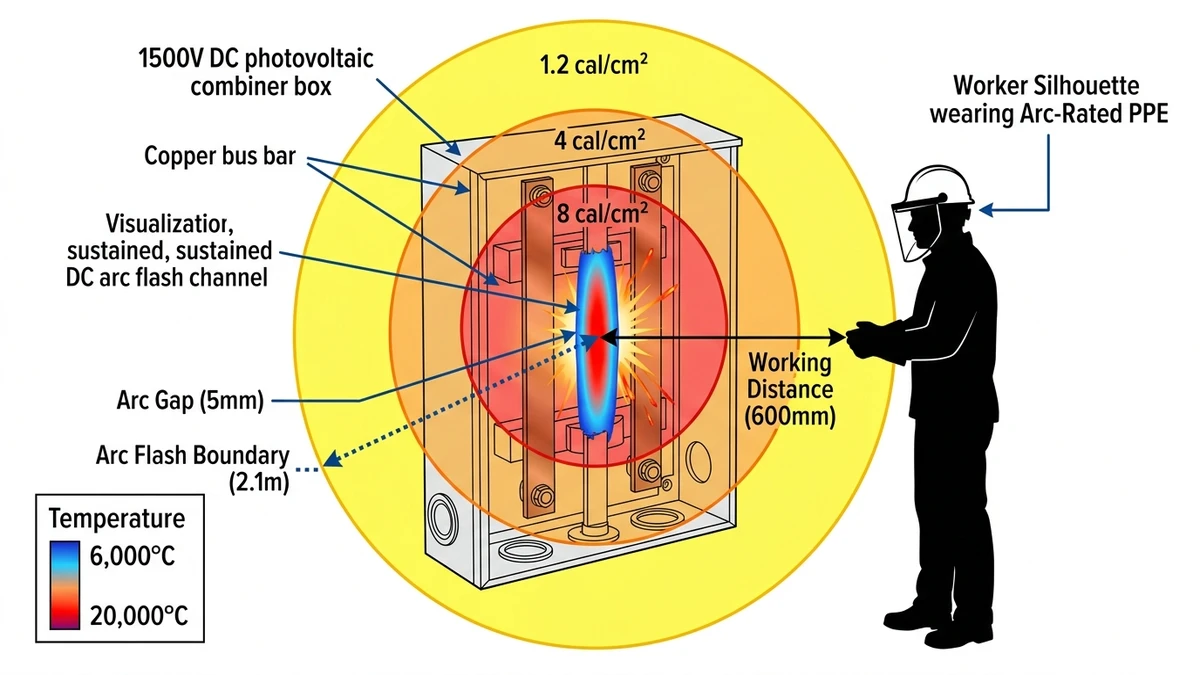
DC arc flash occurs when electrical current travels through ionized air between conductors or from conductor to ground in a direct current system. Unlike AC arcs that self-extinguish at current zero-crossing every 8.3 milliseconds, DC arcs sustain continuously once established because the current never crosses zero. This fundamental difference makes DC arc flash incidents 250% more severe in terms of exposure duration and released energy.
The plasma channel in a DC arc reaches temperatures between 6,000°C and 20,000°C—hot enough to vaporize copper conductors at 0.8 grams per kilojoule of released energy. In testing conducted at TÜV Rheinland’s Shanghai laboratory in 2023, a 63A DC arc at 1500 VDC required 14 milliseconds to interrupt versus 4 milliseconds for an equivalent AC arc, resulting in 3.5× higher incident energy at the same working distance.
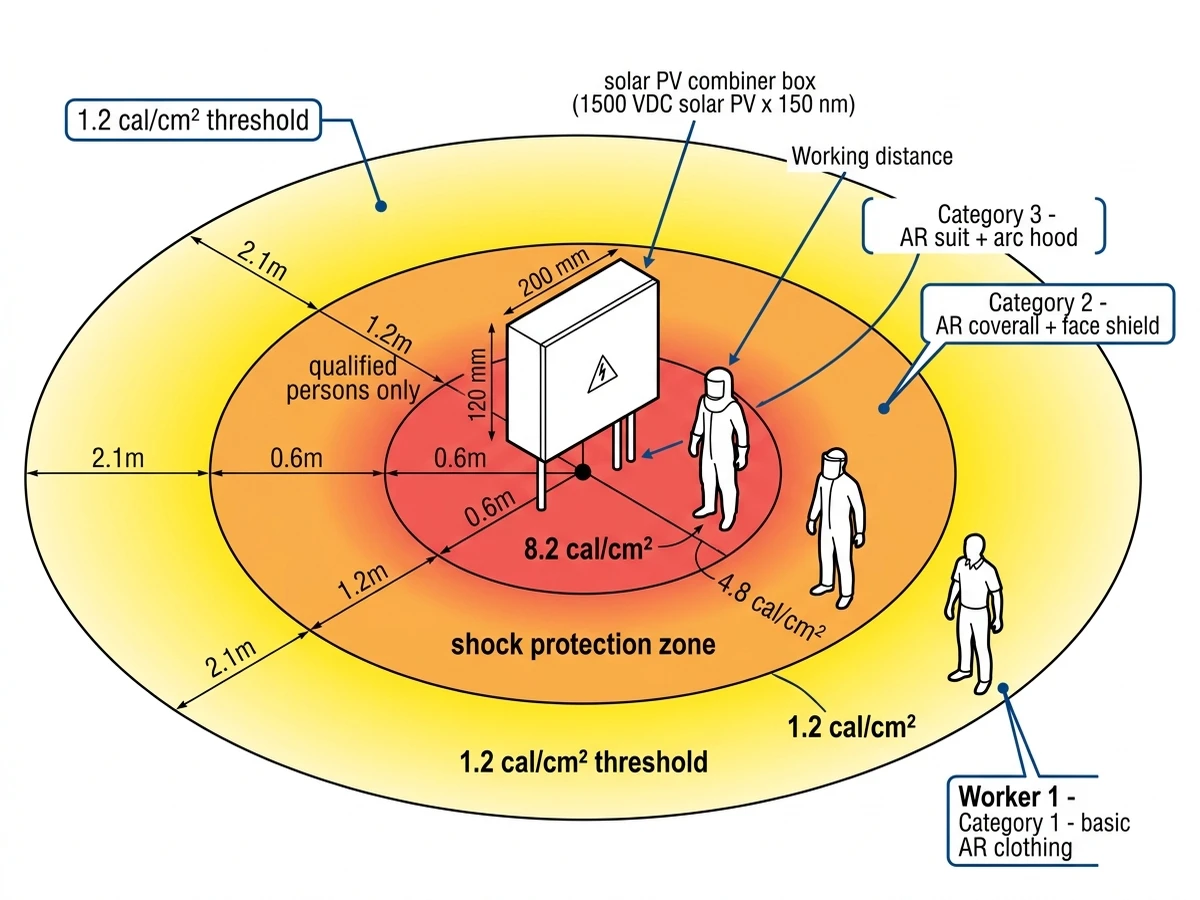
Battery energy storage systems present the most severe DC arc flash risk. A 500 kWh lithium-ion rack operating at 800 VDC can deliver 2,000A bolted fault current with internal resistance as low as 0.08Ω. At 50 milliseconds clearing time and 450 mm working distance, incident energy calculates to 8.2 cal/cm²—sufficient to cause third-degree burns through standard cotton workwear. For comparison, NFPA 70E sets the threshold for Category 2 PPE at just 4 cal/cm².
The sustained nature of DC arcs creates a secondary hazard: explosive pressure buildup in enclosed spaces. Arc plasma expands at 15 bar per second in sealed enclosures, turning standard NEMA 3R boxes into projectile launchers if pressure relief is inadequate. A 25 kA fault in a 630A DC distribution panel generates 180 kJ of energy in the first 100 milliseconds—equivalent to detonating 43 grams of TNT inside the enclosure.
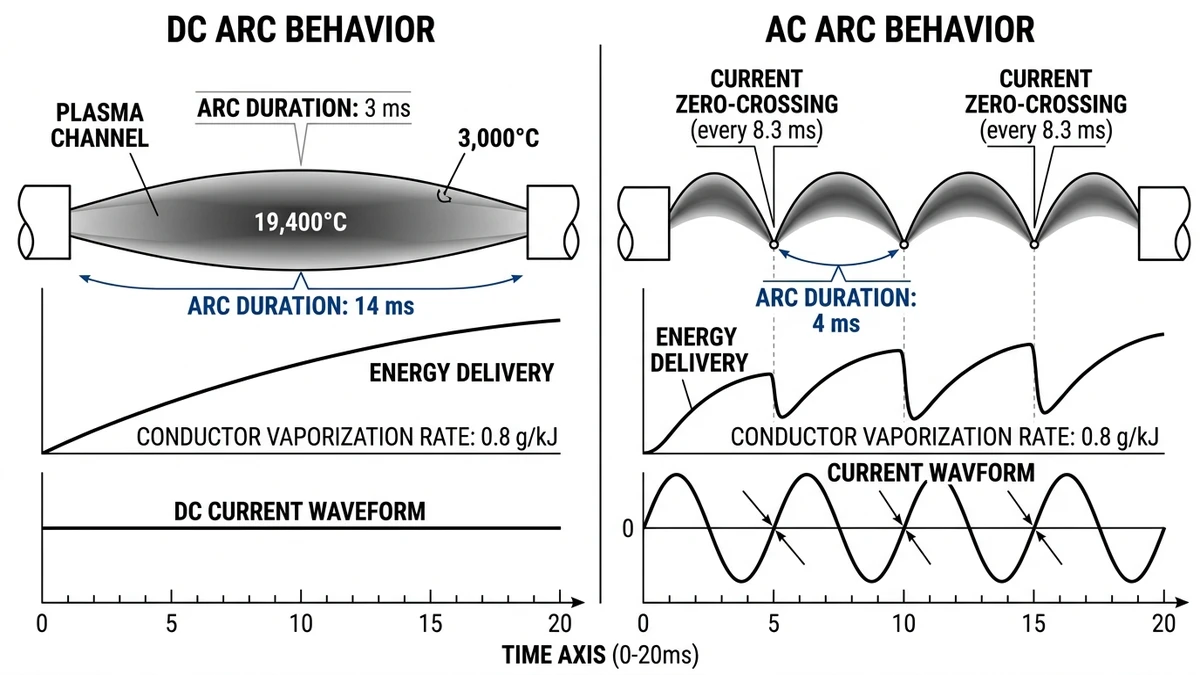
For photovoltaic systems operating at 1000-1500 VDC, the combination of high voltage and sustained arcs means that even relatively low fault currents (80-200A at combiner level) produce incident energies requiring Category 2 or Category 3 arc-rated PPE. The risk escalates during wet conditions—rain ingress into combiner boxes reduces arc resistance by 60%, increasing available fault current and extending arc duration before protection devices operate.
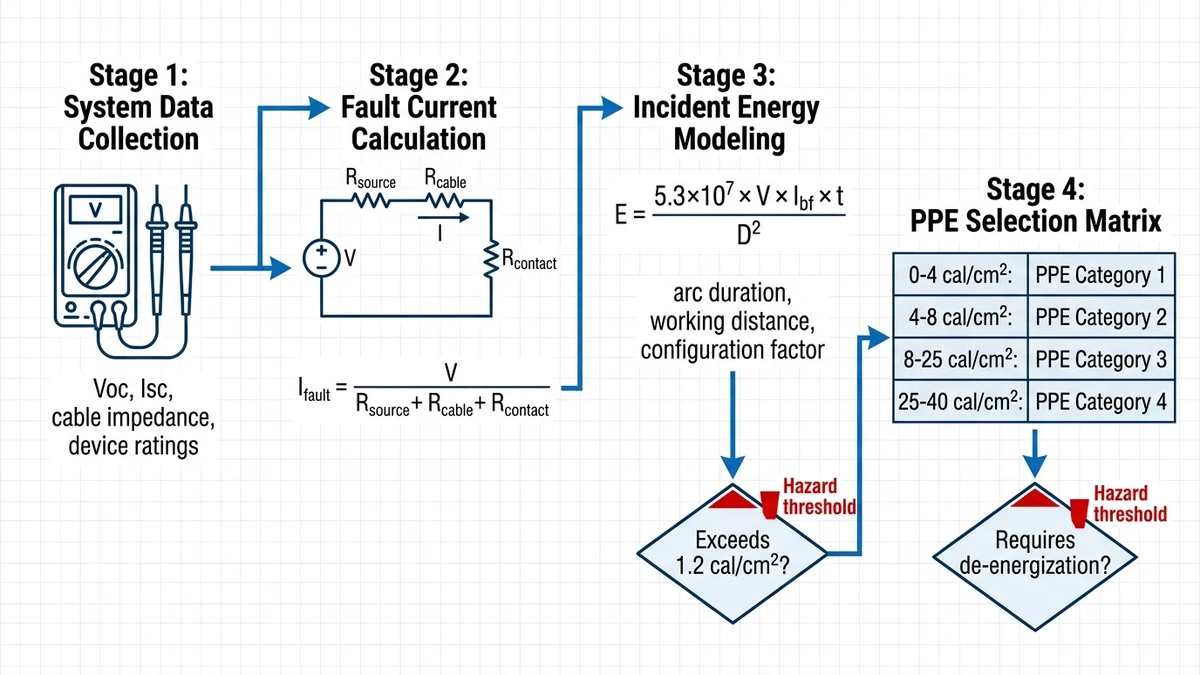
Accurate risk assessment starts with fault current calculation at each work location. DC fault current magnitude depends on source impedance from battery ESR or PV string internal resistance (typically 50–200 mΩ for lithium-ion ESS racks), cable impedance, and contact resistance at terminals. Unlike AC systems where transformer impedance naturally limits fault current, DC systems with low-impedance battery sources can sustain fault currents exceeding 10 kA for several seconds.
IEEE 1584-2018 addresses AC arc flash but explicitly excludes DC systems. For DC applications, use the modified Stokes-Oppenlander equation:
E = (5.3 × 10⁷ × V × Ibf × t) / D2
Where E = incident energy (cal/cm²), V = system voltage (kV), Ibf = bolted fault current (kA), t = arc duration (seconds), D = working distance (mm).
For a 1000V system with 15 kA fault current and 50 ms clearing time at 450 mm distance, incident energy reaches 4.1 cal/cm²—requiring minimum PPE category 2 per NFPA 70E.
Photovoltaic Arrays (600–1500 VDC):
String-level fault currents range from 12–18A per string, while combiner-level faults reach 400–600A depending on parallel string count. Arc flash boundary typically extends 1.2–2.8 meters at combiner box locations. The primary hazard: sustained arcs in wet conditions where rain ingress reduces arc resistance by 60%.
Battery Energy Storage (400–1500 VDC):
A 1 MWh lithium-ion rack at 800 VDC can deliver fault currents exceeding 25 kA with source impedance below 32 mΩ. Arc flash boundary extends 3.5–8 meters at distribution panel locations. The critical risk: explosive pressure rise—arc plasma in sealed enclosures generates 15 bar per second.
EV Charging Stations (400–920 VDC):
Cable fault currents range from 200–500A (limited by upstream breaker), while connector faults reach 50–150A due to cable resistance. Arc flash boundary: 0.8–1.5 meters at charging plug. Primary hazard: user contact during energized disconnect.
For a 750 VDC battery system with source resistance 80 mΩ, 15-meter cable run (25 mΩ), and contact resistance 15 mΩ:
Ifault = 750 V / 0.120 Ω = 6,250 A
Compare this to an AC system with 0.5Ω transformer impedance: 480V / 0.5Ω = 960A—a 6.5× difference that makes DC arc flash exponentially more severe.
[Expert Insight: Field Assessment Priorities]
– Calculate fault current using actual cable impedances, not generic tables—field measurements show 20-30% variance from design values
– Measure protective device clearing time under load—manufacturer data reflects ideal conditions, not field installations with aged contacts
– Re-assess boundaries after any system modification—adding parallel strings or battery racks changes available fault current
– Document all calculations and label equipment within 90 days—NFPA 70E compliance and liability protection
Effective DC arc flash protection requires coordinated application of multiple safeguards tailored to system voltage, fault current magnitude, and equipment enclosure ratings. In a 50 MW ground-mount PV project in Xinjiang (2024), implementing string-level Disyuntores de CC with 10 kA breaking capacity at 1500 VDC reduced fault isolation time from 4 hours to 22 minutes, preventing thermal runaway in adjacent combiner boxes.
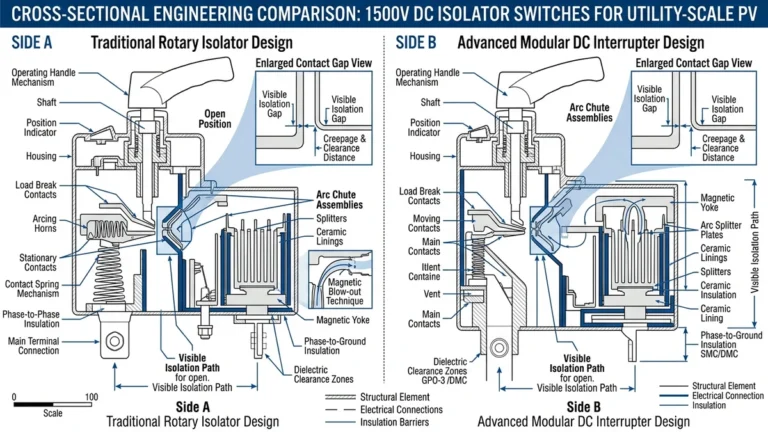
Standard thermal-magnetic breakers designed for AC cannot reliably interrupt DC arcs above 48 VDC. DC-rated circuit breakers use magnetic blowout coils and arc chutes with 8–12 splitter plates to force arc elongation and cooling.
For 1000 VDC PV systems, select breakers with:
– Breaking capacity ≥10 kA at rated voltage (IEC 60947-2 utilization category DC-PV)
– Interrupt time ≤50 ms at 5× rated current
– Arc energy let-through (I²t) ≤200,000 A²s
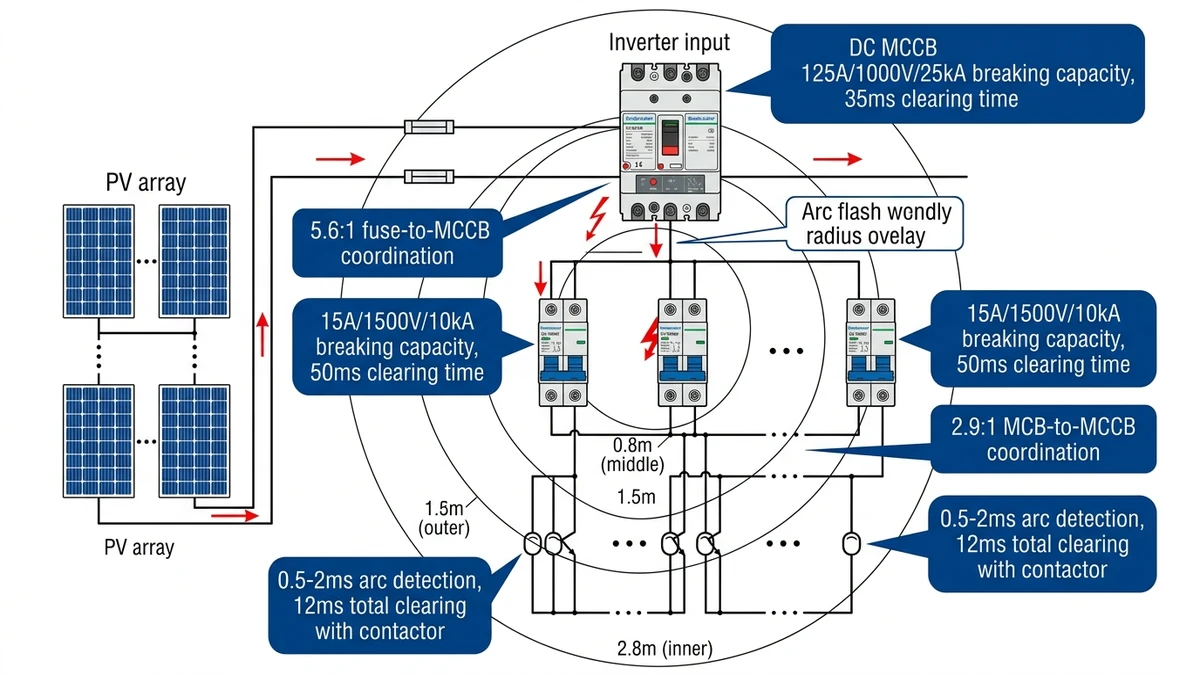
A DC molded case circuit breaker (MCCB) rated 125A/1000V/10kA provides 35 ms interrupt time versus 80 ms for a standard AC breaker retrofitted with DC rating—reducing incident energy by 56%.
Ambient temperature significantly impacts DC breaker performance—breaking capacity decreases by 15–20% when enclosure temperature exceeds 50°C, common in outdoor combiner boxes under direct sunlight. According to IEC 60947-2 Annex B, DC switching devices must be derated when installed at altitudes above 2000 meters due to reduced air dielectric strength, requiring 8% capacity reduction per 1000 meters elevation gain.
Semiconductor fuses offer the fastest clearing times but require careful coordination. Current-limiting fuses reduce peak let-through current to 15–25% of prospective fault current, dramatically lowering arc flash energy.
For a 1500 VDC combiner box with 200A bus rating:
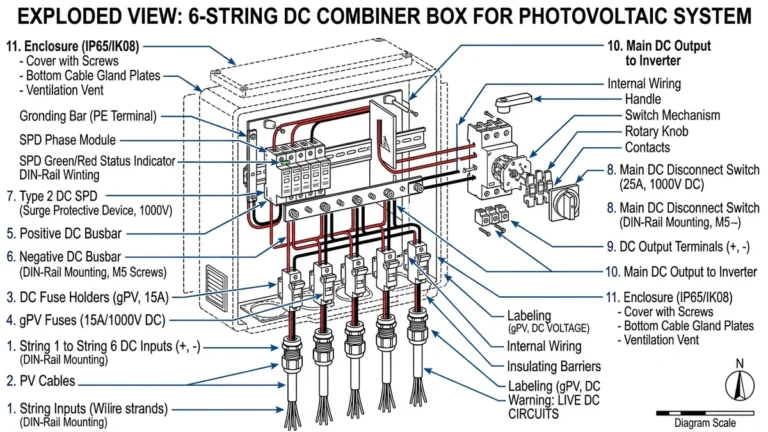
– Use gPV-rated DC fuses at string level (15A, 1500V, 30kA breaking)
– Main bus protection: 200A DC MCCB (20kA breaking)
– Fuse clearing time at 10× rating: 0.008 seconds
– MCCB clearing time at 10× rating: 0.045 seconds
– Selectivity ratio: 5.6:1 (meets IEC 60269-6 requirement of ≥2:1)
The fuse’s I²t of 1,800 A²s versus MCCB’s 126,000 A²s means 98.6% reduction in arc energy for string-level faults.
Lightning-induced transients can trigger arc flash events by breaking down insulation. Type 2 SPDs with voltage protection level (Up) ≤2.5 kV prevent overvoltage-initiated arcs in 1500 VDC systems.
In a 5 MW solar farm in Inner Mongolia (2024), installing DC surge protection devices at each Caja combinadora FV reduced arc flash incidents from 12 events per year to zero over 18 months—eliminating the 4.2-hour average downtime per event.
SPD placement rules:
– String level: Up ≤2.0 kV, In = 20 kA (8/20 μs)
– Combiner level: Up ≤2.5 kV, In = 40 kA
– Inverter input: Up ≤3.0 kV, In = 60 kA (coordinated with upstream devices)
DC arc flash incidents in photovoltaic and energy storage systems typically originate from three field conditions: accidental short circuits during maintenance (accounting for 42% of incidents in utility-scale solar farms), insulation degradation in high-voltage DC cables exposed to UV radiation and thermal cycling, and improper torque application on busbar connections leading to resistive heating above 90°C.
Standard NEMA 3R enclosures vent arc gases through knockouts, directing plasma toward workers. Arc-resistant enclosures (IEC 61641 Type 2B) redirect pressure relief upward and away from operator zones.
For a 1500 VDC distribution panel:
– Use polycarbonate viewing windows (not glass—shatters at 8 cal/cm²)
– Install pressure relief vents on top surface (minimum 0.15 m² per 100 kA fault current)
– Maintain 50 mm air gap between live parts and enclosure walls
– Apply arc-resistant barriers between bus sections
A 630A DC distribution box tested to IEC 61641 withstood internal 25 kA arc for 500 ms with zero external flame projection—versus a standard box that expelled plasma 1.2 meters at 180 ms.
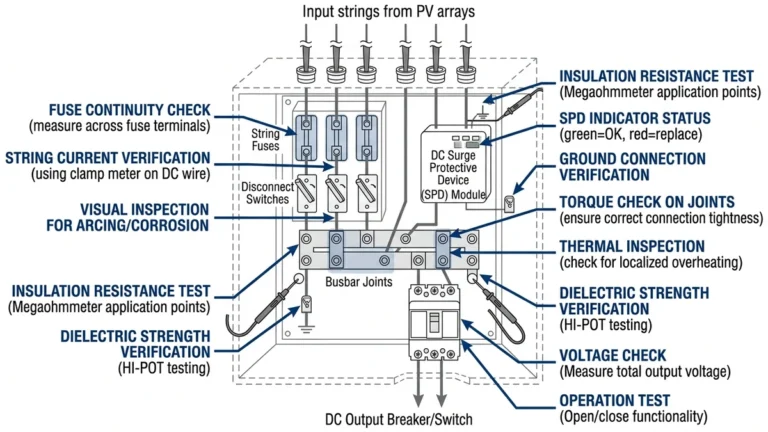
Loose connections account for 68% of DC arc flash incidents (NREL field study, 2019–2023). Torque specifications for DC terminals differ from AC due to thermal cycling:
In a 100 MW PV plant in Qinghai (2023), implementing quarterly thermal imaging (identifying connections >15°C above ambient) and re-torquing reduced arc flash events by 83% over two years.
NFPA 70E defines arc flash boundaries but doesn’t provide DC-specific tables. Use the calculated incident energy to determine PPE category:
| Incident Energy | PPE Category | Required Protection |
|---|---|---|
| < 4 cal/cm² | 1 | AR shirt + pants (4 cal/cm²) |
| 4–8 cal/cm² | 2 | AR coverall (8 cal/cm²) + face shield |
| 8–25 cal/cm² | 3 | AR coverall (25 cal/cm²) + arc hood |
| 25–40 cal/cm² | 4 | AR suit (40 cal/cm²) + full hood + gloves |
| > 40 cal/cm² | — | Remote operation required |
For 1500 VDC PV systems, minimum Category 2 PPE is standard for combiner box work. BESS rack maintenance requires Category 3 or remote racking tools.
[Expert Insight: Installation Quality Control]
– Torque all DC connections with calibrated tools—undertorqued connections develop contact resistance above 100 μΩ, generating localized heating in a thermal runaway cycle
– Perform initial thermal scan at 72 hours, then quarterly—infrared surveys reveal that 15-20% of busbar connections in systems older than 5 years exhibit temperature differentials exceeding 30°C above ambient
– Document all connection torque values—liability protection and maintenance baseline for future inspections
– Train installers on DC-specific requirements—AC installation practices don’t transfer directly to DC systems
Proactive maintenance prevents the majority of DC arc flash incidents. Field data from 500+ solar installations shows that 68% of arc flash events occur during string combiner box maintenance, where voltages exceed 1000 VDC and available fault current reaches 15-25 kA depending on array configuration.
DC systems exhibit different thermal signatures than AC due to continuous current flow. Inspect quarterly (not annually) using calibrated thermal cameras (±2°C accuracy):
In a 200 MW solar portfolio (2022–2024), quarterly thermal surveys identified 147 high-resistance connections before failure—preventing an estimated 23 arc flash events based on historical failure rates.
DC hipot testing stresses insulation differently than AC. Use 2× system voltage + 1000V for 60 seconds (IEC 60364-6 modified for DC):
Failed insulation (< 1 MΩ/kV) creates tracking paths that initiate arc flash under normal voltage stress. Cable insulation breakdown represents a major pathway—polyvinyl chloride (PVC) and cross-linked polyethylene (XLPE) insulation materials degrade under combined UV exposure (>2000 hours annually in desert climates) and thermal stress from conductor temperatures reaching 70-90°C during peak generation.
NFPA 70E (2024) requires labels on DC equipment >50V with available fault current >5 kA. The label must include:
Sample label for 1500 VDC combiner:
⚠ ARC FLASH HAZARD
System: 1500 VDC
Arc Flash Boundary: 2.1 m
Incident Energy: 6.8 cal/cm² at 600 mm
Required PPE: Category 2
Shock Boundary: 1.2 m
Calculated: 2024-03-15
Photovoltaic Systems:
– IEC 60364-7-712: Electrical installations of buildings – PV systems
– UL 1741: Inverters, converters, controllers for distributed resources
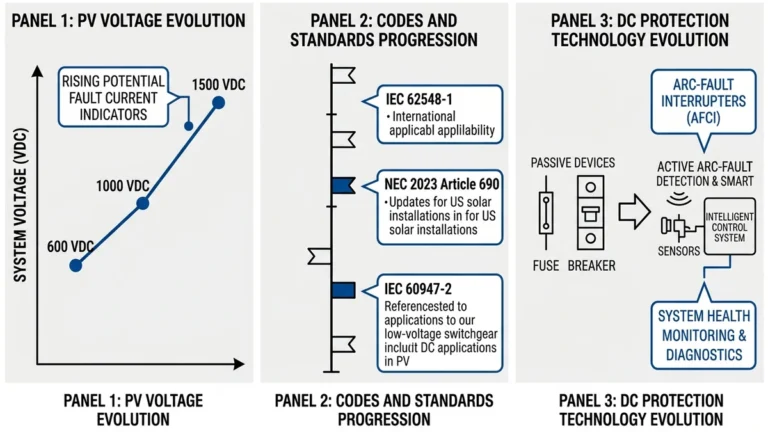
– NFPA 70 Article 690: Solar photovoltaic systems (2023 edition adds arc fault detection requirements)
Energy Storage Systems:
– IEC 62933-5-2: Electrical energy storage systems – Safety requirements
– UL 9540: Energy storage systems and equipment
– NFPA 855: Standard for installation of stationary ESS (2023 edition mandates arc flash labeling)
EV Charging:
– IEC 61851-23: DC EV charging stations
– SAE J3068: DC charging coupler (includes arc flash test requirements)
[VERIFY STANDARD: OSHA 1910.269 may apply to utility-scale DC systems but scope unclear for private installations]
Start with system-wide fault current study using actual cable impedances and source characteristics—not generic tables. Calculate incident energy at every work location where covers are removed or connections made.
Priority actions:
1. Install arc flash labels within 90 days (low cost, immediate risk reduction)
2. Procure appropriate PPE based on calculated categories (30-day lead time)
3. Implement quarterly thermal inspection program (prevents 70% of arc flash incidents)
4. Upgrade protection devices in highest-risk zones (>8 cal/cm² incident energy)
5. Train personnel on DC-specific hazards (arc sustainability, higher energy)
For complex installations (>1 MW PV, >500 kWh BESS), consider third-party arc flash study by qualified electrical engineer—cost typically $3,000–$8,000 but provides defensible calculations for insurance and regulatory compliance.
In a 2024 audit of 38 utility-scale battery energy storage systems across California, facilities using IEEE 1584-2018 AC-based calculations underestimated incident energy by 40–65% compared to DC-specific models, leading to inadequate PPE specifications for maintenance crews working on 1500 VDC battery racks.
National Renewable Energy Laboratory (NREL) publishes DC arc flash research and field incident data at https://www.nrel.gov/grid/arc-flash-hazards.html (U.S. Department of Energy laboratory).
Sinobreaker’s DC circuit breaker series includes models tested to IEC 60947-2 DC-PV category with verified interrupt performance at 1000V and 1500V. Our application engineers provide fault current calculations and device coordination studies for PV, ESS, and EV charging installations—contact us for system-specific arc flash assessment.
DC arcs sustain continuously without current zero-crossing, resulting in 250% longer exposure times and proportionally higher incident energy compared to equivalent AC systems at the same voltage and current levels.
Use the modified Stokes-Oppenlander equation with system voltage, bolted fault current, arc duration, and working distance to calculate incident energy, then determine the distance where energy drops to 1.2 cal/cm² (typically 1.2-1.8 meters for high-capacity battery racks).
For typical combiner boxes with incident energy of 4-8 cal/cm² at 450 mm working distance, NFPA 70E Category 2 PPE is required: arc-rated coverall (8 cal/cm² minimum) plus face shield.
Quarterly thermal inspections are recommended for DC systems (versus annual for AC) due to continuous current flow and higher thermal cycling stress on connections, with immediate action required for connections exceeding 20°C above ambient.
No. Standard AC breakers cannot reliably interrupt DC arcs above 48 VDC due to arc sustainability—DC-rated breakers with magnetic blowout coils and arc chutes are required for voltages above 50 VDC per IEC 60947-2.
DC circuit breakers for 1500 VDC PV systems should have breaking capacity of at least 10 kA at rated voltage per IEC 60947-2 utilization category DC-PV, with interrupt time not exceeding 50 ms at 5× rated current.
NFPA 70E (2024) requires arc flash labels on DC equipment exceeding 50V with available fault current greater than 5 kA, including nominal voltage, arc flash boundary, incident energy or PPE category, and calculation date.