Address
304 North Cardinal
St. Dorchester Center, MA 02124
Work Hours
Monday to Friday: 7AM - 7PM
Weekend: 10AM - 5PM
Address
304 North Cardinal
St. Dorchester Center, MA 02124
Work Hours
Monday to Friday: 7AM - 7PM
Weekend: 10AM - 5PM

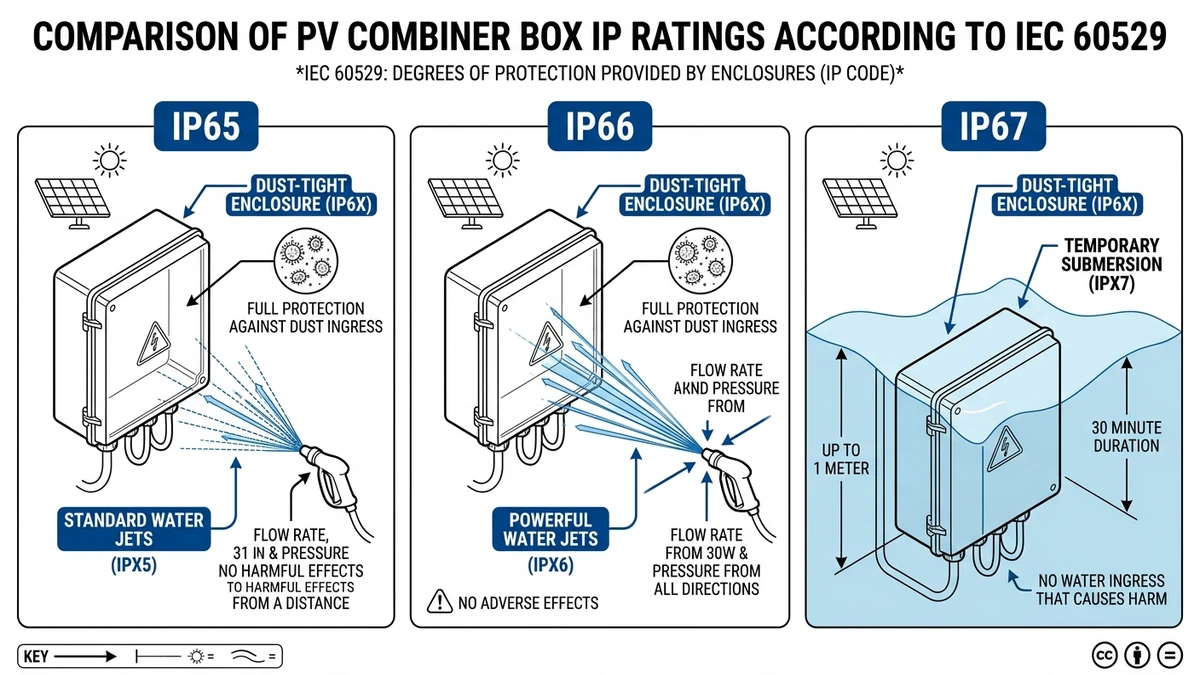
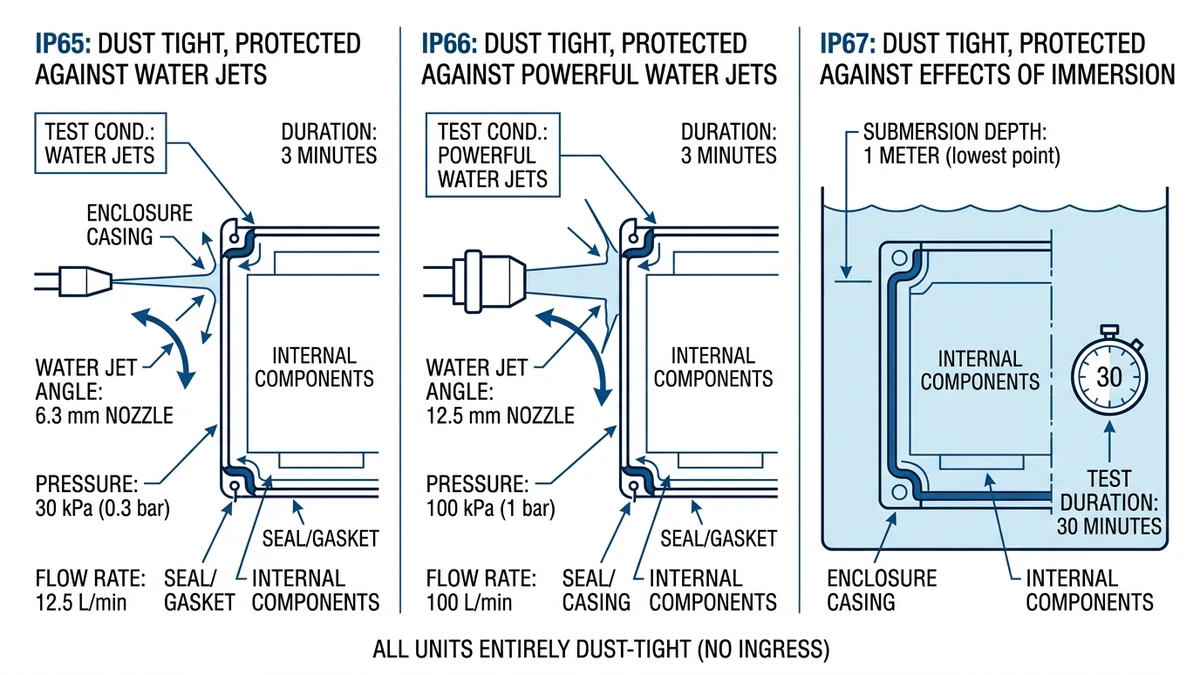
For PV combiner box IP rating selection, IP65 blocks dust and low-pressure water jets, IP66 resists powerful water jets, and IP67 survives temporary submersion up to 1 meter for 30 minutes. The right choice depends on the installation environment — rooftop, ground-mount, or flood-prone terrain — not simply on picking the highest number.
| IP Rating | Dust Protection | Water Protection | Typical PV Application |
|---|---|---|---|
| IP65 | Fully dust-tight | Water jets from any direction (12.5 L/min at 30 kPa) | Rooftop, sheltered ground-mount |
| IP66 | Fully dust-tight | Powerful water jets (100 L/min at 100 kPa) | Exposed ground-mount, coastal sites |
| IP67 | Fully dust-tight | Submersion at 1 m depth for 30 min | Flood-prone areas, low-lying terrain |
Ratings are defined under IEC 60529, which governs ingress protection classifications for electrical enclosures. Both digits matter independently: the first digit confirms complete dust exclusion, while the second digit defines the water-resistance threshold.
In a 32 MW ground-mount installation in Zhejiang Province in 2023, combiner boxes initially specified at IP65 showed moisture ingress after seasonal typhoon exposure, requiring upgrades to IP66 enclosures. The difference between a standard water jet test at 30 kPa and a powerful jet test at 100 kPa proved decisive in that coastal environment.
For most utility-scale and commercial rooftop systems, the PV combiner box selection process should treat IP rating as a site-specific parameter, not a default spec. Internal components — including DC fuses and surge protection devices — rely on enclosure integrity to maintain rated performance over a long service life.
A useful reference for broader selection criteria is this PV combiner box selection guide covering string count and current capacity, which shows how enclosure rating interacts with electrical sizing decisions. For the test basis behind these ratings, see the IEC overview here: https://en.wikipedia.org/wiki/IP_code
Even a correct IP class only describes a narrow lab test, so field performance depends on factors the code itself does not evaluate.
An IP rating tells you whether a combiner box passed a controlled ingress test on a single new unit under lab conditions at a fixed point in time. For a PV combiner box installed on a rooftop in Xinjiang or a ground-mount array in coastal Fujian, that snapshot is only part of the story.
IEC 60529 contains no UV exposure requirement. Polycarbonate and ABS enclosures that pass IP66 on day one can become brittle and micro-cracked after 18–24 months of direct solar irradiance exceeding 1000 W/m². Those cracks can bypass the gasket entirely and create ingress paths that no IP test would predict.
Solar enclosures routinely cycle between low nighttime temperatures and sun-heated daytime surface temperatures. Over a project life measured in decades, repeated expansion and contraction gradually reduce gasket sealing force.
IEC 60529 does not include salt spray testing. Salt fog resistance is evaluated separately, so an enclosure can carry a high IP rating and still underperform in coastal or industrial air if the material system is not qualified for corrosive exposure.
A 2023 installation survey across 14 utility-scale plants in Shandong Province found that roughly 22% of combiner boxes older than five years showed visible gasket deformation, with measured protection degradation from IP66 to below IP54 in field re-tests.
The practical implication is that IP rating alone cannot substitute for material certification. Specifiers should cross-check UV resistance, gasket material data, and any applicable salt-fog testing, especially where long inspection intervals are expected. For sites with high fault-current exposure, the internal protection components — including DC fuses and surge protection devices — also need to be matched to the enclosure’s actual long-term sealing performance, not just its nameplate class.
[Expert Insight]
– Ask for the enclosure material grade and gasket compound on the datasheet, not just the IP mark on the nameplate.
– In coastal projects, review corrosion and salt-fog qualification alongside ingress protection before approving procurement.
– If site maintenance is annual rather than quarterly, specify a wider durability margin because small seal issues can go unnoticed for one full wet season.
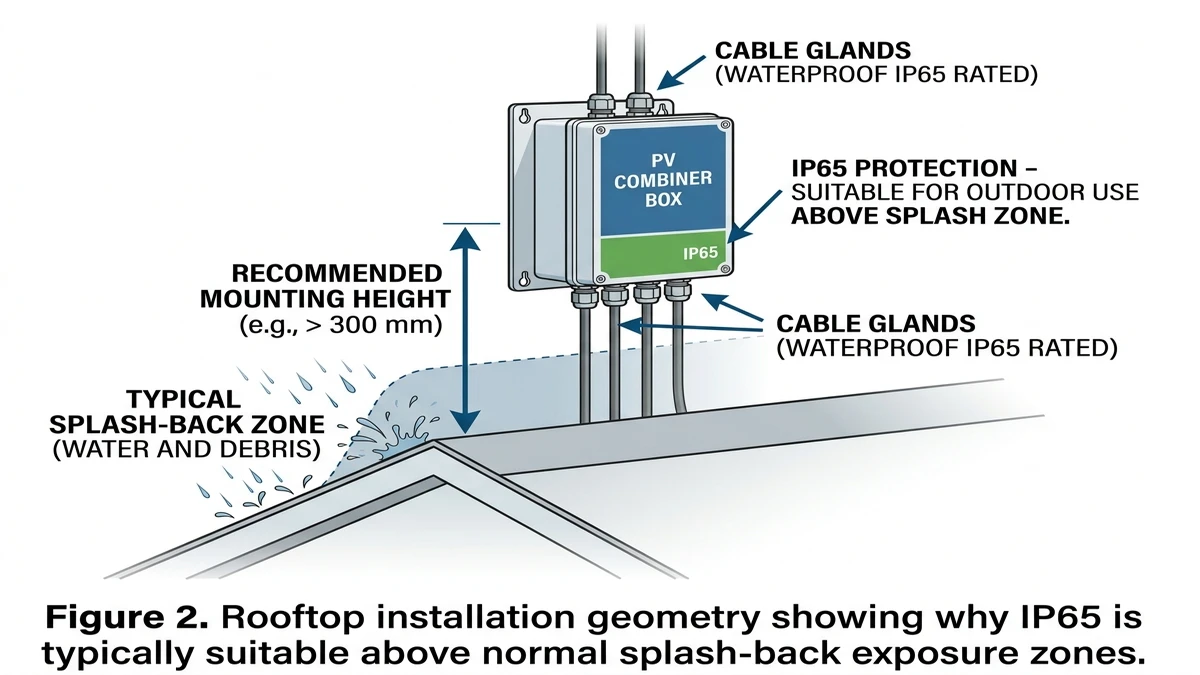
Where the enclosure stays well above pooling water and severe splash-back, IP65 is usually the most economical rating that still matches real exposure.
IP65 is the baseline ingress protection rating for most rooftop and elevated rack PV combiner boxes, providing complete dust exclusion and resistance to low-pressure water jets from any direction.
Mounting height is the primary field variable. Combiner boxes installed at 600 mm or more above the finished roof surface or rack base rail typically sit above normal splash-back zones, where water exposure is limited to rainfall and wind-driven spray.
In a 22 MW rooftop installation across eight logistics warehouses in Zhejiang Province in 2023, IP65-rated combiner boxes mounted at 750 mm above the membrane surface showed no moisture ingress after 18 months of operation, including two typhoon-season events with sustained wind-driven rain.
For elevated ground-mount racks where the combiner box is fixed on the racking structure itself — often 1.2 m to 2.5 m above grade — IP65 remains appropriate if drainage design prevents pooling near the enclosure base.
IP65 enclosures tolerate directed cleaning, but technique matters. Use a low-pressure hose at a reasonable standoff distance, and avoid pressure washers that exceed the IP65 test envelope because they can force water past gaskets and cable gland entries.
After any wash-down, inspect the door gasket for compression set. Internal components — including monitoring terminals — are sensitive to minor condensation ingress, so post-cleaning inspection and drying are worth building into maintenance routines.
Once water impact becomes more aggressive than ordinary rain and spray, IP66 is usually the practical step up from standard rooftop protection.
IP66 raises the bar beyond IP65 by requiring protection against powerful water jets from any direction. That upgrade makes a measurable difference in three site categories where IP65 routinely falls short.
Ground-mounted arrays sit close to grade, often 0.3–1.2 m above soil or gravel. During heavy rainfall, water rebounds from hard surfaces and can strike enclosure seams and gland entries with enough force to exceed typical IP65 exposure.
A 120 MW ground-mount project in Xinjiang in 2023 reported moisture ingress in about 8% of IP65-rated combiner boxes after the first monsoon season, traced to splash-back at cable entry points. After switching to IP66 enclosures, the following season produced no reported ingress events.
Coastal installations face a combined threat: high-pressure sea spray and salt-laden aerosols that accelerate corrosion on any exposed metal or unsealed joint. For sites close to the shoreline, pair IP66 with a suitable enclosure material such as 316L stainless steel or GRP, because IP rating governs water ingress, not corrosion resistance.
Annual rainfall above 2,000 mm creates repeated high-intensity events where water accumulates around mounting structures and drainage can slow. In these conditions, the PV combiner box must withstand not just spray but severe splash and partial pooling at the base.
[Expert Insight]
– For ground-mount rows over gravel, inspect the lowest gland entries first; they are usually the earliest splash-back failure point.
– Near the coast, specify both enclosure material and fastener material together so a corrosion-resistant box is not undermined by standard hardware.
– If routine cleaning uses pressure washers, confirm nozzle pressure at the point of use rather than relying on equipment nameplate ratings.
When the risk shifts from spray to actual immersion, IP67 becomes the rating that separates recoverable flood exposure from enclosure failure.
IP67 combiner boxes are the right choice when temporary submersion is a realistic risk — not just heavy rain. IEC 60529 defines IP67 as protection against immersion up to 1 meter for 30 minutes.
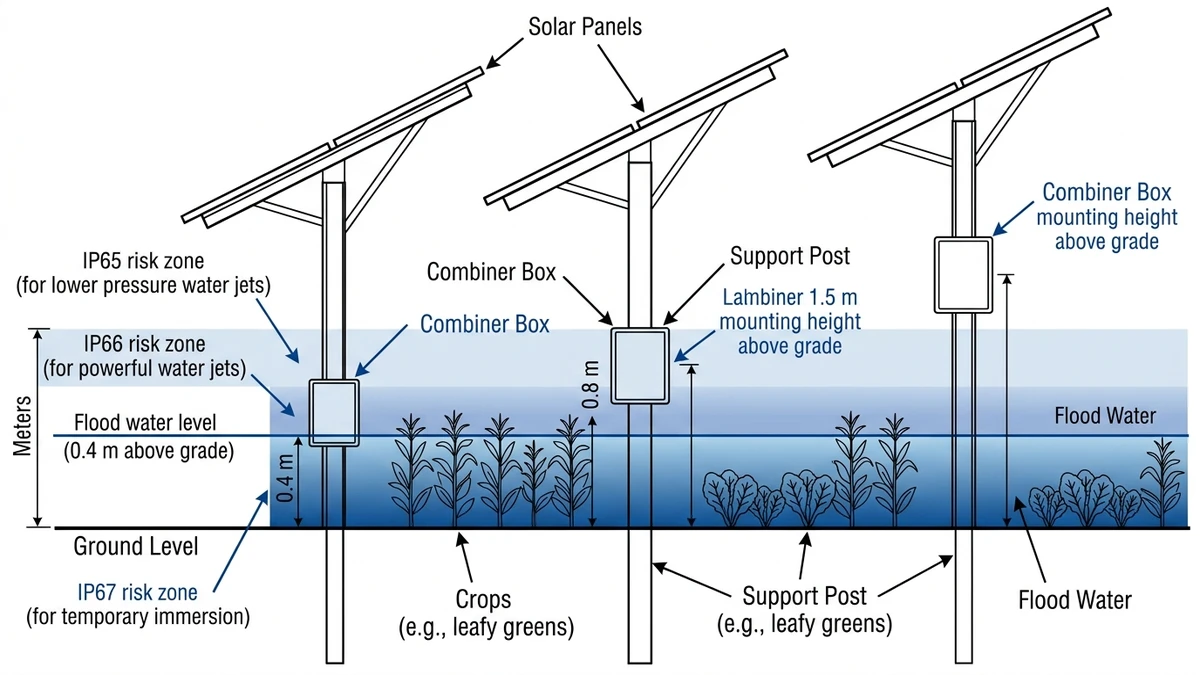
The practical trigger for upgrading from IP65 or IP66 to IP67 is mounting height relative to the site’s likely high-water level. A 120 MW agrivoltaic project in Jiangsu Province in 2023 installed combiner boxes at 0.6 m above grade across rice paddy terrain. After a seasonal flood event submerged equipment to about 0.4 m for roughly 20 minutes, IP65-rated units showed moisture ingress at cable glands, while IP67-rated units on the same site passed post-event insulation resistance testing without remediation.
As a general rule, if mounting height is below 0.8 m above the recorded high-water mark, IP67 should be the minimum specification. Between 0.8 m and 1.5 m, IP66 is often sufficient when drainage, gland torque, and resealing practices are well controlled.
IP68 extends protection beyond the standard IP67 immersion condition, with depth and duration defined by the manufacturer. For most agrivoltaic and flood-prone PV sites, that extra margin adds cost without proportional benefit because flood events rarely sustain deeper or longer submersion.
The decision boundary is simple: if the worst-case flood scenario stays within 1 meter depth and 30 minutes, IP67 is usually adequate. If hydrological modeling shows deeper or longer inundation, move to IP68 and verify the manufacturer’s stated test condition.
For internal components — including DC fuses and surge protection devices — the enclosure rating must still align with the environmental risk of the full assembly.
Choosing the right rating at procurement is only half the job, because seal performance gradually declines under outdoor service conditions.
IP ratings on a PV combiner box are tested on new enclosures under controlled lab conditions. In the field, gasket compression, UV exposure, and thermal cycling slowly erode the sealing system.
EPDM gaskets are common in mid-range combiner boxes and generally offer good weather resistance. However, long-term compression can reduce contact force enough to weaken real-world sealing performance over time.
Silicone gaskets handle a wider thermal range and often retain sealing force better over extended service. In a 35 MW ground-mount installation in Xinjiang in 2023, enclosures retrofitted with silicone gaskets during a mid-life refurbishment showed no measurable IP degradation at the 7-year re-inspection, while adjacent original EPDM-sealed units had failed water jet testing at several sample points.
Gasket integrity alone does not sustain the enclosure rating. Cable glands are the second common failure path, particularly where clamping force drops over time due to jacket creep, vibration, or poor installation torque.
Use double-seal glands for IP66 and above, and verify compatibility between gland material and cable jacket polymer.
For combiner boxes in high-UV or coastal environments, a five-year gasket inspection cycle is a practical maximum. Replace aging EPDM seals proactively, and pair gasket review with inspection of DC fuses and surge protection components because moisture-related seal failures often coincide with corrosion inside fuse holders and terminals.
A simple field checklist makes it easier to translate site conditions into the right enclosure class without over- or under-specifying.
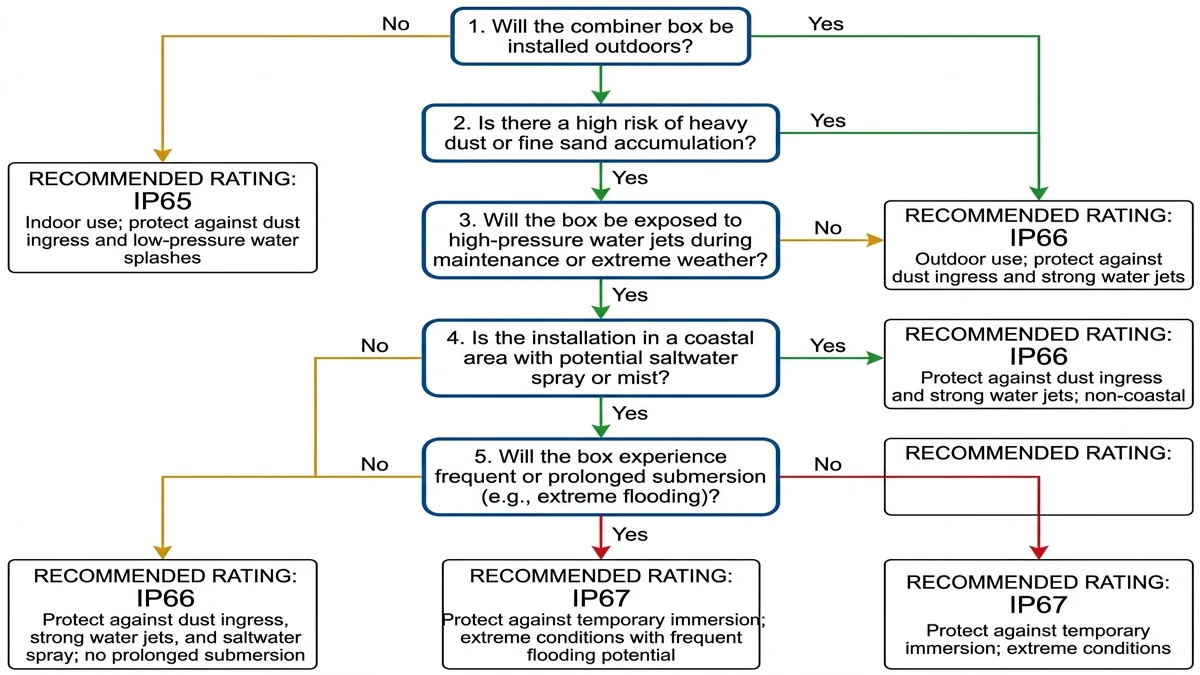
Selecting the right IP rating for a PV combiner box comes down to five site-specific questions.
Indoor combiner boxes in dry electrical rooms may only need a lower enclosure class. Any outdoor installation should start at IP65 as the minimum practical baseline.
Routine rain and standard cleaning usually fit within IP65 conditions. If maintenance crews use stronger wash-down methods or the site experiences severe wind-driven water, step up to IP66.
Ground-mount arrays in flood-prone lowlands require IP67 when standing or rising water can briefly submerge equipment. A 60 MW ground-mount project in Zhejiang in 2023 reported that low-lying rows equipped with IP65 boxes failed within one wet season; replacing them with IP67 units eliminated repeat ingress incidents.
All three ratings carry a “6” dust rating, meaning full dust exclusion. That matters in desert and arid-zone deployments where fine particulate can compromise DC fuse contacts and surge protection devices inside the enclosure.
Sites with infrequent inspection cycles should bias toward a stronger sealing margin, because small seal failures can persist unnoticed through an entire rainy season.
For a broader view of how IP rating interacts with string count and current capacity decisions, the PV combiner box selection guide covers both dimensions together. Internal components — particularly DC MCBs — should also be selected as part of the same environmental specification.
Choose the enclosure rating that fits the site’s actual exposure conditions over the life of the plant, rather than defaulting to the highest number.
For rooftop and elevated inland installations, IP65 is often sufficient and cost-effective. For exposed ground-mount, coastal, and high-rainfall sites, IP66 provides the extra resistance needed against stronger water impact. Where temporary flooding or waterlogging can submerge equipment, IP67 becomes the correct minimum.
Before finalizing a specification, cross-check the enclosure class against the internal protection system. A detailed walkthrough of string count, current capacity, and component matching is covered in the PV combiner box selection guide.
If you’re specifying a combiner box for a utility-scale or commercial project, Sinobreaker’s PV combiner box series covers configurations from 4-string to 16-string with IP65, IP66, and IP67 enclosure options, supporting system voltages up to 1500 VDC and input currents up to 20 A per string. Contact the team with your site classification, string count, and fault current requirements to get a matched specification.
All three are dust-tight, but they differ in water protection: IP65 handles standard water jets, IP66 handles stronger jets, and IP67 is intended for temporary immersion.
Not necessarily. IP67 is useful where flooding or brief submersion is possible, while IP66 is often the better fit for exposed sites dominated by strong rain, wash-down, or coastal spray.
In many rooftop systems, yes, especially when the box is mounted above pooling zones and not exposed to aggressive wash-down practices. The mounting location and drainage design matter more than the roof label alone.
Most coastal projects should start with IP66 because the usual threat is high-force spray rather than immersion. If the site also has flood risk or tidal inundation potential, then IP67 may be justified.
A practical interval is every five years in harsh outdoor environments, with shorter intervals where UV, salt, or temperature extremes are severe. Seal checks should include glands, hinges, and visible gasket compression.
No. IP classification addresses dust and water ingress, but it does not confirm long-term resistance to sunlight, salt fog, or chemical exposure.
Yes, if the washer pressure exceeds the enclosure’s tested conditions or the nozzle is used too close to seals and gland entries. Cleaning method should match the enclosure rating, not just the maintenance habit.