Address
304 North Cardinal
St. Dorchester Center, MA 02124
Work Hours
Monday to Friday: 7AM - 7PM
Weekend: 10AM - 5PM
Address
304 North Cardinal
St. Dorchester Center, MA 02124
Work Hours
Monday to Friday: 7AM - 7PM
Weekend: 10AM - 5PM

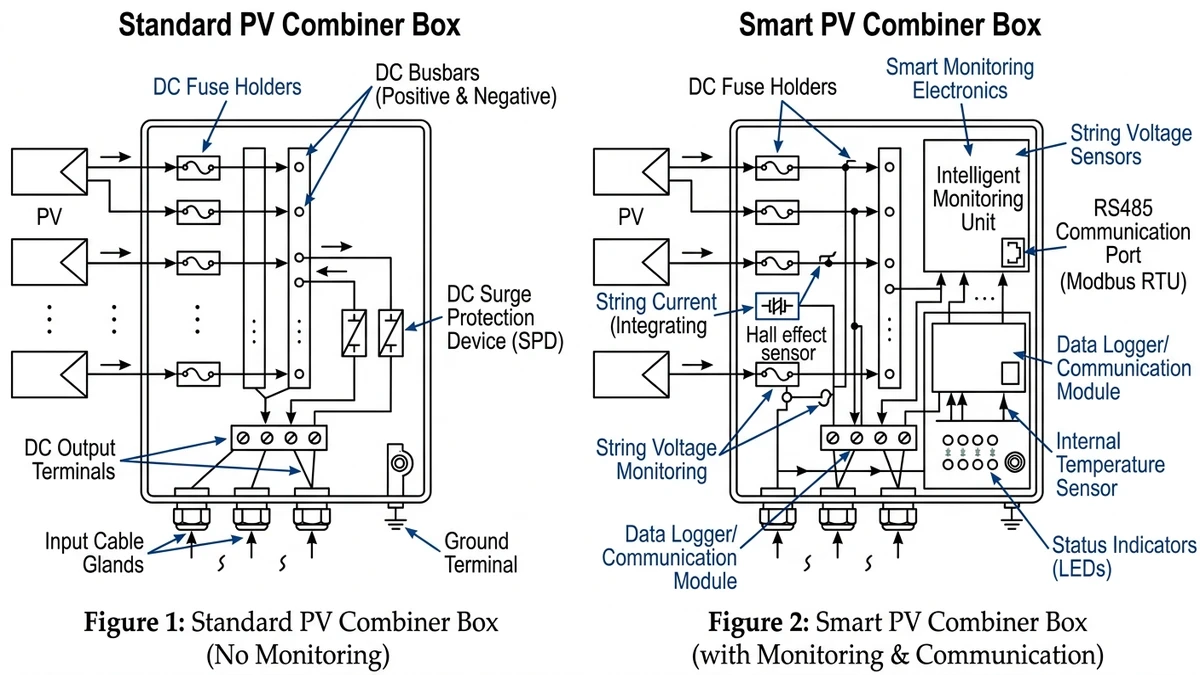
A smart PV combiner box adds real-time string-level monitoring, fault detection, and remote communication to the basic overcurrent protection a standard unit provides. In practical terms, a standard box combines strings and protects circuits, while a smart box continuously reports current, voltage, and fault status per string — typically over RS485 or Modbus RTU.
| Feature | Standard Combiner Box | Smart Combiner Box |
|---|---|---|
| String current monitoring | None | Per-string, real-time (±0.5% accuracy typical) |
| Fault detection | Manual inspection only | Automatic, with alarm output |
| Communication protocol | None | RS485 / Modbus RTU / GPRS optional |
| Remote monitoring | Supported by platforms using protocols such as Modbus; see IEC overview: https://www.iec.ch | Supported via SCADA or cloud platform |
| Overcurrent protection | gPV fuses or DC MCBs | Same, plus electronic monitoring layer |
| Surge protection | Optional SPD | Integrated SPD standard in most models |
| Data logging | None | Historical string data, typically 30–90 days |
| Installation cost | Lower (roughly 30–50% less) | Higher upfront, lower O&M cost over time |
| Enclosure rating | IP54–IP65 | IP65–IP66 (weatherproofing for sensor electronics) |
| Maintenance trigger | Scheduled or reactive | Condition-based, alert-driven |
In a 62 MW ground-mount installation in Xinjiang (2023), switching from standard to smart combiner boxes reduced undetected string underperformance events from an average of 14 per quarter to under 3, mainly because per-string current deviation alerts exposed partial shading and soiling losses early.
From a protection standpoint, both box types still rely on the same fundamentals: DC fuses for string protection and surge protection devices for transient suppression. The smart box does not replace those core devices; it adds a diagnostics and communications layer on top.
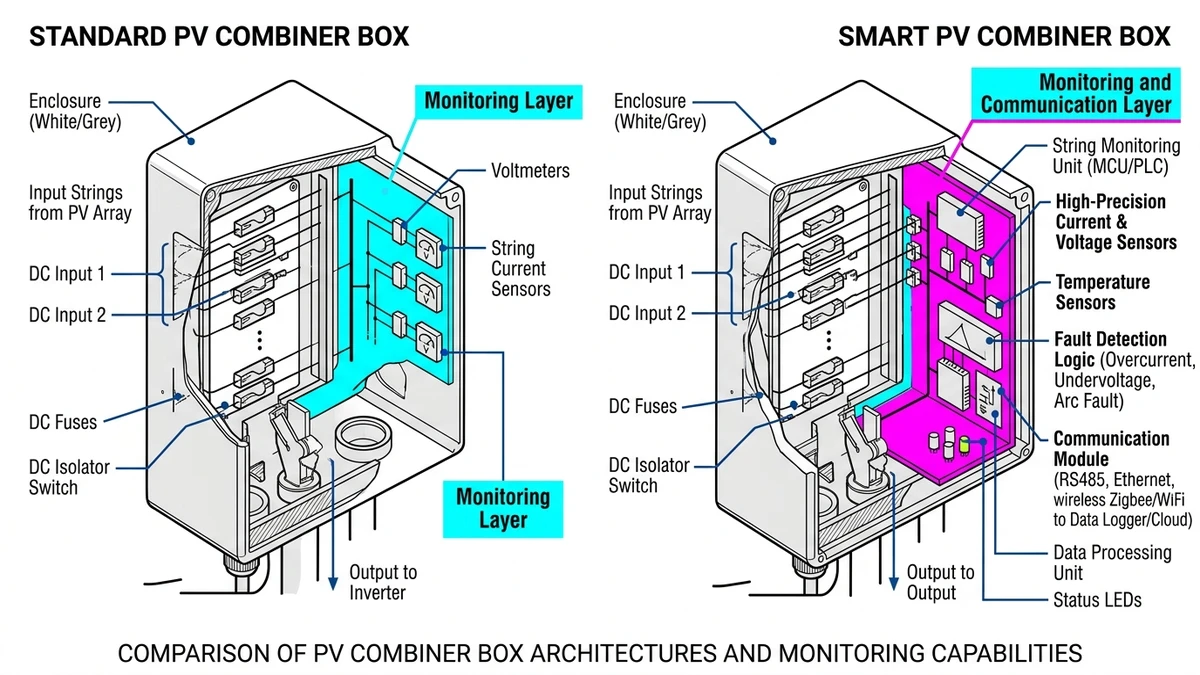
The main technical difference between the two box types is how a smart unit sees each string before the currents merge.
A smart PV combiner box monitors each string independently by routing current through a dedicated sensing circuit before it reaches the DC busbar.
Each string input passes through a sensing stage rated typically for about 0–15 A DC measurement range, with linearity error around ±0.5% or better. Depending on design, the sensor outputs a low-level analog signal such as 0–75 mV or 4–20 mA proportional to string current. Some versions also include a voltage tap at the same node, enabling per-string power calculation without extra field wiring.
In a 60 MW ground-mount installation in Hebei Province (2023), engineers reported that string monitoring identified three underperforming strings within 48 hours of commissioning — strings that would likely have remained hidden for weeks under standard combiner box operation.
The analog signal feeds an onboard microcontroller, commonly via a 12-bit or 16-bit ADC. The controller applies calibration offsets, compares each string’s current against a configurable deviation threshold, and generates local alarm flags when readings fall outside normal limits. Because the logic runs inside the box, fault detection does not depend on the SCADA link being online.
Processed data is then sent over RS485 using Modbus RTU. Typical register maps expose per-string current, voltage, alarm status, and cumulative data for reading by inverters, data loggers, or SCADA gateways.
This signal path works alongside the same physical protection hardware used in any combiner, including fuses, busbars, disconnectors, and grounding components.
[Expert Insight]
Standard combiner boxes provide no per-string visibility. Smart units measure each input continuously, typically in the 0–15 A DC range with about ±0.5% accuracy.
Many smart boxes include arc fault detection modules that identify the high-frequency signature of DC arcing events. Standard boxes generally do not.
Both box types use gPV fuses or DC MCBs for protection, but smart boxes add operating history. If a fuse opens or a protective device trips, maintenance teams can review the current trend leading up to the event instead of relying only on a manual inspection after the fact.
Smart combiner boxes commonly include Class II surge protection devices with remote status signaling. Standard boxes may also include SPD protection, but without feedback, a failed device can remain unnoticed until the next site visit.
Smart units support RS-485 Modbus RTU and, in some models, Ethernet or wireless communication for plant monitoring systems. Standard boxes have no native communication output, so their condition can only be checked on site.
Smart boxes may also log enclosure temperature and door-open events. That matters in unattended sites, where thermal stress, water ingress, or unauthorized access can degrade reliability long before a protection device actually trips.
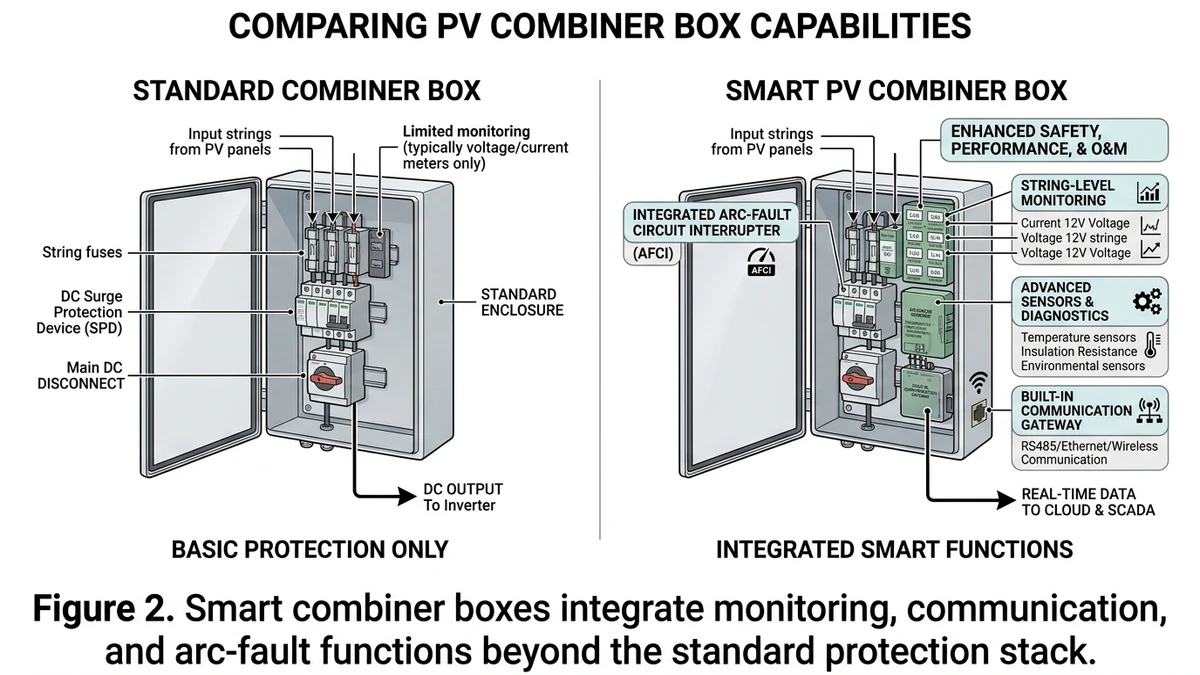
In a 62 MW ground-mount installation in Hebei Province commissioned in early 2024, the site initially deployed standard combiner boxes across 18 inverter zones. During the first summer, a partial shading fault combined with a degraded string connection went undetected for 11 days before a routine manual inspection caught it. Estimated energy loss over that period was approximately 4,800 kWh per affected string across 6 strings, or about 28,800 kWh total. At a feed-in rate of ¥0.39/kWh, that represented roughly ¥11,232 in unrecovered generation.
When the site upgraded two zones to smart combiner boxes with per-string current monitoring and SCADA integration, the same fault class was detected within 35 minutes of onset in later incidents — a reduction from 11 days to under 1 hour.
Standard combiner box O&M typically requires scheduled manual string-level inspection every 30–45 days. For a 62 MW plant with 480 strings across 40 combiner boxes, a full inspection round takes about 3 technician-days at a loaded labor rate of ¥600/day, or ¥1,800 per cycle and roughly ¥14,400 annually across 8 cycles.
Smart combiner boxes with remote monitoring reduce on-site inspection cycles to 2–3 per year for physical checks, cutting annual inspection labor to approximately ¥3,600–5,400 — a saving of ¥9,000–10,800/year on labor alone, before accounting for recovered generation losses.
The protection hardware is similar in both designs, but smart boxes reduce mean time to repair because technicians do not need to isolate faults by checking strings one by one.
String monitoring in a PV combiner box works by measuring the current and sometimes voltage of each individual string before those strings merge at the DC busbar. Continuous sampling lets the system flag deviations caused by shading, soiling, connector issues, cell degradation, or open-circuit faults.
Each string input in a monitored combiner box connects through a current sensor sized for the project architecture, often in the 0–20 A range for smaller systems and around 0–15 A per string in 1500 VDC utility-scale arrays. The sensor sends a low-voltage analog or digital signal to a data acquisition module, which compares the reading against a configured threshold or against peer strings in the same combiner.
Voltage monitoring can run in parallel through a divider network that samples string voltage before the fuse or DC circuit breaker. That dual-parameter view helps technicians distinguish between fault types. For example, a blown gPV fuse can leave voltage present while current drops to zero, whereas a temporary shading event usually depresses current without the same fault signature.
The acquisition module transmits string-level data through RS-485 Modbus RTU or, in newer models, Ethernet or wireless links to the plant monitoring system. Sampling intervals typically range from seconds to minutes depending on the configuration and the level of detail required by the operator.
In a 60 MW ground-mount installation in Xinjiang (2023), string-level current monitoring enabled crews to identify underperforming strings within 15 minutes of an irradiance-normalized deviation exceeding 8%, compared with multi-day detection cycles using inverter-level data alone.
[Expert Insight]
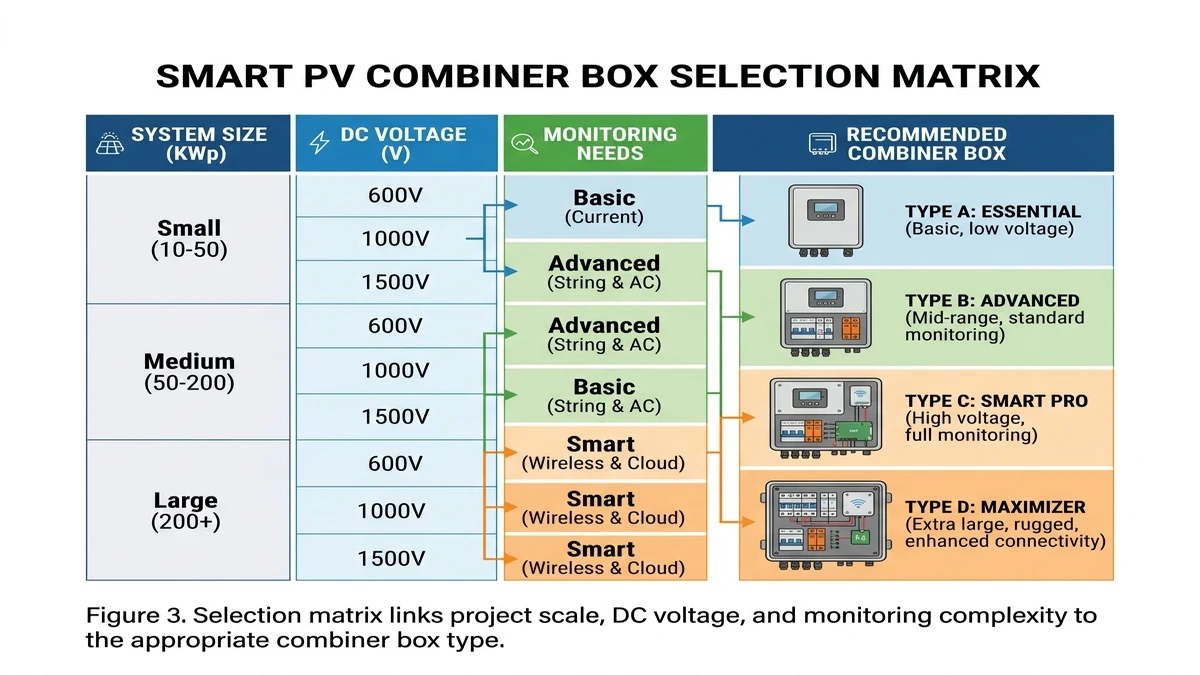
| System Scale | Typical String Count | DC Bus Voltage | Recommended Type | Key Reason |
|---|---|---|---|---|
| Small residential (≤ 30 kW) | 2–4 strings | 600–800 VDC | Standard | Low fault complexity; monitoring via inverter |
| Mid commercial (30 kW–500 kW) | 6–16 strings | 1000 VDC | Smart (entry-level) | String-level current imbalance becomes detectable |
| Large commercial / industrial (500 kW–5 MW) | 16–32 strings | 1000–1500 VDC | Smart (full telemetry) | Remote isolation and detailed fault visibility justify cost |
| Utility-scale (> 5 MW) | 32+ strings per combiner | 1500 VDC | Smart (SCADA-integrated) | Real-time string deviation tracking is operationally important |
At 1500 VDC architecture, a combiner must be rated for the actual system voltage regardless of whether it is smart or standard. Smart combiner boxes built for 1500 VDC typically pair monitoring electronics with gPV fuses rated around 15–32 A per string and a DC switch disconnector capable of interrupting load current safely.
For mid-scale commercial projects, a 6-string or similar monitored configuration is often the practical entry point.
In a 78 MW ground-mount installation in Xinjiang (2024), the project team upgraded from standard to smart combiners at the 500 kW block boundary, reducing undetected string underperformance from roughly 8% of strings to under 1% within the first operating quarter.
Sinobreaker’s PV combiner box lineup covers both standard and smart configurations, allowing designers to move from basic string consolidation to full Modbus-enabled monitoring without changing component ecosystems.
Standard configurations are available in 1000 VDC and 1500 VDC rated enclosures with IP65 or IP66 ingress protection for rooftop commercial arrays and exposed ground-mount sites. String counts are configurable, commonly from 4 to 16 inputs per box. Each string input is protected by a gPV fuse, and surge protection can be added where transient exposure requires it.
Smart configurations add string-level current monitoring, voltage sensing, and Modbus RTU/TCP communication compatible with most SCADA and inverter platforms. In a 35 MW ground-mount project in Hebei Province (2024), smart combiner boxes with Modbus integration allowed the operations team to pinpoint underperforming strings remotely, cutting diagnostic site visits by roughly half over the first operating season.
For projects where layout and grounding matter as much as the box specification, the PV combiner box wiring and grounding guide covers installation best practices. If you are still working through sizing choices, the 2025 combiner box selection guide walks through string count and current capacity logic step by step.
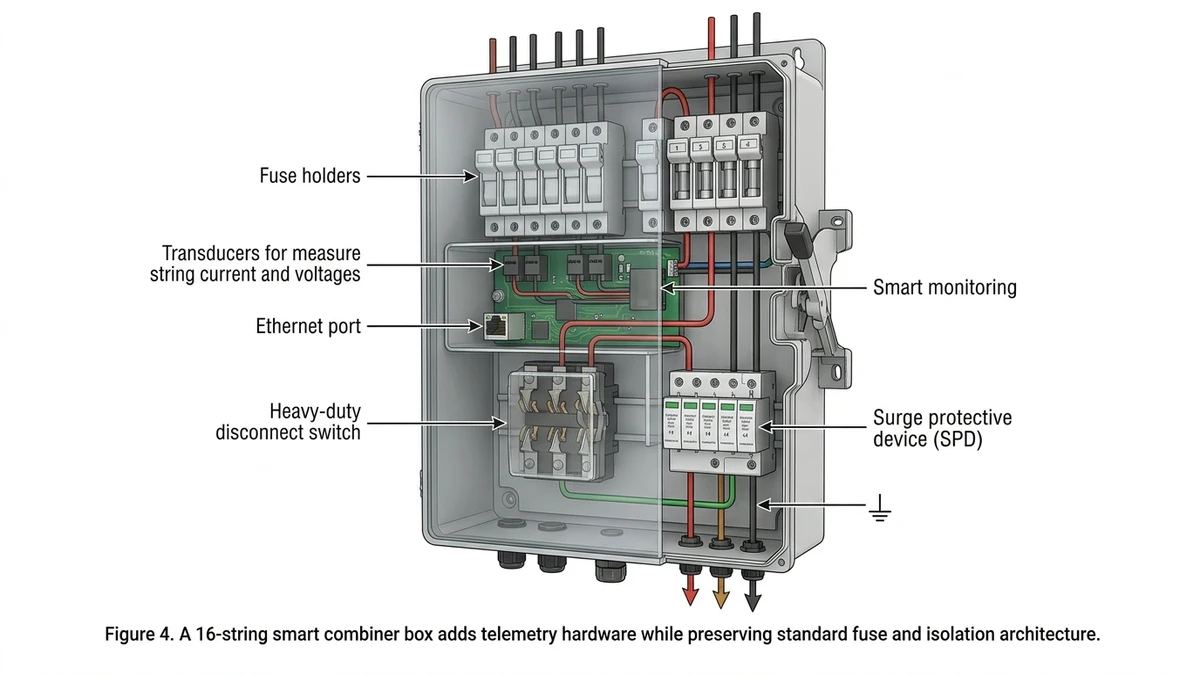
A standard combiner box mainly handles string consolidation and protection, while a smart version adds per-string monitoring, alarms, and communications. That extra visibility helps operators find issues faster.
Usually not for very small residential systems, where inverter-level monitoring may be enough. It becomes more worthwhile as string count, site size, and maintenance complexity increase.
No. Smart functions sit on top of the core protection hardware rather than replacing it, so the box still needs properly rated fuses, disconnects, and SPDs.
It spots abnormal current or voltage behavior at the string level before the problem drags down production for days or weeks. That allows maintenance teams to fix underperformance earlier.
RS485 with Modbus RTU is the most common setup, especially in industrial and utility PV plants, but some models also support Ethernet, TCP, or wireless options. The available protocol depends on the monitoring architecture.
A standard unit is often the right fit when the array is small, access is easy, and operators do not need string-level remote diagnostics. It can also make sense where budget is tight and manual inspections are acceptable.
Yes. They reduce the number of manual inspection rounds and shorten troubleshooting time because technicians know which strings need attention before arriving on site.