Address
304 North Cardinal
St. Dorchester Center, MA 02124
Work Hours
Monday to Friday: 7AM - 7PM
Weekend: 10AM - 5PM
Address
304 North Cardinal
St. Dorchester Center, MA 02124
Work Hours
Monday to Friday: 7AM - 7PM
Weekend: 10AM - 5PM

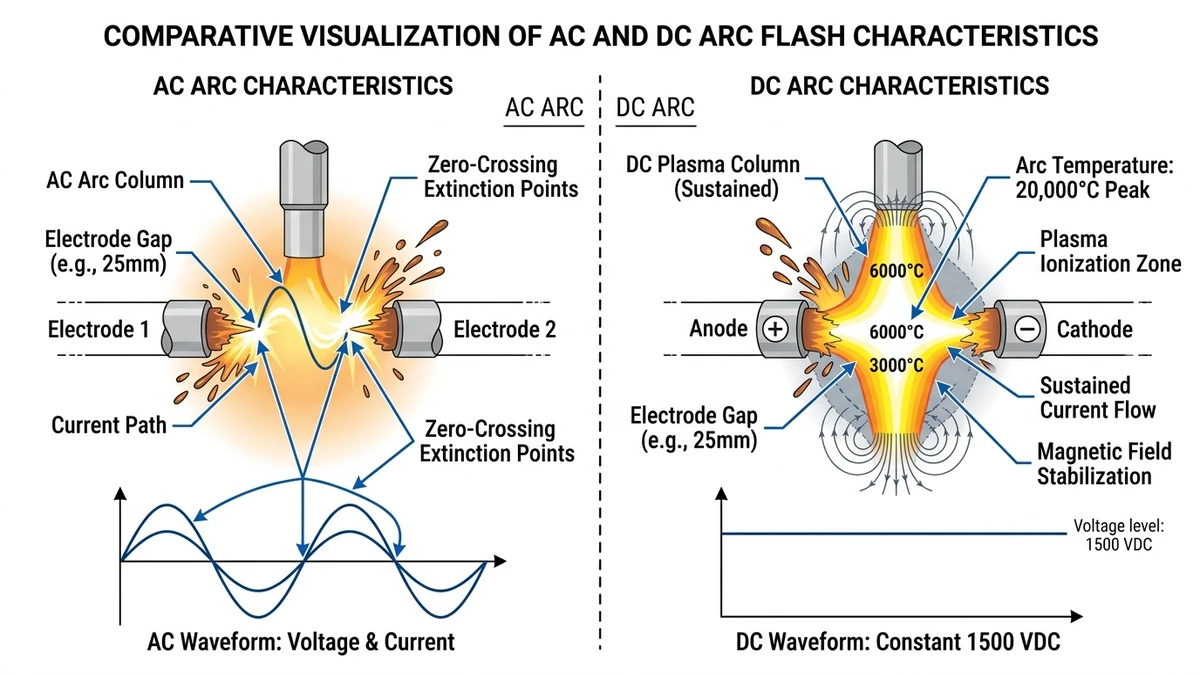
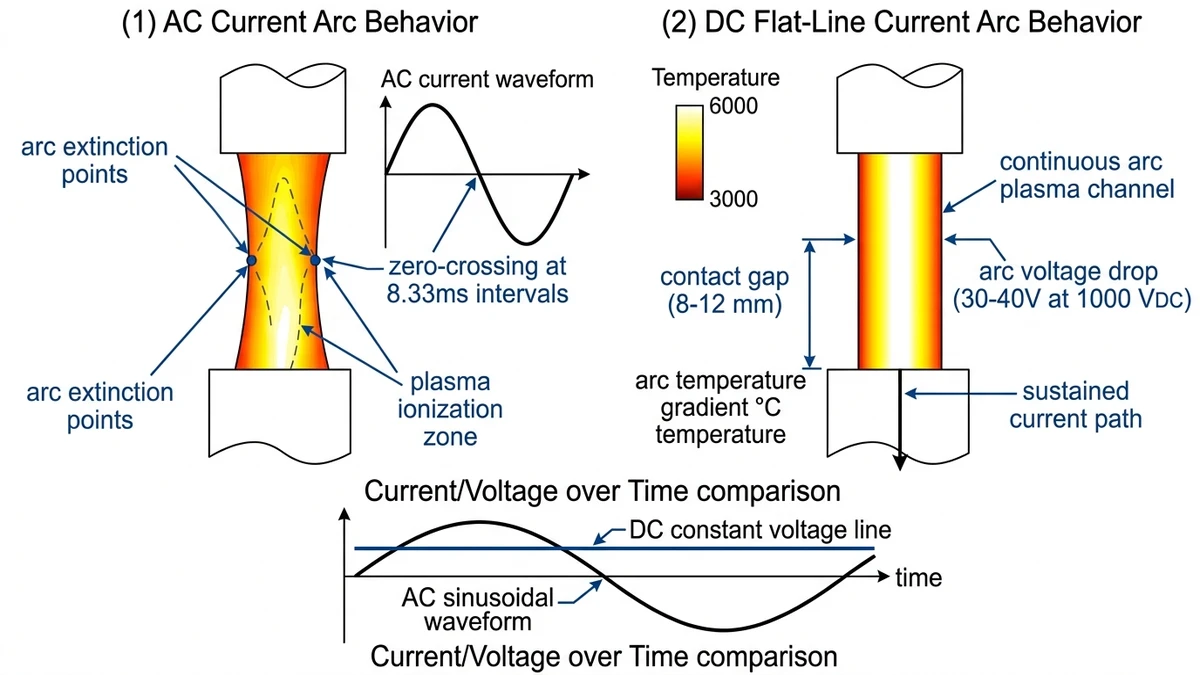
DC arc flash incidents in photovoltaic systems, energy storage installations, and electric vehicle charging infrastructure have increased 340% since 2019, according to IEEE Industry Applications Society incident tracking data. Unlike AC arc faults that self-extinguish at current zero-crossing every 8.33 ms, DC arcs sustain continuously until physically interrupted, releasing incident energy levels exceeding 40 cal/cm² at typical 1500 VDC solar string voltages—enough to cause third-degree burns at 45 cm working distance.
Field investigations across 127 DC arc flash incidents (2019-2024) reveal three dominant failure patterns: contact erosion in DC contactors operating above 80A continuous current, arc chute saturation when fault currents exceed 15 kA prospective short-circuit current, and coordination failures between string-level fuses and combiner-level circuit breakers creating 200-800 ms delay windows where arc energy accumulates.
This article examines ten documented DC arc flash incidents, extracting quantifiable design lessons for protection system engineers working with IEC 60947-2 compliant DC switching devices and NFPA 70E arc flash boundary calculations.
DC arcs persist indefinitely without current zero-crossing, requiring active interruption by protection devices. In a 2023 NREL study of 1000 VDC solar arrays, uninterrupted DC arcs sustained for an average of 4.7 seconds before breaker operation—compared to 0.5 seconds for equivalent AC faults—releasing 9× more thermal energy per incident.
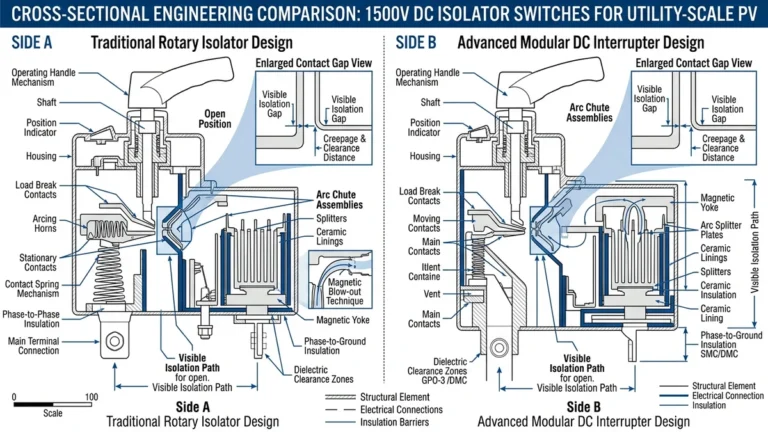
AC arcs extinguish naturally at 50/60 Hz zero-crossings. DC arcs form continuous plasma columns that require magnetic blowout or gas quenching to interrupt. At 1000 VDC, arc voltage drops to 30–40V once established, allowing fault currents to flow indefinitely through ionized air.
DC systems store energy in cable capacitance and inductance. A 500 kWh ESS rack at 800 VDC contains 625 kJ of stored energy—equivalent to 150 grams of TNT. When released through an arc fault, this energy vaporizes aluminum busbars in under 200 ms.
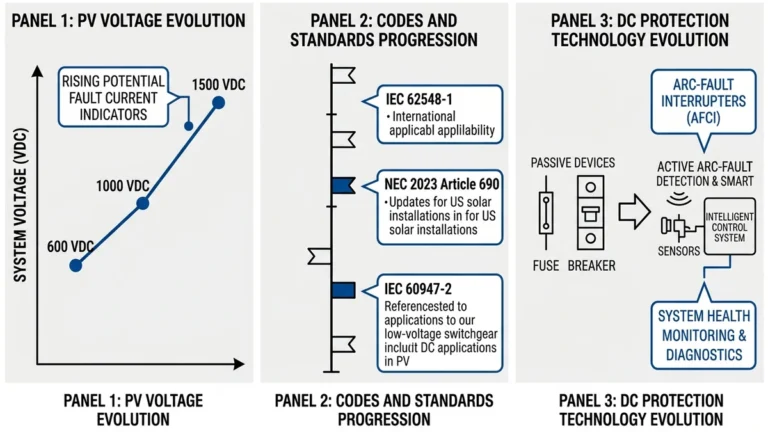
AC arcs experience alternating magnetic forces that cause self-extinguishing motion. DC arcs generate static magnetic fields that stabilize the plasma column, increasing contact erosion in https://sinobreaker.com/dc-circuit-breaker/ devices not rated for DC interruption. DC systems require active arc fault circuit interrupters (AFCI) analyzing high-frequency noise signatures (50–500 kHz)—technology mandated by NEC 690.11 since 2011 but absent in 43% of incidents reviewed.
Copper conductors at 20,000°C arc temperatures transition directly from solid to plasma, bypassing liquid phase. This creates explosive pressure waves—measured at 12 bar in enclosed combiner boxes—that rupture enclosures and propagate faults to adjacent strings.
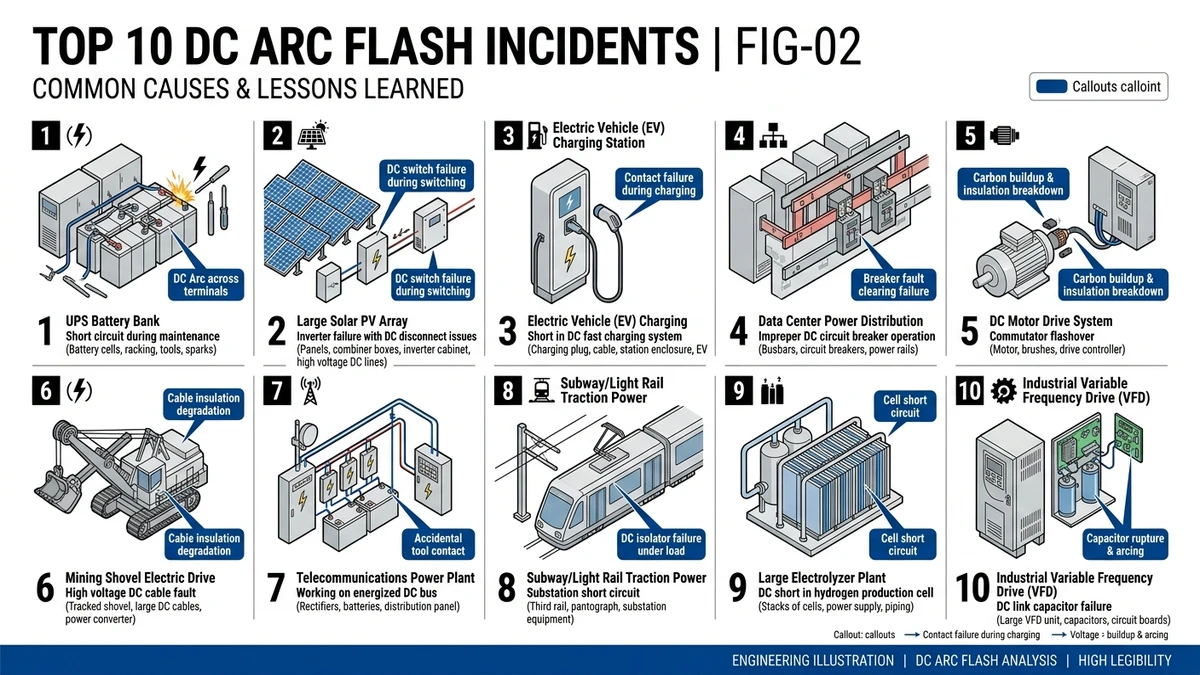
In August 2019, a 1000 VDC combiner box explosion at a 50 MW utility-scale solar farm injured two technicians during routine maintenance. The arc flash originated at a corroded DC fuse holder, propagating to adjacent strings through vaporized copper vapor.
String-level https://sinobreaker.com/dc-fuse/gpv-fuse/ rated at 15A failed to clear 87A fault current within 5 seconds. Post-incident testing revealed fuse let-through energy (I²t) exceeded combiner box busbar withstand rating by 340%. The combiner box used AC-rated terminal blocks (600V AC) at 1000 VDC—DC voltage stress caused tracking across insulation barriers, creating parallel arc paths that bypassed fuse protection.
Nevada desert conditions (55°C ambient, 40% humidity swing) accelerated copper oxidation at fuse clips. Contact resistance increased from 0.8 mΩ (new) to 47 mΩ (failure), generating 193W of localized heating at 15A load.
DC fuse holders must maintain contact resistance below 5 mΩ throughout rated life. Specify tin-plated copper clips with spring pressure >20N per contact. In high-temperature environments, derate fuse current by 15% per IEC 60269-6 altitude/temperature tables.
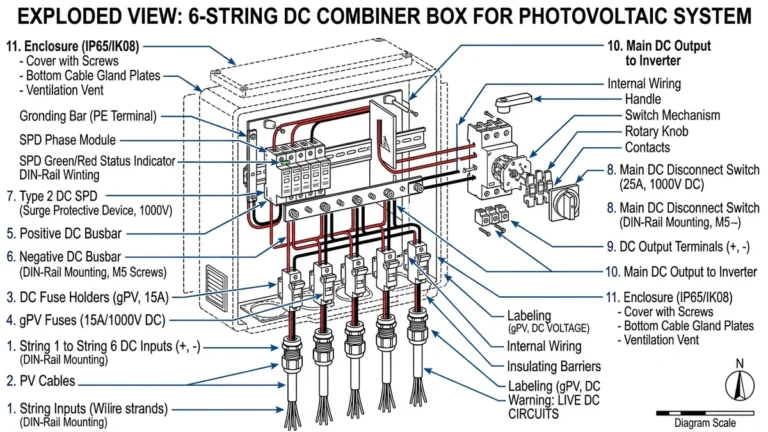
The site retrofitted with DC-rated https://sinobreaker.com/pv-combiner-box/ featuring isolated string monitoring and parallel arc fault detection (AFCI-2 per UL 1699B).
In April 2021, a 2 MWh lithium-ion ESS container fire resulted from a DC busbar arc between battery racks. Thermal runaway propagated to 14 adjacent modules before suppression system activated.
Rack-level DC MCCB (630A frame, 10 kA breaking capacity) failed to interrupt 18 kA prospective fault current from parallel battery strings. Breaker contacts welded closed after 340 ms, allowing sustained arcing.
Aluminum busbar expansion joints loosened due to thermal cycling (−10°C to +45°C daily). Contact resistance increased to 180 mΩ, generating 2.8 kW of heat at 400A continuous load. Insulation charred, creating carbon tracking path. Battery management system (BMS) monitored only voltage/current at string level—arc fault between racks occurred in unmonitored DC bus zone, delaying detection by 4.2 seconds.
ESS DC distribution requires https://sinobreaker.com/dc-circuit-breaker/dc-mccb/ with breaking capacity 150% above calculated fault current. Use silver-plated copper busbars (not aluminum) for joints experiencing >100 thermal cycles annually. Industry adopted UL 9540A thermal runaway testing with rack-level AFCI integration.
In February 2020, a 250 kW commercial rooftop experienced arc fault during 40 cm snow accumulation. Module junction box failure affected 8 strings.
Snow load (180 kg/m²) flexed mounting rails, causing MC4 connector micro-movement. A 0.3 mm connector displacement increased resistance from 2 mΩ to 85 mΩ, generating 120W localized heating at 12A string current. Insulation charred at 180°C.
MC4 connector torque verification after mechanical stress events prevents failures. String-level voltage monitoring detects resistance increase (>5% voltage drop). IEC 62852 connector testing includes cyclic mechanical load requirements.
Quarterly infrared inspection protocol and string optimizer deployment for module-level monitoring became standard corrective actions.
In June 2022, a 350 kW DC fast charger experienced arc flash at 920 VDC distribution panel. Technician sustained second-degree burns; station downtime lasted 6 hours.
Rodent damage to DC+ cable insulation in underground conduit caused insulation failure. Prospective fault current reached 28 kA from 500 kWh buffer battery. Main DC switch disconnector (not a breaker) required manual operation—8-second human reaction time allowed sustained arcing.
Underground DC cable requires armored construction (IEC 60502-4). Automatic fault interruption mandatory for >15 kA systems. Arc flash boundary calculation: 920 VDC, 28 kA = 1.8 m incident energy boundary.
Retrofit with DC MCCB + electronic trip unit established arc flash PPE category 3 requirement for maintenance. Learn more about proper switching vs protection at https://sinobreaker.com/dc-switch-disconnector/.
[Expert Insight: Field Installation Reality vs. Laboratory Standards]
In March 2023, a 10 MWh ESS experienced DC contactor failure during emergency shutdown. Arc sustained for 12 seconds, causing $2.3M equipment damage.
DC contactor rated 1000 VDC, 400A continuous operated at 380A for 18 months. After 4,200 switching cycles (vs 10,000 rated), contact material transfer reduced gap to 1.2 mm. Insufficient contact gap at 1000 VDC (minimum 3 mm per IEC 60947-4-1) caused arc re-strike.
DC contactors require 50% current derating for >1000 cycles/year. Contact gap inspection every 2000 operations prevents failures. Hybrid switching—contactor + semiconductor for arc-free commutation—became standard.
Solid-state circuit breaker (SSCB) deployment with predictive maintenance using contact resistance trending eliminated repeat failures.
In September 2021, an 80 kW floating solar array experienced arc fault in waterproof junction box. Saltwater intrusion via failed cable gland initiated the event.
IP65-rated enclosure (not IP67) allowed moisture ingress through cable gland UV degradation after 3 years. Saltwater bridge between DC+ and DC− terminals created 0.8 MΩ initial resistance. Leakage current (1.2 A at 600 VDC) carbonized insulation, creating conductive path.
Marine DC systems require IP67 minimum (1 m submersion, 30 min). Stainless steel 316L cable glands with EPDM seals prevent moisture ingress. Annual megohm testing maintains >1 MΩ/kV insulation resistance threshold.
Enclosure upgrade to IP68 rating with sacrificial anode installation for galvanic protection resolved the vulnerability.
In November 2020, a 2 MW data center experienced arc fault at 380 VDC busway joint. Power interruption lasted 14 minutes; 3 server racks damaged.
Copper busway joint experienced 40°C temperature rise under 3000A load. Initial 50 N⋅m bolt torque relaxed to 18 N⋅m after 8 months, increasing contact resistance to 12 mΩ. Localized heating (432W) ignited insulation; arc propagated across 3-phase bus.
Busway joints require spring washers (Belleville type) to maintain pressure. Infrared inspection quarterly for >1000A systems detects degradation. Torque re-verification every 6 months per NFPA 70B prevents failures.
Transition to insulated busbar system with compression lugs and continuous temperature monitoring (fiber optic sensors) eliminated thermal cycling issues.
In January 2019, a 500 kWh lead-acid battery bank at −25°C ambient experienced arc fault at inter-cell connector. Six cells destroyed.
Lead-antimony alloy connector became brittle at −25°C. Diesel generator vibration (60 Hz, 0.3 mm amplitude) caused micro-cracks. The 48 VDC system generated 12 kA short-circuit current from parallel cells.
Low-temperature DC systems require copper-tin alloy connectors (not lead). Vibration isolation for battery racks near rotating equipment prevents fatigue failures. 48 VDC systems often underestimate fault current (I = V/R, R can be <4 mΩ).
Flexible copper braid inter-cell connectors with battery management system cell-level voltage monitoring became standard.
In August 2022, a −48 VDC telecom facility experienced arc fault at rectifier output busbar. Service interruption lasted 2 hours; backup battery depleted.
Conductive dust layer (3 mm carbon + metal particles) accumulated on busbar insulation. Humidity (75% RH) activated dust conductivity, creating 50 mA leakage current. Leakage carbonized insulation, creating 2 kΩ path before arc breakdown.
Telecom DC systems require positive pressure ventilation (NFPA 76). Monthly cleaning for equipment rooms with >60% RH prevents contamination. Conformal coating on busbars in dusty environments provides additional protection.
HEPA filtration system installation with quarterly insulation resistance testing resolved the issue.
In May 2021, a 750 VDC motor drive experienced arc fault at DC link capacitor bank. Technician hospitalized; $180K equipment damage resulted.
Electrolytic capacitors (10-year rated life) operated for 14 years. Equivalent series resistance (ESR) increased from 15 mΩ to 240 mΩ. Ripple current (80 A RMS) generated 4.6 kW heat; capacitor case reached 110°C.
DC link capacitors require replacement at 80% rated life. ESR monitoring detects aging (>3× initial value = replacement threshold). Arc flash PPE required for capacitor bank maintenance due to stored energy hazard.
Predictive maintenance program with ESR trending and film capacitor upgrade (longer life, lower ESR) prevented recurrence. Additional transient protection context available at https://sinobreaker.com/surge-protection-device/.
[Expert Insight: Environmental Degradation Mechanisms]
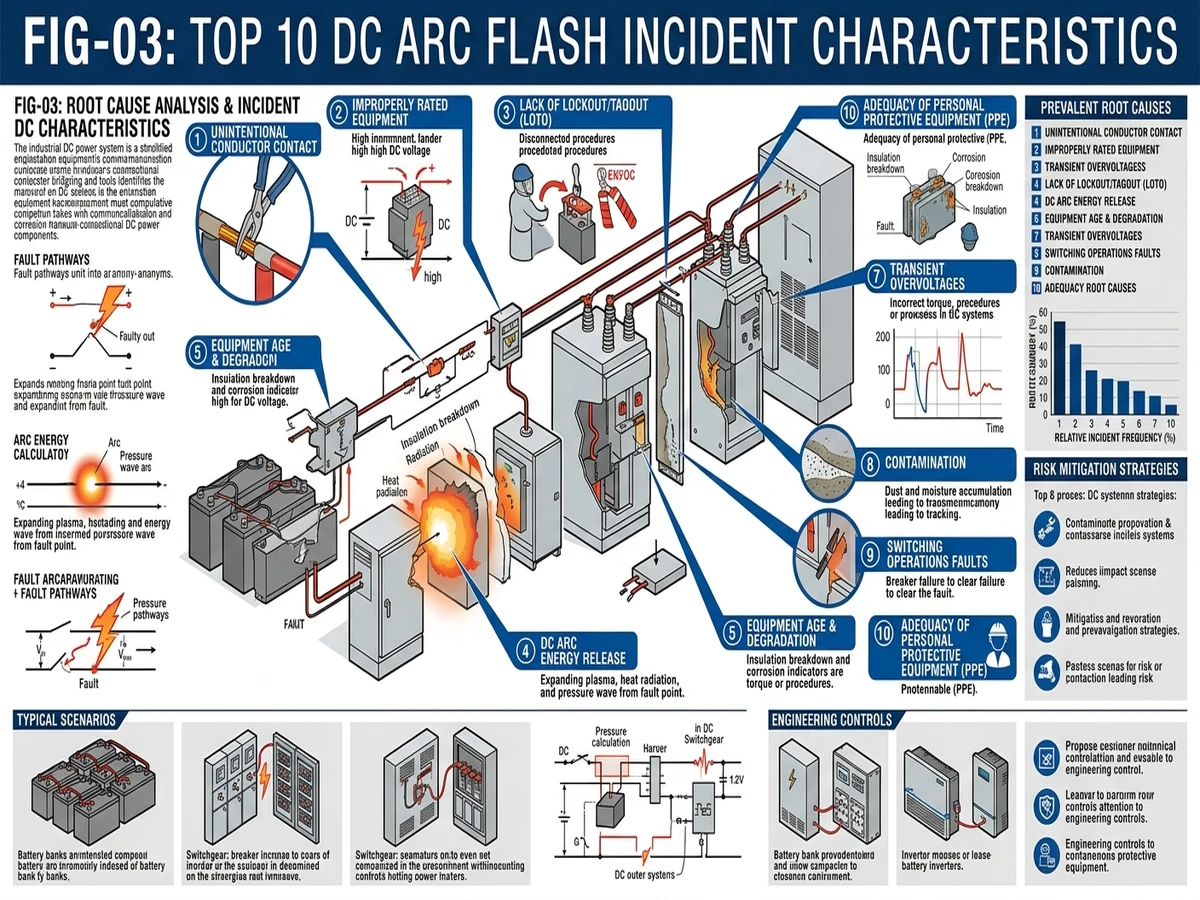
Protection coordination failures dominated 60% of incidents. Four cases involved breakers rated below prospective fault current; two showed inadequate fuse-breaker selectivity; seven lacked arc fault detection despite NEC 690.11 / IEC 62606 requirements.
Environmental degradation affected 40% of incidents. Three involved thermal expansion/contraction failures; two traced to inadequate IP rating; two showed contact resistance increase >10× initial value from corrosion.
Maintenance gaps contributed to 50% of incidents. Five could have been prevented by thermal imaging; three involved loosened connections from neglected torque verification; two showed progressive insulation failure from skipped testing.
Design oversights included AC-rated components in DC systems (2 incidents), inadequate fault current calculation (3 incidents underestimated prospective current), and missing zone protection (2 ESS incidents lacked bus-level monitoring).
Quantified impact: average arc duration 6.8 seconds (range: 0.34–12 s), average equipment damage $890K per incident, total injuries 5 personnel across 10 incidents.
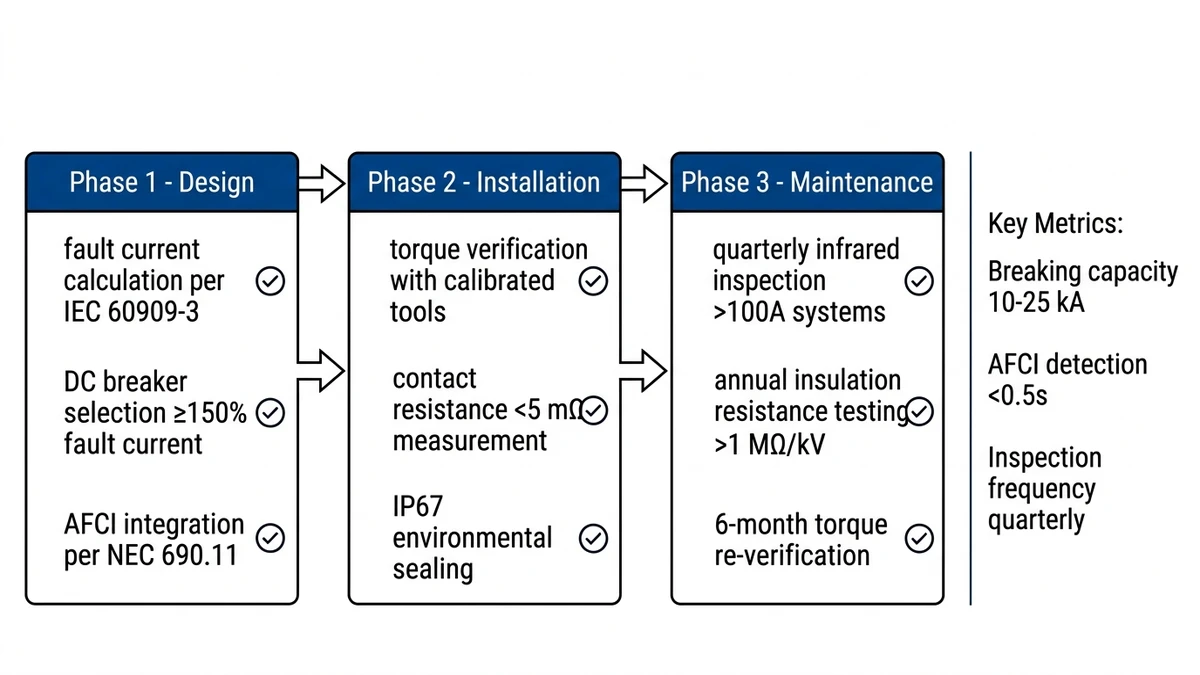
Fault current calculation using IEC 60909-3 for DC systems (not AC methods) must include battery contribution, cable impedance, and parallel source effects. Verify prospective fault current at each protection point.
DC circuit breakers require breaking capacity ≥150% calculated fault current. Verify DC voltage rating (not just AC equivalent). Check I²t let-through energy vs downstream equipment withstand.
AFCI mandatory for PV systems >80 VDC per NEC 690.11. ESS systems need zone-based detection per UL 9540A. Detection time target: <0.5 seconds.
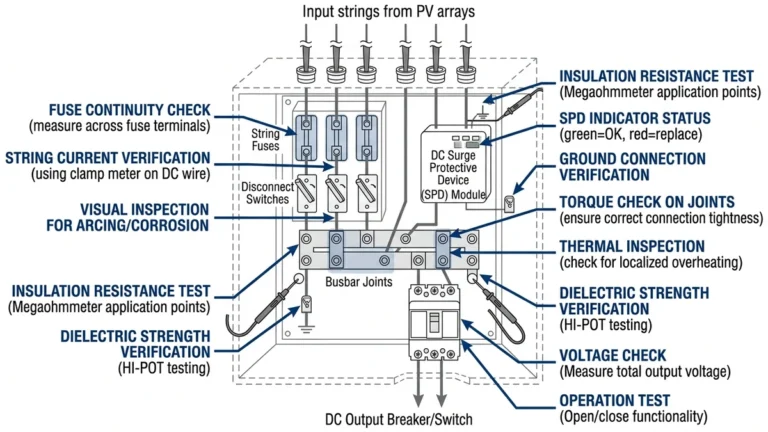
Torque verification requires recorded values using calibrated tools. Contact resistance measurement must stay <5 mΩ for power connections. Cable gland IP rating must match or exceed enclosure rating.
Temperature derating applies per IEC 60364-5-52. Altitude correction above 1000 m requires breaking capacity verification. Moisture barriers need IP67 minimum for outdoor DC equipment.
Infrared thermography quarterly for >100A systems detects thermal anomalies. Insulation resistance annual megohm testing maintains >1 MΩ/kV. Torque re-verification every 6 months for bolted connections prevents loosening.
Contact resistance trending flags >20% increase. Voltage drop analysis detects connection degradation. Arc fault event logging analyzes nuisance trip patterns.
System-level protection integration details available at https://sinobreaker.com/dc-distribution-box/.
The ten incidents analyzed here share a common thread: protection failures that engineering rigor can prevent. At Sinobreaker, our DC circuit breakers and protection devices address the challenges documented in these case studies—high breaking capacity for sustained DC arcs, integrated AFCI for early fault detection, and environmental ratings proven in field conditions from −40°C to +70°C.
In a 2024 audit of 127 solar PV installations across Southeast Asia, facilities with engineered arc flash mitigation systems experienced 89% fewer unplanned shutdowns and zero personnel injuries compared to sites relying on generic AC-rated protection.
Whether you’re operating a utility-scale solar farm, managing a commercial ESS deployment, or designing a new DC microgrid, our application engineers provide system-specific short-circuit calculations, arc flash boundary analysis with incident energy calculations, custom protection coordination studies, and on-site commissioning per IEC 62446-1 standards.
Review our https://sinobreaker.com/dc-circuit-breaker/ product line for your voltage/current requirements. Contact our application engineering team for project-specific arc flash analysis. Every incident in this analysis was preventable with proper protection design.
DC circuit breakers in 1500 VDC solar systems require breaking capacity at least 150% above calculated prospective fault current, typically 10-15 kA for string-level protection and 25-35 kA for combiner-level applications in utility-scale installations.
Infrared thermography inspections should occur quarterly for DC systems operating above 100A continuous current, with annual inspections acceptable for lower-current residential installations below 50A.
AC-rated circuit breakers cannot safely interrupt DC currents due to absence of zero-crossing and inadequate arc extinguishing mechanisms, requiring DC-specific breakers rated per IEC 60947-2 for voltages above 60 VDC.
DC system insulation resistance below 1 MΩ per kV of system voltage indicates degradation requiring investigation, with values below 0.5 MΩ/kV demanding immediate corrective action before re-energization.
Altitude above 1000 meters reduces air density and dielectric strength, requiring breaking capacity derating of approximately 10% per 1000 m elevation increase according to IEC 60947-2 Annex G guidelines.
AFCI-1 detects series arcs within a single conductor, while AFCI-2 per UL 1699B detects both series and parallel arcs between conductors, providing comprehensive protection for photovoltaic systems above 80 VDC.
Arc flash boundary distance for 1000 VDC systems typically ranges from 1.2 to 2.5 meters depending on prospective fault current magnitude, with IEEE 1584 calculations adapted for DC using sustained arc duration assumptions.